Failure of the Élite: Neo-Liberalism, Globalization, & Technology
Democracy is in crisis: How Neo-Liberalism, Globalization, Technology, and Policy Makers Have Failed Workers in Liberal Democracies.
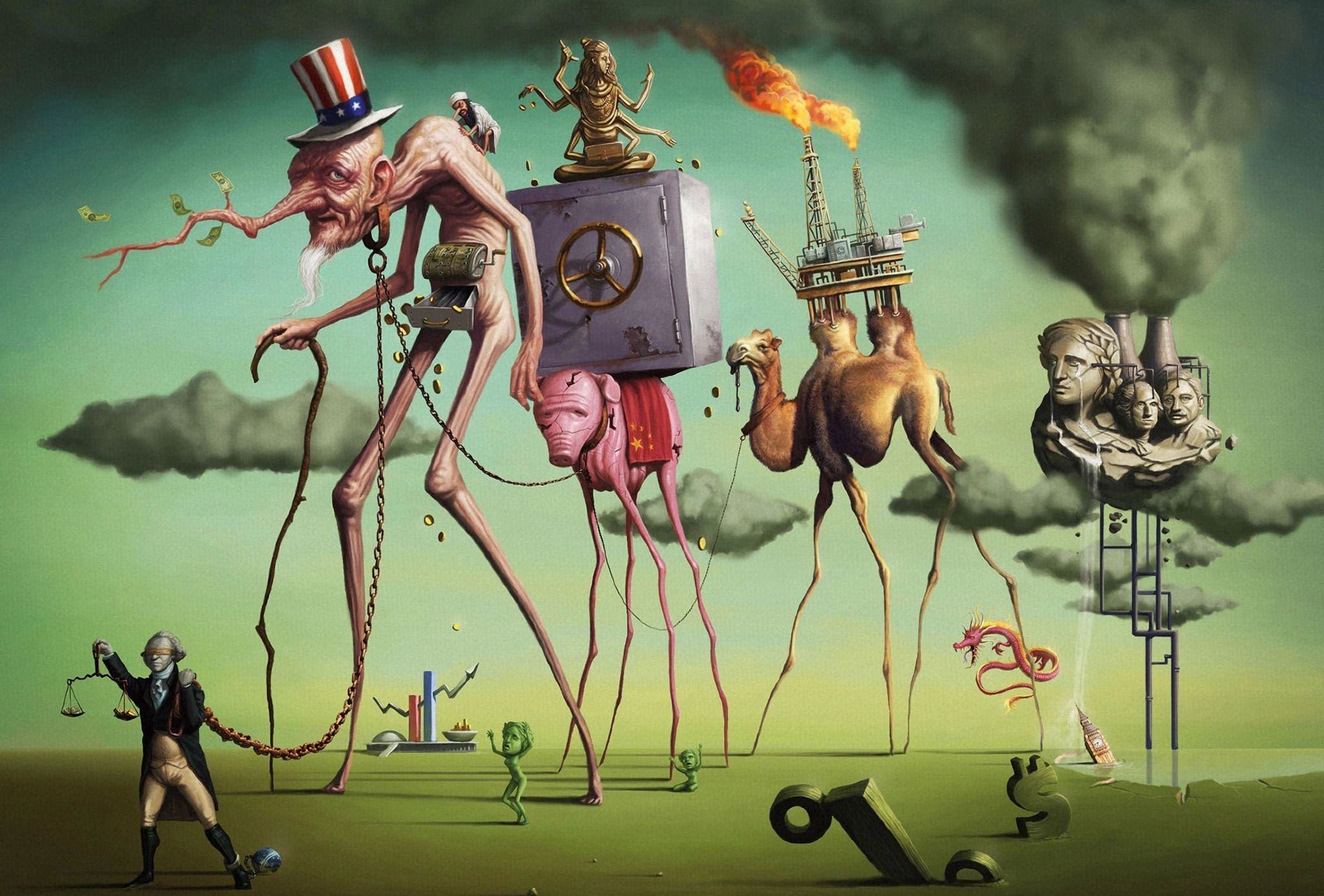
Some sixty years ago Samuel Huntington argued in Political Order in Changing Societies that modernization, undermining traditional economic and cultural mores, would unleash massive social and economic instability across the world. What Huntington did not necessarily foresee, though his protégé Francis Fukuyama did, was that the creeping supremacy of liberal democracy and its concomitant free market ideology would not only cause instability in developing states, but in the developed world as well, and in-so-doing undermine the pillars of its own legitimacy. Across the developed liberal democracies of the world there is a populist fervor gestating in a tripartite petri dish of neo-liberalization, globalization, and technologization. The confluence of these trends has led to economic and social upheaval for workers in advanced liberal democracies. Meanwhile, the policy-making class (alternatively called the college-educated managerial elite or the technocratic elite) have comfortably overseen, encouraged, and benefitted from these trends. As a result, a perilously large gap has emerged between the interests and well-being of the elite and the average worker. Exploiting this gap, charismatic populist redeemers, claiming to stand for the people, are increasingly rising to power.
Undermining the Balance of Power Between the ‘Elites’ and ‘Normal People’
World War I and World War 2, as Michael Lind and others have documented, offered an abnormal environment wherein modern elites came to compromise with a newly emergent city-based working class (the industrial proletariat). The New Deal enshrined policies that benefitted average workers and augmented labor power, facilitating the rise unions and collective bargaining, a form of countervailing power for ordinary workers against a corporate elite. Beyond the fact that union participation and pro-labor lobbying power was at historic highs, evidence for the impact of labor power can be seen in the near perfect alignment between productivity growth and wage growth (Figure 1). For this and many related reasons (e.g. economic mobility; Figure 2), the years following WW2 and up to roughly the Vietnam war have often been seen as a golden period (Donald Trump’s rallying cry to ‘Make America Great Again’ pays homage to these years).
Figure 1: Productivity rising linearly, wages flat lining since early 1970s. Source: Economic Policy Institute
📷
Figure not preserved — pasted from Word into the original blog and never uploaded.
Figure 2: Average Share of U.S. 30-year-olds earning more after inflation than their parents did at age 30. Source: WSJ
📷
Figure not preserved — pasted from Word into the original blog and never uploaded.
Michael Lind’s thesis goes a long way toward explaining this precipitous growth in inequality.1Michael Lind, The New Class War, 2020 As we moved away from total mobilization via war, the need for elites to compromise with normal workers vanished. As Lind noted in a recent podcast conversation with the American Interest, the mechanism through which this happened is that labor lost, as John Kenneth Galbraith labeled it, countervailing power. One could argue that well-educated, benevolent elites could, theoretically, have looked out for labor’s interests even though labor’s countervailing power had disappeared. But, in fact, as Lind notes, in practice a group’s interests tend only to be advanced to the degree to which they have power to advocate for those interests. 2Michael Lind on Reviving Democracy, _The American Interest_https://www.the-american-interest.com/podcast/michael-lind-on-reviving-democracy/ The decimation of labor’s power and the increasing power of a policy-making elite (a college educated managerial elite in Lind’s terms) thus meant the interests of the former were routinely scarified at the altar of the latter’s.
As Sheri Berman helpfully noted in a recent speech, there is both a supply and a demand side explanation for the rise of populism.3In class discussion during ‘Democracy in Crisis’ with Yascha Mounk On the demand side, drawing upon Michael Lind’s argument, workers have lost power and thus their ability to command reform. A positive feedback loop then set in. As the inability of workers to force their liberal democratic systems to accommodate their interests became more apparent, so too did the intensity and the number of people demanding systemic reform grow. Meanwhile, the supply side is characterized by the degree to which an increasingly technocratic, liberal democratic system is capable of providing the reforms desired by the governed. In an ideal situation, a relatively stable equilibrium can be achieved wherein the system reforms sufficiently to the preferences of the median individual, as well as, on specific issues, toward preferences of specific groups that are particularly passionate about an issue, such that aggregate welfare is maximized (see: Quadratic voting). Ultimately, the supply of reform should routinely achieve equilibrium with the (quadratically weighted) demand for reform. This is a goldilocks equilibrium in politics: not too much reform, but not too little
Yet, in many liberal democracies today, a massive imbalance exists between the public demanding systemic reform and the willingness of the policy-making elite to provide substantive reform. Sheri Berman sees this problem as rooted primarily in an increasingly technocratic system that, in contrast to Fareed Zakaria’s view, is unresponsive to the people because it is increasingly undemocratic.4Sheri Berman, Populism Is A Problem, Elitist Technocrats Aren’t the Solution, _Foreign Policy_https://foreignpolicy.com/2017/12/20/populism-is-a-problem-elitist-technocrats-arent-the-solution/ Michael Lind sees the problem as derivative of the rising power of a college educated managerial class whose interests are not aligned with (and no longer countervailed by) workers’ interests. In simple terms, both authors are pointing out the fact that liberal democratic systems are increasingly not working for average workers. Indeed, worker’s ability to impact policy has been increasingly redistributed toward a ‘technocratic’ or ‘managerial’ elite. It is increasingly the preferences of this latter group that are instantiated into policy.
The Populist Petri-Dish: Technologization, Neo-Liberalization, Globalization
Yuval Harrari, in his book 21 Lessons for the 21st Century, hypothesizes that the future will herald not an ‘exploited’ class of people but rather a ‘useless class’ of people. Harari views this as a natural consequence of machines encroaching first on jobs done by the human body (1st and 2ndIndustrial Revolution) and now increasingly on the last reprieve of humanity: jobs accomplished via the mind (3rd and 4th Industrial Revolution). Once neither the human body nor mind are necessary to achieve economic output, the unwashed masses can increasingly be shunted aside. As their necessity in the production process diminishes, so too does their bargaining power. Yet automation via the ‘4th industrial revolution’ is only the latest in a string of developments undermining the working class. At least two major confrères paved the way to the present moment: neo-liberalization and globalization.
Since the 1970s neo-liberal economic policies have grown in prominence in liberal democracies.5David Harvey, A Brief History of Neoliberalism, 2007 These policies, underpinned by a Hayekian ethos of market freedom (“free-marketeerism”), have effectively “redefined state market relations in favor of the latter” and therein redirected power away from labor and toward Lind’s managerial-elite.6Ferragina, Emanuele, and Alessandro Arrigoni. “The Rise and Fall of Social Capital: Requiem for a Theory?” Political Studies Review 15, no. 3 (August 2017): 355–67. doi:10.1177/1478929915623968. These policies, often imbedded in rational choice neo-classical economic assumptions, were adopted across party lines, from Thatcher and Reagan to Blaire and Clinton. These policies worked, in the name of allocative efficiency, to reduce market friction caused by sectoral bargaining, to increase capital mobility for multinationals, and to deregulate industry (particularly finance). As the neo-liberal policy consensus amongst the managerial elite undermined labor’s countervailing power, a prominent empirical consequence was the failure of wage growth to keep pace with productivity growth.
Globalization, meanwhile, rose in lockstep with neo-liberal policies. In order to facilitate fluid capital mobility for corporations and to ease their access to a new, massive pool of cheap labor, policymakers oversaw and facilitated production moving overseas. The poster child of globalization was China, which undertook a rapid ascent based upon a Neo-Listian development model, effectively becoming a vacuum-cleaner of demand from other countries. Its State-Owned-Enterprises expanded enormously via domestic wage suppression, financial repression, and lax environmental regulations. In a globalized world, China’s investment led growth model has effectively redirected demand in developed countries (especially the US) and relocated it to China. 7An excess of savings in China intrinsically leads to decrease of savings in the US, and this occurs via unemployment and/or no income growth. Because Savings and Investment must balance globally, if China runs a Savings surplus and exports the excess, the most liquid and deepest capital market country will naturally absorb that. The US, the country with the deepest capital markets, must in turn see its Investment rise and Savings fall. Yet as we have seen, the US is not constrained by an inability to invest, so investment has largely gone into speculative investments, while savings have had to fall precipitously, largely via growing unemployment. This point is fleshed out more completely in Michael Pettis’ book ‘The Great Rebalancing’. The consequence has been a savings glut exported from China that, in conjunction with corporate inversions and offshoring, has directly led to unemployment and growing inequality in many advanced liberal democracies.8For an example of how cost of capital has been made irrational due to Chinese savings see Niall Ferguson and Moritz Schularick, Chimerical? Think Again, _Wall Street Journal_https://www.wsj.com/articles/SB117063838651997830 The rise of China and other states deploying the same imbalanced model such as Germany, South Korea, and Japan has taken place in a globalized economy to the detriment of workers in deficit countries, above all the United States. As excess savings from China have flooded into advanced liberal democracies, (especially the United States), currencies (especially the USD) have become overvalued, undermining producers and incentivizing cheap consumption. Massive capital inflows in conjunction with technocratic easy money policies from Central Banks9i.e. the Federal Reserve, European Central Bank, Bank of England, and Bank of Japan have led to rampant asset price inflation. Technocratic central bank policies, neo-liberal deregulation, and a globalized savings glut have had the perverse effect (especially in the US) of widening inequality beyond any period in modern history.
As the graphs below from the Wall Street Journal indicate, the top ten percent have seen their wealth balloon over the last two decades, while the absolute_wealth of the bottom 50% in America has decreased_.
📷
Figure not preserved — pasted from Word into the original blog and never uploaded.
📷
Figure not preserved — pasted from Word into the original blog and never uploaded.
While the asset prices of the wealthy have been inflated, average workers in many advanced liberal democracies are experiencing severe economic instability. Workers have increasingly lost their jobs and income (as seen in the historically low labor force participation rate) or otherwise seen no wage growth (actually, slightly negative; Figures 4&5) over the last fifty years, while the cost of crucial goods such as healthcare, education, and housing have ballooned.10Camilo Maldando, Price of College Increasing Almost 8 Times Faster than Wages, _Forbes_https://www.forbes.com/sites/camilomaldonado/2018/07/24/price-of-college-increasing-almost-8-times-faster-than-wages/#30140f5466c1
📷📷
Figure not preserved — pasted from Word into the original blog and never uploaded.
Figure not preserved — pasted from Word into the original blog and never uploaded.
Figure 5: Share of Pre-Tax National Income Accruing to Bottom 50% vs. Top 1%
📷
Figure not preserved — pasted from Word into the original blog and never uploaded.
At first central banks softened the blow by helping to further inflate wealth levels for everyone who owned assets. This enabled increasingly unemployed or underemployed workers to consume beyond their means due to what would prove to be an illusory wealth effect. Having seen no increase in their income over the prior five decades, workers increasingly borrowed against their assets to maintain their standard of living. When the asset bubble, having been engorged via a flood of Chinese savings and decades of technocratic central bank easy money policies, eventually popped due to the proximate cause of cynical financial machinations induced by deregulation, workers finally saw the Faustian bargain the college-educated elites had made for them.
📷📷
Figure not preserved — pasted from Word into the original blog and never uploaded.
Figure not preserved — pasted from Word into the original blog and never uploaded.
With an increasingly precarious employment situation, no wage growth, and assets that had instantaneously devalued (in some cases to nothing), average workers in the millions found out an unpleasant truth. A technocratic and managerial elite facilitated, or at best oversaw, the creation of a false patina of well-being via easy money asset inflation to hide the fact that their de-facto policies of neo-liberalization, globalization, and technologization (NGT) conspired to pull the economic rug of stability out from under the average workers feet. When the crisis hit, the game was exposed, and the feelings of fear, anger, and distrust of those in power have become palpable (Occupy Wall Street being an example of the inchoate anger). As a result, a mindset of scarcity has set in, as people’s hopes for a decent and stable living (what some call the American Dream) are fast receding. This economic environment, giving rise to feelings of status anxiety and scarcity, is incubating feelings of xenophobia, racism, and nativism as people latch onto simple explanations for their troubles.11Extrapolated from: Noam Gidron and Peter A. Hall, The politics of social status: economic and cultural roots of the populist right. The British Journal of Sociology, 2017 Average workers do not, and cannot be expected, to understand how elites have sold them short. In fact, elites themselves likely do not understand how they have sold workers short; for they were only looking out for their own interests, which they assumed to be universal. Rosy beliefs about efficiency gains, cheaper consumer goods, and a futuristic, high-skilled workforce predominated while the well-being of average workers in America and other liberal democracies was rarely front of mind. The fact that college-educated technocrats, the top ten percent, could do well in this NGT system certainly helped bias their focus.
A Modern Sociological Perspective
Just as Huntington and Marx discussed, economic changes often underpin social changes. As workers livelihoods collapse around them, so too are their social lives that give them status and feelings of belonging deteriorating as well. Workers who formerly oriented their lives around what they believed to be steady work now increasingly turn to work in the gig economy. In this unsteady new job market, average workers’ status position has declined precipitously. And, just as “rising prosperity reliably produces a liberalizing, tolerant, positive-sum mood” so does” material insecurity … tend to elicit a grim, zero-sum, us-or-them mindset.”12Will Wilkinson, The Density Divide, Niskanen Center. https://www.niskanencenter.org/the-density-divide-urbanization-polarization-and-populist-backlash/
As Alexis de Tocqueville noted in his incisive book Democracy in America, civic association paradoxically thrived in America alongside an individualistic, bootstrapping ideology. Unfortunately, neo-liberal policies, destabilizing and atomizing our economy, have also undermined the social fabric, or social capital, that the collective, associational spirit of America rests upon.13Ferragina, Emanuele, and Alessandro Arrigoni. “The Rise and Fall of Social Capital: Requiem for a Theory?” Political Studies Review 15, no. 3 (August 2017) Civic organizations, local religious institutions, unions, and other groupings served to provide a bulwark of community, but the last few decades have seen these pillars of communities deteriorate.14Robert Putnam’s Bowling Alone provides a good overview. Average people must navigate the stress and powerlessness associated with gig and temp-work without the countervailing feelings of belonging and personal status that were often provided via these local organizations.15Sarah O’Connor, Driven to despair–the hidden costs of the gig economy, Financial Times, 2017 As Karl Polanyi observed in his book The Great Transformation, every development that increases the role of unstable market forces in individual lives is liable to produce a double, reverse movement that sees people, averse to instability, call for protection against these market forces. The NGT economy, characterized by instability and atomization, is undermining average workers status positions, communities, and sense of belonging. Many feel desperate, angry, and sad. Many want change.
Populists Redeemers: Promises of Change
As Francis Fukuyama documents, a ‘vetocracy’ has captured liberal democratic regimes, especially in America.16See Francis Fukuyama, Political Order and Political Decay Interest groups now have outsized influence, particularly when it comes to forestalling reforms. One of the most quoted studies in political science even goes so far as to say their findings indicate that “average citizens have little or no independent influence” on policy.17Martin Gilens and Benjamin I. Page, Testing Theories of American Politics: Elites, Interest Groups, and Average Citizens Instead, the authors find a near-linear relationship between support among the wealthy and the chances of policy adoption, with outcomes heavily weighted toward the bottom end (i.e. if no wealthy people support the policy, it is extremely unlikely to pass, a ‘vetocracy’). In fact, due to limitations in the study’s methodology, their findings may understate the scale of the problem.18The authors relied upon the preferences of the 90th percentile income group, earning roughly $146,000 in 2012 terms to derive the relationship between their preferences and policy instantiation. Clearly, though, this group is not that rich nor that likely to be as powerful as the many multi-million-dollar earners (what some call the donor class).
With a yawning gap between the interests of the managerial elite and the average workers they claim to represent, the environment has ripened for charismatic political actors to sell a redemptive and change-oriented vision. Some of these people appear to be legitimate reformers (Andrew Yang), while some appear to be demagogic populists (Viktor Orban). A populist, or an individual who advocates for a personalistic style of rule on behalf of an aggrieved group, promotes a non-pluralistic policy prescription, such that only his in-group is intended to benefit. A populist proclaims that only via concentration of power within his own hands can his group overcome the elite / other groups (often foreigners) who are exploiting and holding down his group. In the book Ideas and Economic Crises in Britain, Matthias Matthijs deploys a constructivist approach to show that ‘political entrepreneurs’ are best able to achieve success when they cultivate an air of crisis and proffer a convincing description and proscription to problems. As my essay has attempted to lay out, there is an objective crisis facing many average workers, making crisis-peddlers not only believable, but also making individuals who are in favor of the status-quo appear at best out of touch and at worst exploitative.
Neo-liberalization, Globalization, and Technologization have coalesced under the stead of a college-educated, policymaking, managerial elite to create massive instability in the social and economic lives of average people. Populist reformers are, sometimes accurately, diagnosing and decrying certain elements of these fundamental force drivers, while many in the managerial elite want to continue with business as usual. Alas, populists are also exploiting an evolving mindset of scarcity and anxiety (status and otherwise), created by the contraction in the average working persons’ daily stability and standard of living, to foment xenophobic and racist societal rifts in ways that facilitate their own personalistic ruling ambitions. If the interests of average workers continue to be shunted aside, and managerial elite continue to allow neo-liberalization, globalization, and technologization to continue unabated while tiptoeing around fundamental systemic reforms that would increase the countervailing power of labor, populist challenges are only liable to increase. Millions of workers accustomed to the tacit liberal democratic promise of an increasing standard of living will not go quietly into that goodnight of increasing social and economic instability. Particularly not when they see college-educated professionals, high-end service sector workers, and tech billionaires increasingly reaping the rewards of this new economy that has, incidentally, done them so much damage. Yascha Mounk has shown in his book The People vs Democracy that as liberal democracies becoming increasingly undemocratic, refusing to accommodate the interests of average people, the people in turn retaliate and support illiberal populist reformers who promise change. When people feel desperate, they will often do desperate things. Before the wage laborers in liberal democracies become a useless class, they will become a revolutionary class.