Review: Trade Wars Are Class Wars
This book is an opus of sorts for Pettis. Many of the ideas herein have already been expressed elsewhere–in his blog, in Volatility Machine, or in The Great Rebalancing.
As with all of his work, his first principles style of thinking shines through admirably. Pettis exclusively relies upon the basic macroeconomic accounting definitions and principles as the building blocks of his ideas. The robustness of his ideas stem from this simple heuristic device. As he puts it in a blog post, it is extremely useful in that it immediately sorts out which ideas cannot be true–because they do not align with definitional, first principle truths.
The surprisingly simple logic Pettis uses ultimately allows him to derive much deeper and more substantive conclusions about major macroeconomic shifts than most other economists.
------------- Onto the book itself.
Have you ever had the ominous feeling that a few individuals control the world economy? That a few rich people were prospering from an increasingly globalized world, while the masses were exploited? If so, you weren’t entirely wrong.
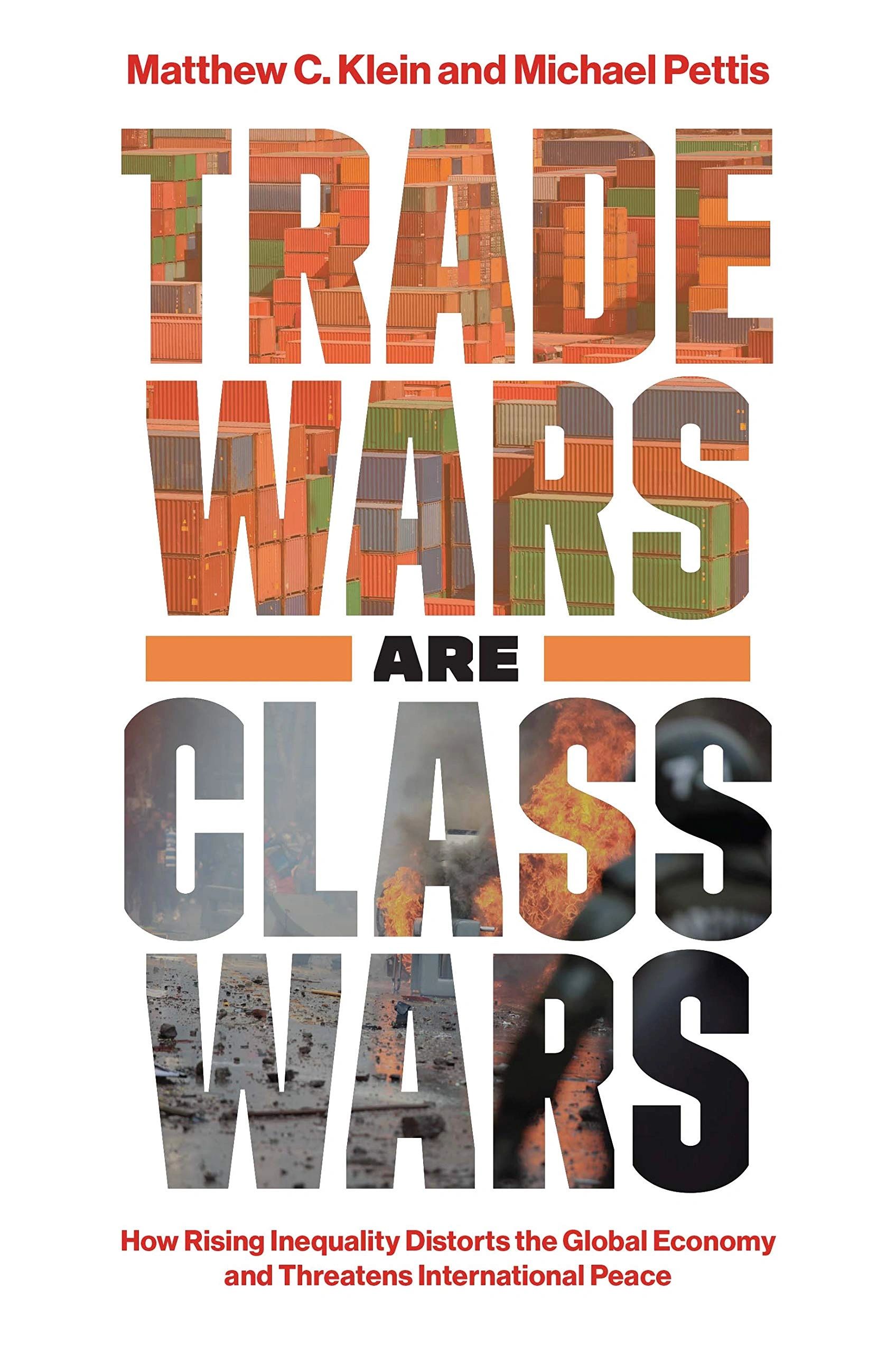
At least, this is the argument Michael Pettis and Matthew C. Klein set forth in their cogent and incisive book _Trade Wars Are Class Wars_.
To be clear, the authors do not argue that a cabal–some sort of illumati–are pulling strings like Geppetto. Certainly, there is no George Soros-linked conspiracy to be found within the 232 pages of text.
However, as Michael Lind argues in a similarly brilliant and similarly titled book, New Class War, shared incentive structures can create outcomes that appear to be the result of coordinated action.
Now, if you’re like me, you are no fan of Karl Marx or Vladimir Ilyavich Lenin. In fact, like me, you may be actively hostile to their political project. But one must give the devil his due. These two individuals put forward several extremely valid critiques of capitalism (though they, particularly Lenin, also put forward particularly atrocious remedies). Financiers in America, industrialists in Europe and Asia (some who themselves claim to be followers of Marx and Lenin!), and their respective policy makers have been engaged in a perverted form of globalization that has validated several critiques of Marxism-Leninism.
Marx argued that capitalism was full of contradictions that, in a ‘dialectical’ process, would ultimately undermine it. One of the most fundamental is the tendency for accumulation to undermine the consumptive capacity upon which capitalism is based. The contemporary manifestation of this trend is to be found in ‘efficiency fetishization’–as corporations and their elite shareholders mandate offshoring, suppress wages, cut taxes, demand deregulation, and ultimately engage in a shift of resources away from the average person and toward themselves.
Lenin, in turn, argued that the highest form of capitalism was imperialism. As capitalists ruthlessly stripped their own countries of resources and undermined the consumptive capacity of their domestic population, they would seek out oversees territories filled with cheap commodities and new markets.
These insights, however, were not actually Lenin’s. They were rather, turn of the century English economist John Hobson’s! Unlike Lenin, who was influenced by Hobson’s arguments but contorted them into a dubious grand-theory of imperialism and capitalism, Hobson merely noted that this domestic under-consumption was the current manner in which capitalism was manifesting and that it in large part drove imperial tendencies.
In Pettis and Klein’s book, we find a contemporary manifestation of this Hobsonian dynamic in ‘beggar-thy-neighbor’ policies implemented in places such as Germany and China–where elites have focused on ‘hoovering up’ foreign demand as opposed to increasing and empowering domestic demand.
The core claim in Trade Wars are Class Wars is that domestic imbalances are created by local elites, and that these imbalances echo through the globalized system–hurting average workers and benefitting elites.
The specific imbalance Klein and Pettis focus on is domestic demand. Cases studies of China and Germany, the two most pronounced imbalanced economies, demonstrate the points. In both countries, elite policy makers and industrial employers engaged in effectively neo-liberal policy proscriptions: rather than increasing domestic demand, reforms focused on increasing domestic production. The result was a widening gap between what these countries produced and what they consumed. The excess production was exported, and the earnings and benefits redounded to the elites who oversaw this strategy. Domestic workers purchasing power was, and is still being sacrificed at the altar of trickle-down economics.
One related, and important, lesson in the book is that to understand financial crises, one must look to creditors, not debtors. Klein and Pettis go through a long list of global financial crises, beginning with the first global financial crisis in 1820–post Waterloo and Napoleon. The general lesson is straightforward. Rapid credit expansion in one country–often in history a war related indemnity–tends to lead toward irrationally exuberant credit exportation abroad. One can always find willing borrowers eager to take on debt for projects. As the exuberance proceeds, however, less and less realistic projects get funding. Then, inevitably, a liquidity shock takes place–often a central bank interest rate hike–and capital conditions tighten, the business cycle inverts, and foreign borrowers and domestic creditors lose their shirts.
In recent years, the worst offender in this regard has been Germany. The country’s massive current account surpluses have been balanced by massive capital exports. In turn, the country’s capital–from both private and public lenders–has gone haphazardly and funded and inflated some of the most devastating bubbles–precipitating both the eurozone crisis and the 2008 housing crisis. Hard to believe, right? Consider, though, that Deutsche underwrote more US mortgage bonds than Citigroup, Countrywide, or Goldman Sachs. Floods of foreign capital precipitate global financial crises. This flood of capital is, in our modern world, itself now caused in large part by domestic class wars, as current account surpluses are jacked-up by suppressing domestic consumption.
------Interlude
One of Peter Thiel’s favorite interview question is: “What important truth do very few people agree with you on?” As Thiel goes on to say, this question seems easy to answer because it’s straightforward, but it is actually extremely difficult–it cannot be just a controversial opinion (i.e. “god doesn’t exist”).
Because of Michael Pettis’ work, I have an answer to that question: US Dollar primacy is not a privilege America enjoys, it is a burden America bears.
If you study political economy related topics at all, you likely recognize that US Dollar hegemony is good for America is widely assumed to be true. In fact, to use David Foster Wallace’s terminology, it’s basically our water–the assumption is so pervasive that we hardly even notice ourselves making it. Just the most recent example can be found in Hank Paulson’s recent piece in Foreign Affairs, worrying about US dollar primacy–tacitly assuming it’s a good thing.
-------Back to the book
The final chapter of Trade Wars Are Class Wars weighs heavily on the issue of US Dollar primacy. As I have foreshadowed, it forcefully makes the case that US Dollar primacy has, overall, been an exorbitant burden, not an exorbitant privilege, for America. In fact, it is precisely the mediating factor that allows imbalanced countries like Germany and China to survive.
Unfortunately, the current distribution of power in the American system makes this situation impossible to remedy. While USD hegemony does not serve the vast majority of America well, it serves financiers extremely well. Thus the interests of American financiers and European and Asian industrialists have converged in such a way that enables the imbalanced nature of our globalized system to deepen rather than unwind.
The ultimate consequences are primarily distributional. Elites win, average joes get squeezed, and inequality grows. Globalization as it is currently practiced is a perversion.