Assets, Dictatorships, and Democracies
According to Carl Boix, how do different assets and degrees of mobility combine to produce dictatorships and democracies?
Barrington Moore once pronounced that there can be no democracy without a bourgeoisie. A general school of thought has since emerged known as ‘Modernization Theory’ which essentially holds that economic development and democracy share an intricate and causal relationship. Carl Boix, in his book Democracy and Redistribution, operates in this vein as a ‘new structuralist’ who strives to push Moore’s theory into more formal ground, arguing that asset specificity, more colloquially referred to as asset mobility (in addition to inequality), plays a decisive and primary role in determining regime type in a given country.
Indeed, for Boix, “causal primacy” in democratization is ultimately attributable to asset specificity “over [and above] mere levels of per capita income in explaining the type of political regime.” In Boix’s model of democratization, he views the fundamental opponents of democracy as land-owners and other such capitalists whose assets are largely immobile. The reason being that such capital owners are highly vulnerable to median-voter led taxation on those assets, as the rightward skew of the wealth distribution, i.e. the wealth of the median voter is less than average, leads to a strong desire for taxation (as formalized by Meltzer and Richard in 1981). Whereas the bourgeoise owners of highly mobile capital (merchants, financiers, skilled services, etc.) can simply move their capital abroad should the hoi polloi’s democratic demands for redistribution via taxation grow too strenuous, the land-barons and their ilk have no such recourse. As a result, the emerging bourgeoisie class can safely support democratization. Boix, like Moore before him, finds that when “manufacturing and commercial interests dominate and are sufficiently protected from the threat of expropriation or excessive taxation, democracy is eventually established.”
This bold claim is undergirded by a rational choice model that views people as economically rational (homo-economicus) societal agents acting to maximize their economic interests. In Boix’s game-theoretic modelling, two games exist with a two-choice and a four-choice framework, analyzing elite, and in the latter the middle class and their alliance structure, decisions to repress or acquiesce to the masses, and in turn the masses decision to either revolt or acquiesce should the wealthier classes repress them. Boix contends that actors (elites & middle class) will repress when their economic cost-benefit calculation leads them to believe repression is less costly (vis-a-vis asset losses and taxation) than democratization, and ergo will democratize when doing so is economically efficient. Meanwhile the masses will revolt if they are sufficiently mobilized such that their similarly probabilistic economic cost-benefit rationalizes this action. Messiness ensues (i.e. deviation from stable authoritarian / stable democracy) in the form of civil conflict, though, when imperfect information leads the elite to underestimate the cost of repression (i.e. underestimate the masses collective action capacity) and / or the masses to overestimate their mobilization abilities (or underestimate the elite repression capacity).
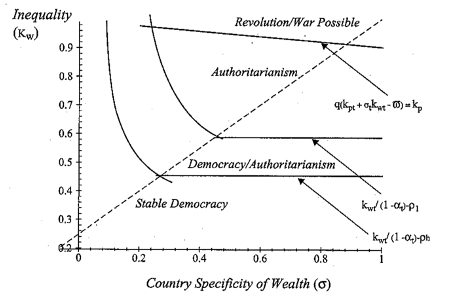
Thus within Boix’s rational choice model, asset specificity, in conjunction with the level of inequality, are seen as having an inverse relationship with democratization. When asset specificity is low and inequality also low, stable democracy is anticipated. Conversely, when inequality is high and asset specificity is also high, revolutionary conflicts are expected as the elite defaults to authoritarianism and the masses strive for communistic expropriation of their assets.
One of the fundamental problems of Boix’s reasoning is that he assumes the masses, dissatisfied with inequality, will intrinsically support democracy, and if not granted, in turn favor communism. This would seem to neglect the role that charismatic demagogues can have in channeling mass dissatisfaction to other routes, as well as the role that legitimizing ideologies can have in acquiescing the masses to inequality. Another issue is that Boix’s allowance for imperfect information may still be a severe understatement of the problem, particularly the asymmetricity of information facing the masses; how is a loose coalition of poor people to successfully calculate their odds of overthrowing a regime? Is such a thing ever possible?
Meanwhile, other scholars have since written on the general democratization topic, reaching different conclusions than Boix. For Acemoglu and Robinson (A&R), their 2006 paper on the subject derived the famous inverse U curve of inequality and democracy, which found that democratization is most likely when inequality is at middling levels, as elites have a strong incentive to oppose democracy at high levels and the poor have little incentive to strive for it when levels are lower (later work has called this relationship into question, too, though).
However, the most trenchant critique, and the critique most pertinent to the topic of asset specificity, comes from Ansell and Samuels (A&S). While Boix maintains that inequality in general is inauspicious for democracy, A&S find that segmenting inequality across asset classes proves to be crucial, as lower land inequality and higher income inequality both positively predict democracy.1Ansell, Ben, and David Samuels. “Inequality and Democratization: A Contractarian Approach.” Comparative Political Studies 43, no. 12 (December 2010): 1543–74. doi:10.1177/0010414010376915. In an important way, though, this is less as a refutation of Boix than a clarification. Boix & A&S both build on Moore, but A&S push Boix’s formalization efforts surrounding asset specificity further by empirically finding that a growing bourgeoisie class (proxied by inequality) does indeed predict regime type, namely democracy.
Ultimately, a foundationally important and seemingly robust conclusion that can be drawn from Boix (and confirmed elsewhere) is that high inequality in land ownership is detrimental to democratization, as the high asset specificity drives elites to great lengths to protect their assets from democracy’s concomitant taxation. Meanwhile Boix, as A&S empirically validate, also convincingly argues that an emerging class characterized by ownership of highly mobile assets (dominated by the merchant class, as Boix put it) is often a robust predictor of democracy.