Capitalism, Inequality, and Pareto
Does capitalism as a system inherently lead to inequality?
The world’s most famous critic of capitalism prophesied that capitalism would crumble under the weight of its own contradictions. For Karl Marx, the crux of this contention lay in the fact that capitalism as a system inherently leads to massive inequality. This essay will argue that Marx was right about capitalism’s tendency to result in inequality. However, this essay will also argue that Marx was wrong in very fundamental and significant ways about why this is the case. In so doing, the essay will make the point that governments, as the progenitors and maintainers of this embedded capitalist system, have a deep and abiding interest in mitigating the worst impacts of inequality, while sustainably reinforcing a more humane version of capitalism itself.
Adam Smith, perhaps the quintessential capitalist political philosopher, is famous for his comments on self-interested market participants operating in a market system to productively grow the economy all to the greater good. He furthered economic thinking in general, and would inform Marx as well, by formalizing a view on the efficaciousness of a large market economy in producing a division of labor, allowing people to specialize and collectively produce in volume and quality what people operating individually never could (ergo his famous fascination with a pin factory). David Ricardo extended Smith’s classical political economic take on the primacy of the economic sphere in life, but also laid the groundwork, via an analysis of class and in his theory of value, for Marx.
As an astute analyst and interpreter of the classical political economists, Karl Marx was able to deliver a biting and finely tuned criticism of the capitalist system. The classical philosophers, like Smith and Ricardo, had failed to appreciate a critical aspect of the capitalist economic system: its reliance on exploitation and oppression. One of Marx’s most fundamental insights though, and simultaneously one of his greatest flaws, was his reliance upon the idea of the labor theory of value, namely the idea that all product value is purely derivative of the number of ‘labor hours’. Through his conception of the labor theory of value, Marx contends that capitalists’ profits derive from their oppression and appropriation of ‘disembodied labor’ to generate a surplus profit, effectively taking from labor what is their true share of production. In turn, as capitalists partake in exploitation-fueled accumulation, and as competition forces corporations to keep labor costs low (keeping a reserve army), they are forced to appropriate and oppress labor even more in order to turn a profit. This spiraling dynamic results in growing inequality, with labor being smothered by the oppression of the capitalist class, and in turn the capitalist system eventually undermining itself, as laborers can no longer afford to purchase goods and engage in consumption. Eventually (miraculously?) class consciousness will be achieved and a proletarian revolution occurs.
The initial stages of Marx’s critique are not all that disparate from what we have seen play out in recent years. Over the last forty years real-incomes have been stagnant for the bottom half of people in most advanced economies, while elites (defined as those with 4 year degree or more) have seen their incomes sky rocket. Similarly, the wealth distribution has become more unequal in developed economies (particularly the US) than at any time prior to WW1. Yet while the higher-order dynamic mimics that predicted by Marx, the underlying reason is vastly different.
The labor theory of value is now considered bunk, supplanted by the much superior supply and demand theory of value. Further, in attempting to construct a materialist-conception of history, Marx appears guilty of applying an economic framework better suited to feudalism than to capitalism, insofar as he largely sees capitalistic production as a zero-sum imputation derived from labor. While Marx accepts and incorporates Smith’s division of labor argument, he does not agree with Smith’s ultimate conclusion regarding its benign nature and fails to comprehend the radical positive-sum nature that capitalism makes possible. This is perhaps Marx’s greatest flaw: his failure to foresee that capitalism would prove to be, not an oppressive torrent, but rather a rising tide–if raising yacht-like vessels much higher than others. Indeed, the reality is that capitalist production has eradicated more poverty, led to enormous technological breakthroughs, and drastically improved human quality of life far beyond anything that could have been imagined during the dark and dreary early days of industrialization, when Marx was writing and forming his worldview.
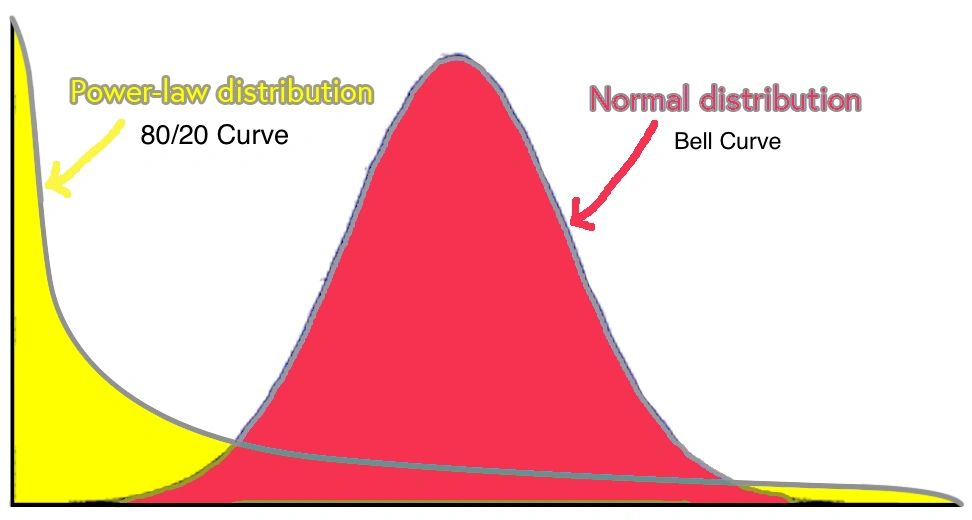
Yet, inequality is indeed an innate quality of capitalism, for capitalism–private property and incentive systems–intrinsically creates inherently hierarchical reward structures. In fact, even worse than unequal, unbridled capitalism eventuates in a pareto distribution. In a pareto distribution, the tail of the distribution is characterized by a power law (e.g. Pr[Income > y] = y^(−1/η)) such that “the fraction of people with incomes greater than some cutoff is proportional to the cutoff raised to some power.”1http://www-leland.stanford.edu/~chadj/piketty.pdf A back-of-hand estimation is that the top 20% under a pareto distribution will accumulate 80% of the resources. This phenomena of a pareto, or power law distribution has been documented in many realms of life, from the population of cities, firm sizes, book sales, and to wealth and income distributions (indeed wealth and income distribution in the United States, the quintessential capitalist economy, can be approximated nicely by a power law, the top 20% own 77% of the wealth).2https://www.brookings.edu/blog/up-front/2019/06/25/six-facts-about-wealth-in-the-united-states/ In the terminology of Nassim Taleb, when it comes to wealth and income, we are living in ‘Extremistan.’
Undergirding and giving rise to capitalism’s intrinsic pareto distribution is the fact that capitalist incentive structures create, perpetuate, and rewards performance hierarchies. Namely, given that humans value certain types of economic activity, i.e. of particular goods or service, a hierarchy of competence in ability to perform that activity or provide that good naturally forms (we cannot all be LeBron James, for instance). Particularly in our globalized version of capitalism, wherein goods and services from one firm can relatively easily be sold around the world, returns to highly-skilled / effective capitalist-market participants are increasingly manifest: the best product in a given category can be, and is, demanded throughout the world (try convincing someone to use a different version of excel). As access to opportunity has expanded, so too have the rewards to those who capitalize on that opportunity, ergo why a company such as Instagram, with only 13 employees, could be sold for a billion dollars.3https://www.businessinsider.com/its-been-1-year-since-facebook-bought-instagram-for-1-billion-heres-how-co-founder-kevin-systrom-spent-it-2013-5#for-memorial-day-weekend-systrom-spent-time-with-friends-at-the-parker-in-palm-springs-5 See also the ‘The Economics of Superstars’ by Sherwin Rosen. https://www.uvm.edu/pdodds/files/papers/others/1981/rosen1981a.pdf Making it to the top of a hierarchy in a globalized ecosystem entails great remuneration. Our globalized economy is one of superstars, where increasing returns flow to those on top.
However, unchecked capitalist systems tend to create a pareto distribution of wealth, other structural factors inherent to capitalist systems also further inequality. Thomas Piketty recently provided a rather explicit update to Marx’s famous Das Kapital when in 2013 he published a similarly titled book: ‘Capital in the 21st Century.’ The central contention of Piketty’s well-known book is that the rate of return on capital (r) is greater than the general growth rate of the economy (g), and as a result returns will accrue to holders of capital faster, and at a greater rate of compounding, than to laborers. Another related factor contributing to this dynamic is that capital holders are able to use their capital as collateral for loans and other such contract-based agreements, whereas laborers can do no such thing with their labor (nor would this be advisable given the history of indentured servitude and slavery). The problem of greater returns accruing to capital than labor thus further compounds intrinsic pareto-based inequality; the rich get richer. Many other issues also lead to inequality within capitalism, but these are common to all political economic systems: such as corruption and nepotism, erosion of a meritocracy, luck and path-dependence, familial privileges and inheritance, government capture, etc.
While Marx was wrong about the true nature of the causes of economic inequality, he was not wrong in concluding capitalism intrinsically engenders inequality. Yet, in thinking about what governments ought to do given the endogenous nature of inequality, another scholar provides a much more relevant analysis from which to draw conclusions. Karl Polanyi penned his famous book ‘The Great Transformation’ as a diagnosis of the ‘double movement’ of market economies. The first movement is the creation of the market itself by the state (markets are of course embedded within political systems), while the second counter-movement occurs as people, exposed to the volatility of the market, desire the state to reign in the market and provide them protection from it. In explicating this phenomenon, Polanyi maintains that as markets grow to be a more pervasive aspect of peoples’ lives, people will grow increasingly unhappy living on a proverbial roller-coaster, as their livelihoods and well-being track with the business cycle.
Those in the lowest income strata, the people living on the razor’s edge of subsistence, are on the front lines of human exposure to market forces, as their existence as commodified labor leaves them routinely buffeted by market storms. Whether it be a recession in demand for labor, a wholesale change in market preferences for goods and services, or, more ominously, automation, the working poor are startlingly exposed to the vicissitudes of the market. One of the more troubling insights provided by recent analysts, such as Yuval Noah Harrari, is that even beyond Marx’s vision of an oppressed laboring class, we may soon have a ‘useless’ class of people. These people will not be oppressed by corporations into selling their wage labor below its true value, they will rather be entirely redundant in the modern economy. Given the inherent frailty and problems of human laborers (health issues, ethical issues, general job friction issues, etc.) and the growing progress in automation technology, it is not hard to see the logic behind corporate cost-benefit analyses. The modern capitalist economy drives home the fact that inequality is an inherent feature of capitalism in an inescapable manner: the rise of automation, a byproduct of capitalist market forces, threatens not only to increasingly reward those capital owners at the top; it threatens to make redundant an entire strata of people. Is it plausible that Schumpeter’s famed creative-destruction dynamic could result in the obsolescence of labor itself?
In the face of increasingly troubling market dynamics, people, desiring stability, will seek protection via the state; a cushion that mitigates their exposure to the vagaries of a market economy that can increasingly do without them. As capitalism leads to both inequality and instability, and as capitalism is instantiated, or embedded within, political systems, there exists both a duty and an interest in mitigating the downsides of unbridled capitalism. Indeed, the progressive story of Europe and North America, since Bismarck’s iron hand was first wrapped in a velvet glove, has largely been a story of welfare state expansion under capitalism. This has allowed a market economy to continue to produce extraordinary progress, while ensuring that citizens in lower economic strata are not overexposed to instability and inequality of the system. States have a self-interest and a duty in pursuing and continuing this process. Capitalism is the greatest wealth generating system known to man, thus states will want to maintain it for their own benefit–and for the wellbeing of their populations. However, states also want to avoid radicalization of their populous, and therefore must insulate them from hardships that are likely to increase the likelihood of popular resentment against the existing order. Moreover, state’s ought to maximize the well-being of their populace, and this means both maximizing the productive capacity of the economic system, but also shielding people from its worst downsides.
Today, and toward this end, government’s ought to ensure a ground level of stability for people. However, they ought to do so in a way that accomplishes two goals simultaneously: efficiently protecting people from the vicissitudes of the markets while also minimally distorting dynamic capitalist incentive systems. Universal Basic Income (UBI) is a policy that acknowledges the realities of the pro-growth tendencies of capitalism (i.e. its radically efficient incentive system) as well as the inequality / instability downsides of capitalism. UBI allows states to buffer their citizens from tyrannical and tempestuous labor market demands, while also ensuring that they do not fall so low that they can no longer successfully compete and seek opportunities in the capitalist system. This, in conjunction with progressive taxation and very high inheritance taxes, will help mitigate capitalism’s intrinsic inequality and thus preserve the capitalist system itself by forestalling cries for its abolition.