Culture vs. Economics
Americans fight over culture, but should fight over economics

By: Jonathon P Sine
Prepared for Yascha Mounk’s seminar ‘Democracy in Crisis’
American politics can be conceptualized through two questions. The first: who gets what? The second: who are we? Different periods of American history have seen either of these two questions emphasized. Since the peak of the cold war, increasingly the dividing line in contemporary America is cultural; the primary question in America has become “who are we?”. This essay will first introduce the larger geopolitical and institutional shifts, beginning in the late 1950s, that have laid the foundations for the change from “who gets what?” to “who are we?”. The essay will then examine the roots and evolving branches of the emerging “who are we” landscape. In particular, the essay will examine how the evolution of a number of forces, top down and bottom up, have worked to do this, including: shifting donor-class strategies and top-down polarization, changing incentives and mediums in the media ecosystem, geographic and demographic changes, and increasing economic hardship. Finally, the essay will make the case that shifting the dividing line of politics back to economics and “who gets what?” questions will be palliative, both for our democracy and for the lives of average Americans. Economic problems are more amenable to compromise, if addressed can immediately improve people’s well-being, and many enjoy widespread support among diffuse populations. Ultimately, moving to first and foremost resolve economic issues will also ease cultural tensions, making those problems easier to resolve as well.
From “who gets what?” to “who are we?”
Existential danger often helps put things into perspective. At the national level, the specter of fascism and then communism kept Americans aligned on fundamental questions of who we are. During the period from the New Deal to the peak of the Cold War in the 70s, questions of who we are were far less prominent than questions of who gets what. As Lee Drutman shows, the dividing line of politics was indeed principally over economic issues.1Lee Drutman. How race and identity became the central dividing line in American politics. Vox. 2016. https://www.vox.com/polyarchy/2016/8/30/12697920/race-dividing-american-politics As Michael Lind describes it, there was an unsteady class peace that took shape as ‘democratic pluralism’–the representation of workers throughout many realms of society–reigned. During this period unions were widely subscribed (35% in 1954)2Drew Desilver. 10 facts about American workers. Pew Research Centers. 2019. https://www.pewresearch.org/fact-tank/2019/08/29/facts-about-american-workers/, served as a civic and associational pillar in American life, and tripartite system of government-industry-labor negotiated for wages.
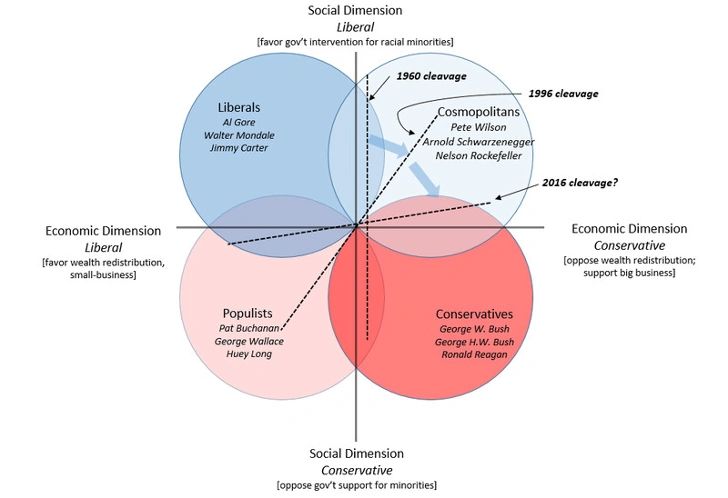
Figure 1: Changing Political Alignments Source: Lee Drutman
However, as the fear of foreign and existential threats subsided, so too did a sense of common identity and purpose. Without something to compare, and unite, ourselves against, we increasingly lost a broader sense of shared identity and fragmented internally. At the same time, because the economic situation for the average person was stable or improving, the impetus to maintain focus over economic resource distribution, or who gets what, naturally diminished. These larger geopolitical and macro-level developments set the stage for the resurgence of cultural conflict.
Cultural conflict, while always present, truly ignited in the 1960s over civil rights and cultural issues surrounding the Vietnam War.3Patrick Goldstein. Vietnam: A Seismic Cultural Shift. Los Angeles Times. 2020. https://www.latimes.com/archives/la-xpm-2000-apr-16-mn-20298-story.html It would, however, take more than a generation, and the concomitant rise of several additional systemic issues, for the transition from economic to cultural issues to fully manifest in the political arena. Since 1960s, though, the locus of the cultural debate, the “who are we” questions, has come to center primarily around “a combination of open borders globalism, anti-nationalism, and radical race- and gender-based identity politics” issues.4Michael Lind. New Class War. Pp 81
Economic Inequality and Political Decay
In addition to shifting geopolitical realities, two institutional problems in America grew that facilitated this transition. Growing economic instability and political sclerosis have ensured that the cultural conflagration that began in the 60s would ultimately erupt into a national fire.
Since the 1950s, economic inequality and stability in America have ballooned. No matter the measure, whether wealth or income, things are more unequal than they have ever been in this country. A later section expands on the larger economic issues, including globalization, neo-liberalization, and technologization, but here we should ask: what’s driving this? Many academic studies have looked at the skills gap: the divergent returns accruing to those with a four-year education and those without.5David H. Autor. Skills, education, and the rise of earnings inequality among the “other 99 percent”. MIT. 2014. https://dspace.mit.edu/handle/1721.1/96768 Others have looked at the increasing returns to capital over and above wage labor.6Thomas Piketty. Capital in the 21stCentury. 2015. Still others have looked at corporate offshoring, labor arbitrage, and employment of cheap immigrants.7Tracy C. Miller. Impact of globalization on U.S. wage inequality: Implications for policy. North American Journal of Economics and Finance. 2001. https://www.sciencedirect.com/science/article/pii/S1062940801000535?casa_token=pLem9jiPBNkAAAAA:NM_qdGHfd1Quy4y_HMVunI_kvn5A-Ee9jObq5lyEbRGS0OtW0yQbBFcOhs6RFAN5QZPXAMgPuA However, as Michael Lind has pointed out, there is a common feature undergirding all of these developments: the overall diminishing power of the working class in decision making. From corporate board rooms to government policy making, the interests of ‘average American’8The term “average Americans” is a catchier way of phrasing “median American.” Median American, in turn, refers to the typical American who has slightly more than a high school diploma (i.e. 1 year of trade school or post-secondary education) and with an income level around $40,000. This person, and the large band around him/her, is the average American. workers have rarely been front of mind since the 1970s. The trends mounted slowly, but with 50 years of historical data, the implications stemming from average Americans diminishing power have become clear: stagnating wages, communal decay, deaths of despair, and plummeting intergenerational mobility.
Meanwhile, interrelated to diminishing power for average Americans, the American political process and its enabling institutions has experienced substantive decay. In one sense, this is because they simply do not work as intended. the weaponization of the minority position and strategic undermining of bipartisanship, pioneered particularly (but not exclusively) by Newt Gingrich and Mitch McConnell, has ensured that undertaking the business of governing the country remains incredibly difficult.9“But Gingrich had a plan. The way he saw it, Republicans would never be able to take back the House as long as they kept compromising with the Democrats out of some high-minded civic desire to keep congressional business humming along. His strategy was to blow up the bipartisan coalitions that were essential to legislating, and then seize on the resulting dysfunction to wage a populist crusade against the institution of Congress itself. “His idea,” says Norm Ornstein, a political scientist who knew Gingrich at the time, “was to build toward a national election where people were so disgusted by Washington and the way it was operating that they would throw the ins out and bring the outs in.” In: McKay Coppins. The Man Who Broke Politics. The Atlantic. 2018. https://www.theatlantic.com/magazine/archive/2018/11/newt-gingrich-says-youre-welcome/570832/ ; on McConnell: Carl P. Leubsdorf. Mitch McConnell is Gingrich-ing the Senate. Dallas Morning News. 2019. https://www.dallasnews.com/opinion/commentary/2019/04/11/mitch-mcconnell-is-gingrich-ing-the-senate/ Concomitantly, armies of lobbyists have descended upon Washington, D.C. to insert themselves into the political process, collectively reporting more in annual lobbying expenditures than the federal government expends to fund both the House and Senate combined. The vast majority, 34 to 1 based upon funding, serve at the behest of business interests.10Lee Drutman. How Corporate Lobbyists Conquered American Democracy. The Atlantic. 2015. https://www.theatlantic.com/business/archive/2015/04/how-corporate-lobbyists-conquered-american-democracy/390822/ Interest groups have inserted themselves into the political process and their mission has been primarily to forestall harmful regulation, helping create what Francis Fukuyama calls a ‘vetocracy’–or rule by veto.11Ezra Klein. Francis Fukuyama: America is in “one of the most severe political crises I have experienced”. Vox. 2016. https://www.vox.com/2016/10/26/13352946/francis-fukuyama-ezra-klein
Furthermore, as Sheri Burman highlights, there is a growing democratic deficit as policy has been shifted from democratic institutions into the hands of unelected technocratic bureaucrats. Ultimately, political decay has combined with technocracy to produce policy stagnation, or policies that are not responsive or aligned with average Americans’ desires.12Sheri Burman. Populism is a Problem. Elitist Technocrats Aren’t the Solution. Foreign Policy. 2017. https://foreignpolicy.com/2017/12/20/populism-is-a-problem-elitist-technocrats-arent-the-solution/ Much of this has occurred at the behest of corporate and economic elites. The interrelated nature of economic instability and political sclerosis arises largely from the fact that entrenching the status-quo and forestalling political-economic reforms redounds to the benefits of already wealthy elites. Even more broadly, the top 10-20% of Americans have captured policy making at many levels, engaging in a process known as ‘dream hoarding’.13Richard Reeves. Dream Hoarders: A Book Talk with Richard Reeves. Aspen Institute. 2017. https://www.aspeninstitute.org/events/dream-hoarders/ As average Americans’ economic livelihoods have worsened, this problem has become ever more poignant. The upshot is that growing economic anxiety is simultaneously refracted through increasingly pervasive cultural and identity lenses. Meanwhile, as economic and policy solutions to economic woes have been increasingly precluded, the donor-classes who largely caused the above institutional problems have also been at the vanguard of explicitly hyping up cultural issues as the key area of political conflict. This donor-class preference is crowding out focus on economic policy issues and exacerbating cultural fissures.
The View from Above: The Donor Class
Wealthy donors of the left are far more socially liberal than the average democrat. On the right, wealthy donors are far more economically conservative than the average republican. For different reasons, both donor classes have converged on culture as their preferred field of conflict. One uniting factor may be that both classes are deeply unconnected, unaware, and unconcerned with what life is actually like for the average American.14What Do Donors Want? Heterogeneity by Party and Policy Domain (Research Note) by David Broockman & Neil Malhotra https://web.stanford.edu/~neilm/donor.pdf
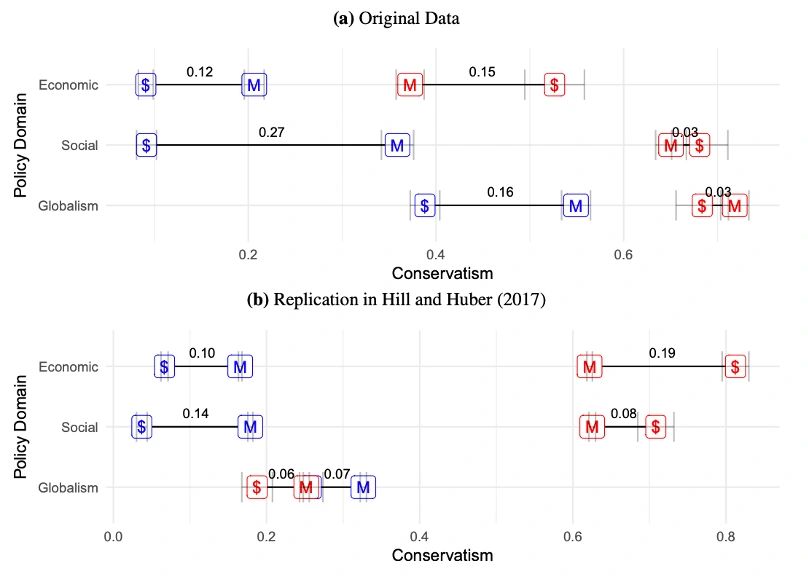
Figure 2: Donor Divergence from Median. Source: What Do Donors Want?
Political decay and interest-group mediated ‘vetocracy’ have been underwritten and overseen by donor classes (D & R) that are increasingly at odds with each other and with the average person in each of their respective parties.15David Broockman & Neil Malhotra. What Do Donors Want? Heterogeneity by Party and Policy Domain (Research Note). 2019. https://web.stanford.edu/~neilm/donor.pdf The upshot is polarization emanating from the top-down.16Introduction to How Democracies Die by Steven Levitsky & Daniel Ziblatt Elites in the media, in academia, and in politics have increasingly shifted the debate from “who gets what” to “who are we.” Because these questions of identity tend to be deeply personal and mutually exclusive (i.e. abortion, gun rights, identity politics), they are intensely combative in nature. Meanwhile, as a result of the increasing political and economic dysfunction, and the increasing focus on volatile cultural issues, key norms undergirding democratic functioning are threatened, as each side views the other as an existential threat.17Thomas B. Edsall. What Motivates Voters More than Loyalty? Loathing. New York Times. 2018. https://www.nytimes.com/2018/03/01/opinion/negative-partisanship-democrats-republicans.html
On the left, the democratic donor class has developed a zealous, quasi-religious focus on social justice and identity issues.18James A. Lindsay. Postmodern Religion and the Faith of Social Justice. Areo. 2018. https://areomagazine.com/2018/12/18/postmodern-religion-and-the-faith-of-social-justice/ A key outgrowth, as the data above indicate, is that leftist donors are far more socially liberal than the average democrat. If one looks at the history of leftist activism in America, its relevant roots may be the ‘New Left’ of the post-Vietnam era. Universities, to appease activists, made concessions by establishing entirely new, and at first small, academic departments such as Gender Studies and Race studies. These departments have come to be called ‘grievance studies’ departments, as they are highly siloed, self-referential, and often characterized by questionable methodology.19Yascha Mounk. What an Audacious Hoax Reveals About Academia. The Atlantic. 2018. https://www.theatlantic.com/ideas/archive/2018/10/new-sokal-hoax/572212/ Indeed, it is not uncommon to see these departments produce quite radical work, tinged with quasi-revolutionary, anti-system zeal. This work has widely penetrated the elite leftist milieu. Endeavors such as the 1619 project, whose work was recently validated with a Pulitzer prize, speak to the bottom line: endeavors are oriented more toward emphasizing systemic racism, sexism, and bigotry than objective analysis or pragmatic solutions.20“The project’s central conceit is that “out of slavery grew nearly everything that has truly made America exceptional: its economic might, its industrial power, its electoral system.” Hannah-Jones even argued that the main reason American Revolution was fought to preserve slavery — a claim so contrary to the truth that the Times eventually corrected that part of her essay, though only to add two words: Now it says “some of” the founders fought chiefly for that reason.” Post Editorial Board. The only Pulitzter the 1619 Project deserved was for fiction. New York Post. 2020. https://nypost.com/2020/05/04/the-only-pulitzer-the-1619-project-deserved-was-for-fiction/ An elite themselves, these academics often appear more interested in deconstructing and replacing the American governmental system than reforming it. As Coleman Hughes and John McWhorter argue, these scholars are turning politics into a battleground for identity struggles that often preclude constructive and pragmatic debate. As McWhorter recently stated: “for a certain kind of white person…showing that you are not racist trumps the truth.”21https://www.youtube.com/watch?v=Xym3kFuBX3Y Indeed, the people most influenced by these beliefs are a politically active, yet overwhelmingly white, elite (as measured by educational attainment) ‘progressive activist’ subset of the democratic party.22More in Common Report Political Tribes In turn, democratic politicians and the party itself increasingly cater to the religious-like focus on social justice / identity issues. The democratic party, at the behest of a democratic donor elite, has helped shift the conversation away from “who gets what” and onto the donor-elite preferred “who are we” questions.
On the right, the Republican donor class can still be found lionizing Friedrich Hayek, Milton Friedman, and other neo-liberal thinkers. In fact, for the elite Republican donor, free-markets and deregulation are often seen as morally virtuous in and of themselves, insofar as they are seen to promote libertarian individual freedom.23The Road to Serfdom by Friedrich Hayek is the ideal example. Though the book provides insightful arguments in favor of markets as a top-notch information mechanism, it quite often falls into moralizing dogmatism against state intervention. Elite conservative donors, while seemingly as conservative on social issues as the average Republican, are far more economically conservative. Here then, the historical record elucidates a conscious trend amongst these elites, since Goldwater’s epic defeat and Nixon’s success, to strategically play-up cultural issues. While the initial gambit was Nixon’s Southern Strategy, it has only become more pronounced since. Conservative elites are as likely to talk about god, guns, family, and country (issues that are often tinged with traditionalism and Christian morality) as they are to talk about deregulation and limited government. Indeed, it may even be that “due to the general social homogeneity of the Republican party…Republicans are more susceptible to identity‐based politics [than Democrats].”24See first: Lilliana Mason & Julie Wronski. One Tribe to Bind them All: How Our Social Group Attachments Strengthen Partisanship. Political Psychology. 2018 https://onlinelibrary.wiley.com/doi/full/10.1111/pops.12485 Similarly, as ‘Salon’ is wont to do, this story misinterprets the legitimately devout religious and non-racist identity issues motivating many people in America, yet it does connect key identity issues: Amanda Marcotte. In Trump’s America “Christian” is no longer a religious faith–it’s white identity politics. Salon. 2019. https://www.salon.com/2019/12/23/in-trumps-america-christian-is-no-longer-a-religious-faith-its-white-identity-politics/ In juxtaposition to the elite on the left, who are proponents of a new, postmodern religion focusing on a diverse array of social justice issues, the elite on the right appear to have co-opted a narrow band of religious-linked cultural issues linked to god and the nation. Overall, Republican party has furthered the interests of the donor class by turning the conversation away from economic “who gets what” issues. The Republican party has successfully catered to the economic interests of the elite while playing-up the social issues on which the donor elite and hoi polloi align.
The divergence amongst the elite donors is self-perpetuating. As the Republican donor class has hyped up their own religion-linked cultural issues (often tinged with implicitly, and even explicitly, racist dog whistles), so does the Democratic donor class become more committed to their own social justice religion. The data on this, according to More in Common, is fairly clear: small but extremely fervent activists (progressive and conservative) are commanding a focus on cultural issues.25More In Common. The Hidden Tribes of America. More In Common. 2018. https://hiddentribes.us All the while, as these issues become more salient, economic issues are crowded out or refracted through cultural lenses.
While this section of the paper has been intended to demonstrate how polarization along cultural issues has emanated from top-down donor preferences, there is a key area upon which the donor class tends to agree. On the issue of globalism, i.e. immigration and trade, both donor classes (D & R) come close to seeing eye-to-eye. In fact, both donor classes are quite fervent supporters of immigration and trade, particularly when juxtaposed with their average party compatriot. The left-elite support immigration through a social justice lens, while the right-elite support it through a moral-libertarian/economic lens. Democratic donors in big cities who claim to favor more egalitarian economic policies routinely employ cheap immigrant labor in their homes, while Republican donors who claim to righteously support their country, meanwhile, are amongst the first to advocate and take advantage of tax arbitrage. One panders at the economic benefits donors have accrued behind the scenes of the culture wars they have hyped.
Ultimately, both donor classes increasingly enflame, without resolving, underlying cultural problems, while themselves benefitting socially and economically from the globalist status-quo. As Haidt elucidates, highly polarized and tribal groupings develop into moral communities.26Jonathan Haidt & Jesse Graham. Beyond Beliefs: Religions Bind Individuals into Moral Communities. 2010. https://journals.sagepub.com/doi/abs/10.1177/1088868309353415 Within these communities, individuals can achieve status and prestige by saying the ‘correct’ things. As a result, the cordoned off elites in their Ivy league clubs have developed orthodoxies and shibboleths that differ across party lines. Though they seem to uniquely converge on issues of globalization, the disagreements are fraught and increasingly fought in the arena of culture.
Gasoline on the Cultural Bonfire: Media and Geography
Two final factors, media and demography, have interacted with the changing landscape to enflame the culture wars in ways that diminish focus on “who gets what” and increase focus on “who are we.”
The media environment, from mainstream media (MSM) to social media, thrives on attention. Profitability under the advertising revenue model is a matter of attracting clicks, views, and eyeballs. This leads to highly sensationalist coverage that has hastened the MSM’s exit from the news industry and entrance into the entertainment industry. It is, at times, comical. Consider the MSM’s weeks long, 24-hour coverage of the downed Malaysian airliner MH 370. It was a highly interesting event, to be sure, yet barely informed speculation co-opted an enormous portion of the news cycle, as more substantive issues were crowded out. This, in microcosm, is how the MSM fans the flames of cultural problems. Because cultural issues are incredibly poignant and cause emotional engagement with content, they tend to garner high levels of interest from viewers. MSNBC, CNN, and Fox routinely run segments where talking heads combatively debate the most recent culturally linked happenings (immigration, race and gender, religion, etc.) In addition to the revenue model incentive, talking heads are incentivized to gain influence and attention via short sound bites, encouraging highly hyperbolic analysis. It is hardly surprising that in this context, people who report watching the most mainstream news are consistently less informed on issues, but routinely more polarized along partisan lines, which are themselves increasingly cultural.27Bryan Clark. Cable news viewers more likely to believe political falsehoods than print, public radio consumers. 2018. https://thenextweb.com/media/2018/12/15/cable-news-consumers-more-likely-to-believe-political-falsehoods-poll/
Social media and more tailored media (such as radio talk shows and podcasts) have a tendency to further several of the problems in the mainstream media environment. Commentators and commenters are encouraged to make rhetorical flourishes that spike engagement by appealing to emotionally evocative subjects. Just as in the mainstream media, issues that revolve around “who are we”, i.e. deeply identitarian issues, tend to spike the most engagement and get the most eyeballs. While the left and right are increasingly segmenting into real life tribes, on the internet the trend is even more apparent. Left and right leaning twitter accounts circulate information solely amongst themselves, creating a phenomenon known as ‘filter bubbles’. 28This is what filter bubbles actually look like. MIT Technology Review. https://www.technologyreview.com/2018/08/22/140661/this-is-what-filter-bubbles-actually-look-like/ Foreign governments exploit these filter bubbles in ways that highlight the importance of the cultural factor. These foreign actors generate stories out of whole cloth that align precisely with our deeply divisive cultural rifts, such as social justice & conservative morality issues.29Darren Linvill & Patrick Warren. That Uplifting Tweet You Just Shared? A Russian Troll Sent it. Rolling Stone. 2019. https://www.rollingstone.com/politics/politics-features/russia-troll-2020-election-interference-twitter-916482/ While these malign foreign actors ultimately aim to gain followers so they can amplify their disinformation, they are also, in effect, holding up a mirror to our societal ills.
One of the most poignant of these societal ills revolves around place and space in America. In particular, the growing ‘density divide’ in America. 30https://www.niskanencenter.org/the-density-divide-urbanization-polarization-and-populist-backlash/ As if imitating the social networks, people are increasingly sorting themselves geographically based upon highly salient characteristics, such as personality and education. A hastening divergence between ex-urban / low density areas and urban / high-density areas is taking place. Urban and especially rural people report feeling very different from each other (50% and 70% respectively).31https://www.washingtonpost.com/graphics/2017/national/rural-america/?utm_term=.d18ec222e0fa The complicating effect of this “big sort” is a furthering of tribalism and facilitating a confluence of cultural fissures and economic instability: “as like people tend to vote the same way, and like people tend to cluster together, such clustering increases polarization in voting patterns.” 32The Big Sort Revisited. City Lab. 2016. https://www.citylab.com/equity/2016/10/the-big-sort-revisited/504830/
The Personal Should Not Be Political
The culture wars revolve around highly-charged, deeply personal issues that are exceedingly difficult to compromise upon. Christopher Hitchens once argued that religion poisons everything, in that it encourages people to have strong yet unreasoned commitments to highly salient issues.33Christopher Hitchens. god Is Not Great. Tribalized culture wars do much of the same. Teams are increasingly formed and delineated, with sacred values at the center. Morality both binds teams together and blinds them into cooperation (morality is itself an emergent property arising from its success at facilitating human cooperation). Haidt puts it pithily in arguing that humans are led by their intuitive, emotional machinery (their ‘elephant’) but justify their beliefs and actions post-hoc (via their ‘rider’).34Jonathan Haidt. The Righteous Mind. Party membership has quickly become one of the most prevalent identity markers for Americans, and party identification has increasingly split along cultural lines.35Thomas B. Edsall. What Motivates Voters More than Loyalty? Loathing. New York Times. 2018. https://www.nytimes.com/2018/03/01/opinion/negative-partisanship-democrats-republicans.html Also see unwillingness to date political opponents: Anna Brown. Most Democrats who are looking for a relationship would not consider dating a Trump voter. Pew Research Center. 2020 https://www.pewresearch.org/fact-tank/2020/04/24/most-democrats-who-are-looking-for-a-relationship-would-not-consider-dating-a-trump-voter/ People are increasingly incentivized and encouraged to let their elephants run wild, as their strong predilections toward various cultural issues dictate their tribal loyalties. With the Party divide increasingly about cultural issues, and Party identification increasingly integral to identity, emphasizing deeply personal identitarian and cultural issues only furthers these trends and increases political polarization.36: Lilliana Mason & Julie Wronski. One Tribe to Bind them All: How Our Social Group Attachments Strengthen Partisanship. Political Psychology. 2018 https://onlinelibrary.wiley.com/doi/full/10.1111/pops.12485
The reasons for this shift were elucidated above. A more peaceful geopolitical environment, economic instability and inequality, domestic political sclerosis (purposeful breaking of democratic institutions), donor-classes shifting debates from economics to culture, and media and geographic factors have coalesced to cause this shift away from economics and on to culture. The position in this paper is not that economic issues are altogether ignored. Rather, it is that cultural issues are the driving force in politics, the dividing line, and thus receive disproportionate airtime. It is important here to discuss the effect of this shift.
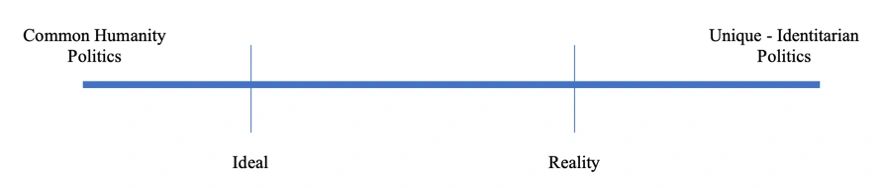
Democratic politics is fundamentally about recognition.37Francis Fukuyama. Identity: The Demand for Dignity the Politics of Resentment. 2018. However, at the highest level, recognition concerns can be adjudicated in one of two ways: via either common-humanity politics or unique-identitarian politics. In the former, divergent groups advocate for equal treatment and inclusion under the law and through policy. In the latter, divergent groups work to advocate for unequal treatment and unique policies tailored to specific groups. This conceptualization is more of a spectrum than a dichotomy. Yet, today, political conversations animated by “who am I” questions have undoubtedly shifted us closer to the latter side (see graphic below).
Yet, legislating unequal treatment in pursuit of ‘equity’, as people such as Ibram X. Kendi suggest, is less likely to resolve underlying problems than it is to create a myriad of new and unexpected ones.38Kendi, for example, suggests solutions that totalitarian dictators would immediately see utility in: “To fix the original sin of racism, Americans should pass an anti-racist amendment to the U.S. Constitution that enshrines two guiding anti-racist principles: Racial inequity is evidence of racist policy and the different racial groups are equals. The amendment would make unconstitutional racial inequity over a certain threshold, as well as racist ideas by public officials (with “racist ideas” and “public official” clearly defined). [The anti-racist amendment] would establish and permanently fund the Department of Anti-racism (DOA) comprised of formally trained experts on racism and no political appointees. The DOA would be responsible for preclearing all local, state and federal public policies to ensure they won’t yield racial inequity, monitor those policies, investigate private racist policies when racial inequity surfaces, and monitor public officials for expressions of racist ideas. The DOA would be empowered with disciplinary tools to wield over and against policymakers and public officials who do not voluntarily change their racist policy and ideas.” Coleman Hughes. How to Be an Anti-Intellectual. City Journal. 2019. https://www.city-journal.org/how-to-be-an-antiracist Coleman Hughes astutely analogized this to psycho-therapy: many people appear intent on using politics for the impossible goal of moral absolution for past-wrongs. As McWhorter has pointed out, though, resolving real and persistent inequities requires concrete policy goals, not moralization.39“Note that none of these things involve white people “realizing” anything. These are the kinds of concrete policy goals that people genuinely interested in seeing change ought to espouse. If these things seem somehow less attractive than calling for revolutionary changes in how white people think and how the nation operates, then this is for emotional reasons, not political ones. A black identity founded on how other people think about us is a broken one indeed, and we will have more of a sense of victory in having won the game we’re in rather than insisting that for us and only us, the rules have to be rewritten.” John McWhorter. Black People Should Stop Expecting White America to ‘Wake Up’ to Racism. Daily Beast. 2017. https://www.thedailybeast.com/black-people-should-stop-expecting-white-america-to-wake-up-to-racism
There is an increasing belief that all personal problems are inherently political, and thus politics should extend into every facet of life. This notion either fundamentally misunderstands how politics in a democratic nation works, or is a hope that democratic politics ceases to function. Politics in democracies is an inherently contentious realm, where issues are to be intensely and openly debated. In so doing, though, people must also ultimately be open to compromise, especially in a non-parliamentary democracy like America. As more highly salient issues in politics arise that cannot be compromised upon, the more difficult democratic politics becomes.
Cultural issues that are deeply rooted in personal feelings and beliefs are particularly unamenable to compromise. The treatment of cultural issues, stemming from the top-down, has fomented a quasi-religious zeal around cultural issues amongst the public. The ‘my way or the highway’ quality intrinsic to issues such as abortion, gun rights, immigration, or affirmative action has not scaled well with their increased salience. When the dividing line of politics is culture, and the questions of “who are we” are especially prevalent, politics takes on an increasingly winner take all feeling. Under such conditions, it is possible to understand how and why, as several political scientists document, the crucial undergirding norms of our democracy have been, and are increasingly, breaking down.40Introduction to How Democracies Die by Steven Levitsky & Daniel Ziblatt It also explains why economic issues, or questions of “who gets what” have taken a backseat to culture, or are otherwise principally refracted through cultural debates: economic issues themselves are just far less poignant than issues of cultural identity. But the fact remains that these cultural issues are in large part mutually irresolvable: you cannot both ban and allow abortion, for instance. When people do not agree on issues of faith, which cultural / identity issues are effectively tantamount to, there are only two resolutions: re-education campaigns or power-mediated imposition of one group’s preferences over another. Though one hears increasing calls for both in different guises, neither is achievable in the short-term in a way that is compatible with American democratic values.
Yet there is another way forward.
The Economy is the Way
How we shift from cultural debates back to economic debates is far from obvious. In this section I first discuss why it needs to be done (from an economic lens) and what we should do, and then offer a potential means for fomenting the necessary change.
In the last 50 years, economic rifts in our society have turned into fissures. When one juxtaposes the successes of the civil rights and gay rights movements in instantiating equality of opportunity and common treatment under the law, the trajectory provides reasons for hope. Yet against this backdrop, increasing inequality, declining opportunity, and decreasing mobility have made average and elite Americans, on a socio-economic or class basis, more unequal and less common than ever before.4120 Facts About U.S. Inequality that Everyone Should Know. Stanford Center on Poverty & Inequality. 2011. https://inequality.stanford.edu/publications/20-facts-about-us-inequality-everyone-should-know Economic issues should be front and center for two reasons: 1) for average Americans, they have only gotten steadily worse over the last 50 years, and 2) unlike the American culture war, which is at an intractable stalemate, less polarizing economic issues are actually resolvable. Furthermore, there are ways of talking about economics that unite people across broad swaths of the population. Indeed, resolving economic issues would also substantially improve the livelihoods of some of the most marginalized people in society (from Native Americans on reserves to poor blacks in inner cities to whites in Appalachia).
Adverse economic changes since the peak of the cold war have affected vast swaths of America. As Raj Chetty and his team found, “absolute income mobility has fallen across the entire income distribution, with the largest declines for families in the middle class.”42Raj Chetty et al. The Fading American Dream. 2016. https://opportunityinsights.org/paper/the-fading-american-dream/ What’s more, while all 50 states have experienced declines in mobility, the largest declines were in the industrial heartland. And, with the China shock in the late 90s and early 2000s, these changes have only exacerbated.43David Autor et al. The Chick Shock: Learning from Labor Market Adjustment to Large Changes in Trade. NBER. 2016. https://www.nber.org/papers/w21906 As I have argued before, the three joint trends of neo-liberalization, globalization, and technologization (NGT) explain much of average Americans economic dislocation. NGT trends have drastically changed our economy, undermining the economic livelihoods of many average Americans.44Previously submitted paper from the author for Yascha Mounk’s Democracy in Crisis
For many, the American dream for a more prosperous future has been uprooted. Acknowledging that entire communities in America’s heartland have fallen into disrepair, that overall income and wealth inequality has grown to unprecedented levels, and that wages for the bottom 50% have hardly increased over the last 50 years, is a crucial first step in addressing them. If properly acknowledged, then, we must also recognize the ample room to do something about them. First, though, we have to galvanize support for changing the conversation back to economics.
Mediating this change may require playing the ‘Chinese Communist Party (CCP) Card’.45It is imperative we be very specific about using ‘Chinese Communist Party’, in my view, as the CCP is a despotic regime, not representative of the Chinese people. Tarun Chhabra, Scott Moore, and Dominic Tierney. The Left Should Play the China Card. Foreign Affairs. 2020. https://www.foreignaffairs.com/articles/china/2020-02-13/left-should-play-china-card It is self-evident that economic issues in and of themselves are far less animating than cultural issues. Playing the CCP card, done judiciously so as to avoid either racism or war mongering, could galvanize a patriotic spirit that spotlights economic reforms as necessary for continued American success. The righteousness of a mission to promote American prosperity and values (defined in the broadest sense, such as freedom of speech and self-determination) will take on increasing verve when American ideals are juxtaposed against those of the Chinese Communist Party. Indeed, no hyperbole or warmongering will be necessary, just a simple factual analysis designed to promote unity and guide economic reform. Pitting America against an increasingly powerful Leninist regime has clear historical antecedents. We should pull from the Cold War the best lessons we can and apply them. In particular, couching economic reforms in a national security frame can serve to galvanize broad swaths of the population who care about otherwise disparate issues such as human rights, freedom, and resolving economic inequality. In short, what should be argued is this: in order to pursue these worthy endeavors, we have to ensure America remains far more competitive than China under the CCP, and to ensure this, the American economy and economic power structure must be reformed.
Part of the strategy of playing the CCP card also recognizes that Donald Trump’s America First strategy was not entirely misguided. At a high-level, we must strive to harness his populist energy and direct it toward the more benign strategic end of readjusting key institutions to better represent the interests and will of the American people. First, this strategy recognizes that donor elites have furthered globalization policies that have been detrimental to average Americans. Donald Trump and his team have already correctly honed-in on the idea that the issues surrounding the CCP represent a potentially crucial political pivot, as decades of ‘engagement’ with the CCP have redounded to the benefit of the neo-liberal donor-class who pushed this policy, while hurting average Americans and empowering an anachronistic Leninist dictatorship. Yet, “demagogues are good at channeling popular grievances and bad at redressing them.”46Michael Lind. New Class War. Pp 83 Concerned Americans should therefore not cede the field to Trump on issues revolving around the CCP. Rather, we should recognize their poignancy and co-opt them toward more benevolent ends. As the CCP becomes more powerful and increasingly threatens the elite interests it once served, the room for top-down concession also grows.
If we can properly play the CCP card, one important step on the road to economic reform will be to re-instantiate ‘democratic pluralism’–i.e. multi-pronged representation that empowers average Americans across key economic structures in society. As our own history, and Germany’s contemporary system demonstrates, work councils, sectoral bargaining, and mandatory positions on corporate boards for worker’s representatives will redound to the benefit of average workers. Elizabeth Warren’s Accountable Capitalism Act would enshrine much of this into law.47Elizabeth Warren. Empowering Workers Through Accountable Capitalism. https://elizabethwarren.com/plans/accountable-capitalism Political and economic power of the average American needs to be reestablished, not just in governance institutions but in multiple venues across the economy. In America, Covid-19 has accelerated two key developments: consensus on pulling back on globalization and consensus around opposing the CCP. The first development could aid the process of re-enfranchising the economic power of labor in the US, while the second may induce elites into a more compromising attitude. As world historical events increasingly conspire to conjoin economic and national security interests, they can also be leveraged by political entrepreneurs to increase the power of average Americans.
Through the unifying forces of national security and ideological competition, we may be able to refocus the political debate away from “who are we” and back onto “who gets what” questions. If the US is to muster the totality of its national strength to beat back a resurgent Leninist power, our politicians and political institutions must be able to harness the full strength of the American people. In order to do that, though, they will have to represent and compromise with them–not just with corporations and the donor class. Furthermore, to effectively counter the CCP, our congressional and other democratic political institutions must be able to function once there is majority support for a policy direction. American democracy, and our democratic institutions, are deeply flawed at the moment but they are not irredeemably broken. Emphasizing national security imperatives and an impending struggle over global values may galvanize the support, and concessions, necessary to fix them.
At a fundraising event, Mitch McConnell once told this author that money is like water: it will always find a way into politics. Over time, this author has begrudgingly come to accept his view. Rather than despair at the outsized influence that the donor class can command in politics, though, there are several bold steps we could take to make American democracy work again–quickly.
First, fight money with money: give every American citizen a $100 tax credit to spend exclusively on political donations. If money, like water, always finds a way in, then let there be a tidal wave commanded by the people of this country. Second: every state should pass the Anti-Corruption Act, authored by non-profit Represent.Us, which would ban lobbyists from making political donations themselves, places limitations on specific types of lobbying activity (such as donation bundling), bars politicians from fundraising during working hours, and closes the revolving door.48Represent Us. Anti-Corruption Act. https://represent.us/anticorruption-act/ Under conditions of peaceful decadence, the wealthy were increasingly able to wrest control of the political process away from average Americans. As great power competition reemerges, it must be taken back if we are to fight and win.
Conclusion: Remembering Who We Are
Cultural issues have come to dominate American discourse in the last several decades. A large part of the story is that cultural issues are simply more enticing to talk about: identity discussions make for compelling viewing/listening and often get people engaged (positively or negatively). Another part of the story is that our political and economic ecosystem is increasingly complex, and cultural issues offer simple ways for people to make sense of things. This is especially the case when economic and political change has been effectively forestalled behind the scenes by a vetocracy put in place principally by wealthy donors and corrupt and/or self-interested politicians. Overlaid atop this is virtue and status signaling, tribalism, and polarization that have arisen as a result of an unvirtuous cycle of debate over “who are we” cultural issues. Amidst conditions of peaceful decadence, the wealthy have taken control of the political debate and political process. Without a grander cause for Americans to unite around, they have begun to unite into tribes to fight one another.
We need to shift the debate back to economic issues. In addition to increasing the well-being of average Americans, a strategy of first and foremost resolving economic problems will lower tensions on an array of other issues in American society. As economic scarcity, anxiety, and dismay over the demise of one’s community eases, people’s outlooks will brighten. Whereas “material insecurity … tends to elicit a grim, zero-sum, us-or-them mindset,” so does “rising prosperity reliably produce a liberalizing, tolerant, positive-sum mood.”49Will Wilkinson, The Density Divide, Niskanen Center. https://www.niskanencenter.org/the-density-divide-urbanization-polarization-and-populist-backlash/ At the same time, as great power competition reemerges, problems stemming from the war on normal people (as Andrew Yang calls it) comes into sharp relief, as American democracy is juxtaposed against an illiberal, undemocratic rival. The American model must once again prove its merit.
The American political and economic system is in desperate need of rebalancing. The wealthy have far too much influence, while your average joe has far too little. It is only by both decreasing the influence of the donor classes and by increasing the power of average Americans that the system can be fixed. When workers once again have institutionalized power, and once congress and our democratic institutions are once again focused on the interests of average Americans, the incentives in the system can largely self-correct. In order to do that, political entrepreneurs, intellectuals, and concerned citizens must work to shift the debate from culture back onto economics. The era of pax-Americana saw cultural debates underwritten by America’s elite rise to dominate political discussions, as we forgot who we were. Perhaps the threat of less peaceful times will seed the shift back to economics and questions of who gets what, as history once again asks Americans to remember who we really are.