An Analysis of Entrepreneurship in China
Can a Leninist Political System Move China from Input-Led Growth to Innovation-Led Growth?

By: Jonathon P Sine
Prepared for: Professor David Bulman’s Seminar on China’s Economic Reforms
“We should create a favorable development environment for innovation, entrepreneurship and creativity” – Xi Jinping, March 10, 2019
Introduction
The story of China’s economic rise can be told straightforwardly. The Chinese Communist Party (CCP) successfully harnessed the East Asian model, originally pioneered by Japan during the Meiji restoration, at an unprecedented scale and with exceptional rapidity (thanks in large part to its State capacity and command economy inheritance).1“China’s growth model” can be thought of as “merely a more muscular version of the Japanese or East Asian growth model, which is itself partly based on the American experience.” Michael Pettis. China and the History of U.S. Growth Models. 2017. China Financial Markets. https://carnegieendowment.org/chinafinancialmarkets/68128 Also: Andrea Boltho & Maria Weber. Did China follow the East Asian development model? The European Journal of Comparative Economics. http://eaces.liuc.it It was a tale of martialing and deploying resources, as the vast majority of China’s growth in output has been due to growth in inputs.2Recent evidence suggests that 91% of growth from 1980-2012 has been driven simply by capital and labor inputs, and only 9% by TFP growth. “Of the 8.94-percent annual output growth rate for the entire period, the contribution of capital input was 6.71, labor input 1.40 and TFP 0.83. This means that 64 percent of the real value-added growth relied on capital input, 27 percent on labor input, and 9 percent on total factor productivity growth.” See: Harry X. Wu, Sustainability of China’s Growth Model: A Productivity Perspective. 2016. China & World Economy. https://onlinelibrary.wiley.com/doi/epdf/10.1111/cwe.12174 Further, Bulman et al examine the importance of reallocation to growth, indicating room for reallocation based growth: David Bulman and Aart Kraay. Growth in China 1978-2008: Factor Accumulation, Factor Reallocation, and Improvements in Productivity. 2011. World Bank. http://documents.worldbank.org/curated/en/206401468024284207/pdf/925520WP0Box38080200800PUBLIC000020.pdf Looking beyond Mao’s destructive cultural revolution, even Deng’s reforms seem to lose their efficiency luster. See Paul Krugman. Myth of Asia’s Miracle. 1994. Foreign Affairs. https://www.foreignaffairs.com/articles/asia/1994-11-01/myth-asias-miracle However, it is increasingly accepted that the era of input-led growth is by necessity coming to an end. While ample room would appear to exist for efficiency led, re-allocative growth3Chang-Tai Hsieh & Peter J. Klenow Misallocation and Manufacturing TFP in China and India. 2009. The Quarterly Journal of Economics. http://klenow.com/MMTFP.pdf, the CCP appears intent on leapfrogging over this stage and directly into innovation-led growth. Li Keqiang, China’s Premier, is spearheading a policy initiative dubbed “double innovation,”4State Council on Promoting High-Quality Development of Innovation and Entrepreneurship Opinions on creating an upgraded version of “Shuangchuang”. 2018. State Council. http://www.gov.cn/zhengce/content/2018-09/26/content_5325472.htm building off of ideas that Xi Jinping himself has clearly expressed:
“The old path seems to be a dead end. Where is the new road? It lies in scientific and technological innovation, and in the accelerated transition from factor-driven and investment-driven growth to innovation-driven growth.” (June 9, 2014)5Xi Jinping on Innovation, Entrepreneurship and Creativity. 2019. Beijing Review. http://www.bjreview.com/Nation/201903/t20190311_800161250.html
Thus, the question must be asked, can the CCP successfully oversee a transition of the Chinese economy to one based upon innovation-led growth? In particular, how will the CCP’s Leninist political apparatus facilitate or undermine this effort, given the contemporary nature of the technology and innovation economy?
This paper explores one key facet of these questions: the nature and character of the entrepreneurship ecosystem in China. Entrepreneurial innovation will prove critically important, given declining factor productivity and continued inefficient allocation of resources (predominately to state firms), to China’s growth and to an innovation-led growth model.
This paper takes the assumption, as Baumol outlined in his classic essay on entrepreneurialism, that “entrepreneurs are always with us,” for it is human nature to strive and pursue ‘wealth, power, and prestige.’6William J. Baumol. Entrepreneurship: Productive, Unproductive, and Destructive. 1990. Journal of Political Economy. https://delong.typepad.com/baumol-1990-entrepreneurship.pdf In an addendum to Schumpeter’s ideas, the key question is ultimately where entrepreneurialism is allocated.7Expanding the Schumpeterian framework which holds that an “entrepreneur is an agent of change that is the source of his famous creative destruction. He introduces a new good or a new method of production, opens a new market or discovers a new source of supply, or carries out a new organization of an industry. He upsets the conventional way of doing things.” Schumpterian Entrepreneurship. Serguey Braguinsky, Steven Klepper, Atsushi Ohyama. 2009. https://economicdynamics.org/meetpapers/2009/paper_772.pdf Will it be to innovative and productivity enhancing endeavors, or will it be routed through rent-seeking or extra-legal pursuits?
The paper begins by analyzing the literature on entrepreneurship and identifies several overarching areas of significance. The paper then evaluates evidence regarding how areas critical for entrepreneurship manifest in contemporary China. The paper concludes by analyzing the evolving interaction of the CCP’s Leninist political system with China’s entrepreneurial ecosystem.
Entrepreneurship: A Literature Review
At the highest level, research focusing on entrepreneurship tends to focus on three areas: personal traits relevant to entrepreneurship (e.g. personality and intelligence), socio-cultural context of entrepreneurship (e.g. social status accorded to entrepreneurs), and the institutional context (e.g. educational opportunities). A World Economic Forum (WEF) survey on entrepreneurship found that “entrepreneurs view three areas of an entrepreneurial ecosystem as being of pivotal importance – accessible markets, human capital/workforce and funding & finance.” In this review, I slightly expand the scope of analysis to incorporate a breadth of push and pull factors in the socio-cultural8I.e. factors that are “socially embedded in China’s peculiar social networks and informal institutional context” Canfei He, Jiangyon Lu & Haifeng Qian. Entrepreneurship in China. 2018. Small Business Economics. https://link.springer.com/article/10.1007/s11187-017-9972-5 and institutional arenas that appear to be key elements undergirding successful entrepreneurial ecosystems (personality characteristics are important to entrepreneurship but are here assumed exogenous to political systems and thus outside the scope of analysis). 9Marco Vivarelli, Is entrepreneurship necessarily good? Microeconomic evidence from developed and developing countries. 2013. Industrial and Corporate Change. https://doi.org/10.1093/icc/dtt005
Socio-Cultural Characteristics of Entrepreneurship
Social Status & Prestige
Evolutionary psychologists recognize social status, or prestige, to be a universal motivating factor in humans.10The core of the argument is that homo sapiens, as a highly-evolved and cooperative species, evolved to recognize and desire status as an outgrowth of their reliance upon accumulating cultural knowledge. See: Joseph Heinrich, The Secret of Our Success, for a deep and detailed elaboration of how ‘culture’, i.e. knowledge acquisition over time, is the key to human evolutionary success, and how prestige and status facilitated this. Economic literature suffers from a lacuna insofar as it mistakes human economic endeavors to be solely about pecuniary interest and not social status.11Nikhil Swaminathan. For the Brain, Cash Is Good, Status Is Better. 2018. Scientific American. https://www.scientificamerican.com/article/for-the-brain-status-is-better/ Recent evidence has explicitly linked job and educational choices to prestige concerns,12Diogo Pinheiro, Julia Meikers, Sunni Newton. Take me where I want to go: Institutional prestige, advisor sponsorship, and academic career placement preference. 2017 PLoS One. https://journals.plos.org/plosone/article?id=10.1371/journal.pone.0176977 as well as to entrepreneurship.13M. Halis, I.H. Ozsabuncuoglu, and A. Ozsagir. The Values of Entreprenurship and Factors that Effect Entrernurship: Findings from Anatolia. 2007. Serbian Journal of Management. http://citeseerx.ist.psu.edu/viewdoc/download?doi=10.1.1.707.16&rep=rep1&type=pdf Status concerns play a key role in where entrepreneurial efforts are apportioned.
The socio-cultural milieu plays an instrumental role in determining whether or not entrepreneurs are likely to receive social status. Indeed, local “values can create an entrepreneurship-friendly ‘mental software’ in the regional population” that can incentivize productive entrepreneurship.14Michael Fritsch & Michael Wyrwich. The Long Persistence of Regional Levels of Entrepreneurship: Germany, 1925–2005. 2013. Regional Studies. https://www.tandfonline.com/doi/full/10.1080/00343404.2013.816414 Such reasoning explains why Germany, known for its economic efficiency, nonetheless has a relatively low rate of entrepreneurialism for its development level: “Entrepreneurs are not held in great esteem in Germany and the trivialization of their practices may deter potential entrepreneurs… lower social status for German entrepreneurs, than those in other economically successful countries, may limit individual desire to form a new business venture.”15Jan Niklas Kaldeen, James Cunningham, Alistair Andersen. The Social Status of Entrepreneurs: Contrasting German Perspectives. 2017_. The International Journal of Entrepreneurship and Innovation._ https://journals.sagepub.com/doi/full/10.1177/1465750317706439 Having, or fostering, a socio-cultural environment wherein productive entrepreneurship is seen as prestigious is crucial to fostering allocation to productive entrepreneurial activity.
Social Networks: Weak and Strong Ties
Social networks play an instrumental role in three core aspects of entrepreneurship: “discovery of opportunities, securing resources, and obtaining legitimacy.”16Tom Elfring & Willem Hulsink. Networks in Entrepreneurship: The Case of High-technology Firms. 2003. Small Business Economics. https://knsecure.com/Resources/Articles/Networks%20in%20Entrepreneurship-The%20Case%20of%20High-technology%20Firms.pdf Specifically, as Granovetter originally posited in his work on ‘The Strength of Weak Ties’, there are two dichotomous forms of association: relationships characterized by strong and by weak ties. Strong ties are characterized by high-levels of intimacy and long-histories of reciprocal interaction, while weak ties tend to be less intimate and more overtly transactional. Weak ties, Granovetter submits, are critical to getting individuals outside of closed networks, and thus allowing them to gain access to novel information, knowledge, and opportunities.17Mark S. Granovetter. The Strength of Weak Ties. 1973. American Journal of Sociology. https://sociology.stanford.edu/sites/g/files/sbiybj9501/f/publications/the_strength_of_weak_ties_and_exch_w-gans.pdf A case study of high-technology firms affirms and augments this, finding that when it comes to discovering new opportunities, weak ties are of most prominent importance for entrepreneurs, whereas for acquiring legitimacy (i.e. institutional support), strong ties predominate (a key caveat is that for companies pursuing ‘radical innovations’ the opposite pattern holds true).18Tom Elfring & Willem Hulsink. Networks in Entrepreneurship: The Case of High-technology Firms. 2003. Small Business Economics. https://knsecure.com/Resources/Articles/Networks%20in%20Entrepreneurship-The%20Case%20of%20High-technology%20Firms.pdf
Evidence thus indicates that strong and weak ties are, respectively, necessary for acquiring legitimacy (e.g. state backing) and for being able to maximally take advantage of new opportunities. An important, yet preliminary, conclusion from the literature is that “weak ties are individually less effective in transmitting information, yet collectively account for the most successes (jobs found, novel ideas, and so on) in many countries.”19Laura Gee, Jason Jones, Christopher Fariss, Moira Burke, James Fowler. The Paradox of Weak Ties in 55 Countries. 2017. Journal of Economic Behavior & Organization. https://www.sciencedirect.com/science/article/pii/S0167268116302864 Ultimately, entrepreneurs in countries with differential social network endowments face divergent sets of advantages and obstacles.
Institutions that Facilitate Entrepreneurship
Geographic Clustering
An idea closely related to social network, but in important ways distinct from it, is geographic clustering, or as a recent paper termed it, “clusters of entrepreneurship and innovation.” One often hears policy makers pay lip service to clustering, saying they want to create “the new Silicon Valley.”20Aaron Chatterji, Edward Glaeser, William Kerr. Clusters of Entrepreneurship and Innovation. 2013. Harvard Business School. https://www.hbs.edu/faculty/Publication%20Files/130424-CGK-IPE_45be2057-0f20-4dc2-98d4-e422198bd55c.pdf The correlational evidence linking clustering with entrepreneurialism is robust. An NBER study concluded that agglomeration of many independent small firms is highly interrelated with levels of entrepreneurship.21Edward Glaeser, William Kerr, Giacomo Ponzetto. Clusters of Entrepreneurship. 2009. National Bureau of Economic Research https://www.nber.org/papers/w15377.pdf However, several studies reach inconclusive findings on the benefits of clustering.22Hector O. Rocha. Entrepreneurship and Development: The Role of Clusters. 2004. Small Business Economics. https://www.jstor.org/stable/40229373 As one paper put it:
“Even though entrepreneurship is a powerful force that engenders local and economic growth, it is not obvious that government policy can create entrepreneurship. Even if entrepreneurs naturally cluster in tight geographic units, it is not obvious that the government should use public policy to support such clusters.”23Aaron Chatterji, Edward Glaeser, William Kerr. Clusters of Entrepreneurship and Innovation. 2013. Harvard Business School. https://www.hbs.edu/faculty/Publication%20Files/130424-CGK-IPE_45be2057-0f20-4dc2-98d4-e422198bd55c.pdf
Nonetheless, factors such as lower fix costs for businesses and entrepreneurs, knowledge spill-over effects, concentration of specialized equipment, externalities from complementary economic activity, and ease of establishment of supportive institutions (such as educational) may be endogenously interrelated with clustering.24Mercedes Delgado, Michael Porter, Scott Stern. Clusters and Entrepreneurship. 2010. Journal of Economic Geography. https://dspace.mit.edu/handle/1721.1/65083 Given the inconclusive nature of the literature on the of the role of government policy in promoting clustering means a strategy of ‘isomorphic mimicry,’ wherein governments artificially incentivize clustering, may be not be misguided.25Philipp Krause. Of institutions and butterflies: is isomorphism in developing countries necessarily a bad thing? 2013. ODI. https://www.odi.org/sites/odi.org.uk/files/odi-assets/publications-opinion-files/8353.pdf Though the success of such a strategy is by no means guaranteed.
Human Capital – Educational Institutions
Just as clustering is interrelated with social networks, so too is human capital. In fact, it can be argued that “talented human capital is the driving-force behind the growth and development of cities and regions and underpins regional innovation.”26Richard T. Harrison, Sarah Y. Cooper and Colin M. Mason. Entrepreneurial Activity and the Dynamics of Technology-based Cluster Development: The Case of Ottawa. 2003. Urban Studies. https://journals.sagepub.com/doi/pdf/10.1080/00420980410001675841 Educational institutions, particularly those renowned for a focus on high-technology and entrepreneurship, are viewed as essential to augmenting human capital, and to mobilizing entrepreneurship. Stanford University in Silicon Valley is the quintessential example. Through innovation institutions such as Stanford Industrial Park and Research Institute and licensing of technologies to student-entrepreneurs, “as of 2011 nearly 5,000 companies existed which could trace their roots to Stanford, including Hewlett-Packard, Cisco Systems, Sun Microsystems, Yahoo, and Google.”27Best Practices in State and Regional Innovation Initiatives: Competing in the 21st Century. Stanford and Silicon Valley. 2013. National Academy of Sciences. https://www.ncbi.nlm.nih.gov/books/NBK158815/
The combined importance of knowledge transference, social networking, entrepreneurial training, and the incubational and seed funding roles that high-tech focused universities play are seen as crucial in stimulating entrepreneurship.28Youtie, Jan & Shapira, Philip, 2008. “Building an innovation hub: A case study of the transformation of university roles in regional technological and economic development.” 2008. Research Policy, Elsevier. https://econpapers.repec.org/article/eeerespol/v_3a37_3ay_3a2008_3ai_3a8_3ap_3a1188-1204.htm Thus, facilitating the establishment and growth of cutting-edge academic institutions, and encouraging their robust interconnectivity to the broader business ecosystem, likely plays a crucial role in fostering entrepreneurialism. However, efforts must begin even earlier, as an educated populace from primary through tertiary education is crucially important in providing the “generalized form of competence that underpins the variety of skills an entrepreneur needs to succeed in business.”29Ivar Kolstad. Arne Wiig. Education and Entrepreneurial Success. 2015. Small Business Economics. https://link.springer.com/article/10.1007/s11187-014-9621-1
Financing & Capital Markets
Financing and access to capital is a major factor in entrepreneurial firm formation and growth.30Cristiano Bellavitis. Entrepreneurial finance: new frontiers of research and practice. 2016. International Journal of Entrepreneurial Finance. https://www.tandfonline.com/doi/full/10.1080/13691066.2016.1259733 Lack of access to capital is one of the leading drags on entrepreneurialism. In developed economies, financing beyond one’s family and friends (which is fairly common) typically comes via venture capital funds, university-backed seed funds (mentioned above), private equity funds, corporate ventures, banks, governmental subsidies and investment vehicles, or public financing (IPO). Increasingly, new sources of funding such as crowdsourcing are also available. Yet despite these many varieties of funding, entrepreneurs still rely most heavily on formal debt financing (i.e. business credit and owner-backed bank loans). In fact, “roughly 80%–90% of most firms’ startup capital is made up in equal parts of owner equity and bank debt.” These findings “underscore the importance of liquid credit markets for the formation and success of young firms.”31Alicia Robb, David Robinson. The Capital Structure Decisions of New Firms. 2012. The Review of Financial Studies. https://academic.oup.com/rfs/article/27/1/153/1572752 The fact that capital structure remains stable over time, thus necessitating continued credit access, further underscore this point.32Michael Lemmon, Michael Roberts, Jaime Zender. Back to the Beginning: Persistence and the Cross‐Section of Corporate Capital Structure. 2008. The Journal of Finance. https://doi.org/10.1111/j.1540-6261.2008.01369.x Although external validity may be a factor (these studies took place in a developed economy), it heavily implies that facilitating institutional access to credit is crucial for entrepreneurship.
While governments may try to pursue subsidy policies to correct for limited capital allocative efficiency, “entrepreneurship within the targeted group [may be] greatly improved” but it may come “at the cost of the non-targeted entrepreneurs” and thus “the fraction of all agents engaging in entrepreneurial activities [may be] lower.”33Wenli Li. Entrepreneurship and government subsidies: A general equilibrium analysis. 2002. Journal of Economic Dynamics and Control. https://www.sciencedirect.com/science/article/pii/S0165188901000112 And while venture capital and other forms of ‘angel financing’ are important in accelerating highly successful entrepreneurial endeavors, “most entrepreneurs never get into contact with these financiers and need to attract financing from other more “traditional” sources of external financing, or rely on financial bootstrapping.”34Cristiano Bellavitis. Entrepreneurial finance: new frontiers of research and practice. 2016. International Journal of Entrepreneurial Finance. https://www.tandfonline.com/doi/full/10.1080/13691066.2016.1259733 Furthermore, “establishing public venture funding in an area lacking the requisite entrepreneurial climate or technology infrastructure may create a “catch 22” situation where locally oriented funds invest in bad deals or where venture capital is simply exported to established high technology regions.”35Richard Florida, Martin Kenney. Venture Capital and High Technology Entrepreneurship. Journal of Business Venturing. http://citeseerx.ist.psu.edu/viewdoc/download?doi=10.1.1.469.3086&rep=rep1&type=pdf The emerging institution of crowdsourced financing could serve as a remedial institution, though this is highly uncertain.
Governance and the Business Environment: Laws, Regulations, and the Rules of the Road
This category relates to whether the rules of the road in the entrepreneurial ecosystem “enable the optimal use of new ideas, concepts and business models.”36Parisa Maroufkhani, Ralf Wagner, Wan Khairuzzaman Wan Ismail, (2018) “Entrepreneurial ecosystems: a systematic review.” Journal of Enterprising Communities. https://doi.org/10.1108/JEC-03-2017-0025 The ability of entrepreneurs to operate in a market where they can effectively innovate rests on a number of important institutional pillars that are themselves underpinned by good governance. Scholars in the entrepreneurship literature “tend to agree on various categories of determinant factors on entrepreneurship,” and they broadly include: a solid and fair regulatory framework and clearly-defined property rights (i.e. rule of law), transparent regulations on starting and running a business (regulatory quality), good public infrastructure (e.g. electricity and broadband), control of corruption, and competitive markets.37Groşanu, Adrian; Boţa-Avram, Cristina; Răchişan, Paula Ramona; Vesselinov, Roumen; Tiron-Tudor, Adriana. The Influence of Country-Level Governance on Business Environment and Entrepreneurship: a Global Perspective. 2015. Amfiteatru Economic Journal. https://www.econstor.eu/bitstream/10419/168902/1/aej-v17-i38-p0060.pdf As the World Bank’s 2012 Doing Business Report summarizes: “economic activity requires good rules—rules that establish and clarify property rights and reduce the cost of resolving disputes; rules that increase the predictability of economic interactions and provide contractual partners with certainty and protection against abuse.”38Doing Business. 2012. World Bank. https://www.doingbusiness.org/content/dam/doingBusiness/media/Annual-Reports/English/DB12-FullReport.pdf
Amongst the Doing Business reports many variables, the factor that appears to have the most influence on entrepreneurship is regulatory quality (a one-point increase in regulatory quality being associated with a 34.4% increase in entrepreneurship in one study). The other two highly significant factors were control of corruption and political stability.39Groşanu, Adrian; Boţa-Avram, Cristina; Răchişan, Paula Ramona; Vesselinov, Roumen; Tiron-Tudor, Adriana. The Influence of Country-Level Governance on Business Environment and Entrepreneurship: a Global Perspective. 2015. Amfiteatru Economic Journal. https://www.econstor.eu/bitstream/10419/168902/1/aej-v17-i38-p0060.pdf However, an interesting caveat is the finding that corruption in highly regulated economies can ‘grease the wheels’ and thus actually facilitate greater levels of entrepreneurship (measured as firm entry) than would otherwise be the case.40Axel Dreher & Martin Gassebner. Greasing the wheels? The impact of regulations and corruption on firm entry. 2013. Public Choice. https://link.springer.com/article/10.1007/s11127-011-9871-2
The Situation in China: Evidence for Entrepreneurship
Several attempts have been made to rank entrepreneurship in China in aggregate. The 2019 Global Innovation Index put China in 14th place for innovative capacity.41Global Innovation Index. 2019. https://www.wipo.int/edocs/pubdocs/en/wipo_pub_gii_2019-intro4.pdf The Global Entrepreneurship and Development Institute’s index ranks China’s entrepreneurship ecosystem 43rd out of 137 countries.42Global Entrepreneurship Index. 2018. Global Entrepreneurship and Development Institute. https://thegedi.org/global-entrepreneurship-and-development-index/ Data analytics firm Knoema ranks China’s entrepreneurship ecosystem 34thout of 136 countries.43Global Entrepreneurship Index. 2019. Knoema. https://knoema.com/atlas/topics/World-Rankings/World-Rankings/Global-entrepreneurship-index Meanwhile, perhaps the most comprehensive study, the Global Entrepreneurship Monitor (GEM) in 2016 places China 22nd of the 62 countries analyzed in terms of entrepreneurial ecosystem (see figure below).442015/16 Global Report. 2016. Global Entrepreneurship Monitor. http://thecis.ca/wp-content/uploads/2016/04/GEM-Global-Report-2015.pdf
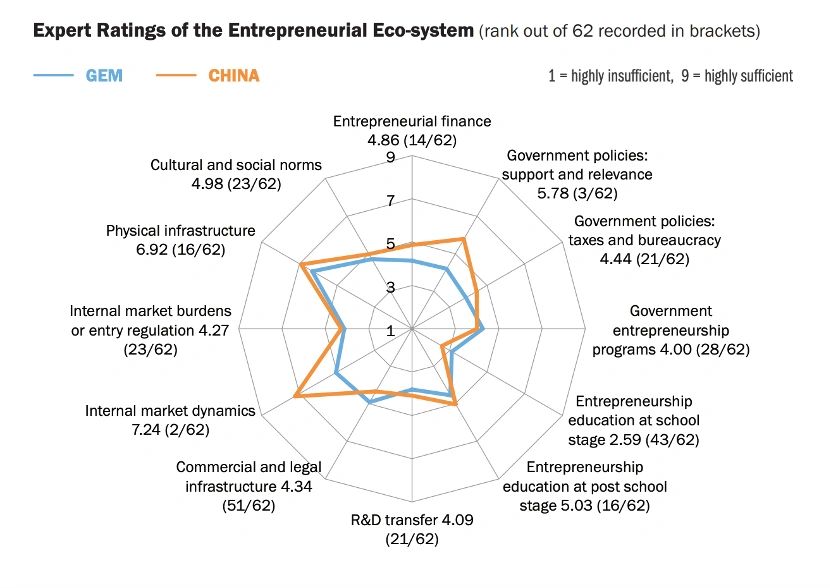
Although not offering an explicit ranking, the World Economic Forum on entrepreneurship looked at countries along three variables: “early-stage entrepreneurial activity,” the proportion of “ambitious” entrepreneurs (defined by intent to create 6+ jobs), and the proportion of “innovative” entrepreneurs. The WEF concluded that “China stands alone in a sub-cluster group with high early-stage entrepreneurial activity, above-average ambitious activity and slightly below average innovative activity.”45Leveraging Entrepreneurial Ambition and Innovation: A Global Perspective on Entrepreneurship, Competitiveness and Development. 2015. GEM & World Economic Forum. https://www.gemconsortium.org/file/open?fileId=49141 The following section dives deeper into the minutiae.
Socio-cultural
Status and Other Variables
Kai-Fu Lee memorably begins his book ‘AI Superpowers’ by describing China’s entrepreneurs as “conquering the most cutthroat competitive environment on the planet.” Chinese entrepreneurs, he goes on, are like “gladiators in the Coliseum” who are battling opponents who “have no scruples.”46Kai Fu Lee. AI Superpowers. 2018. Pp 15 As I will show, patronage and favoritism invalidate much of Lee’s competitivity assertions. Yet, it is plausible that the combination of lax intellectual property enforcement and a competitive socio-cultural environment stimulate entrepreneurialism.47Heidi L. Williams. Intellectual Property Rights and Innovation: Evidence from the Human Genome. 2013. Journal of Political Economy https://www.journals.uchicago.edu/doi/10.1086/669706
More importantly, though, a GEM and WEF report confirms the presence of a crucial incentivization factor in China’s entrepreneurial ecosystem: social status and prestige for entrepreneurs. Entrepreneurship is accorded a high status in Chinese society, ranking the country 13th out of the 60 countries ranked. Further, a high percentage of entrepreneurs are very ambitious and expect to create 6+ jobs, ranking China 5th out of 60.48Leveraging Entrepreneurial Ambition and Innovation: A Global Perspective on Entrepreneurship, Competitiveness and Development. 2015. GEM & World Economic Forum. https://www.gemconsortium.org/file/open?fileId=49141
While entrepreneurialism appears to be strongly socially incentivized in many parts of China, joining the Party bureaucracy can often be more socially and economically remunerative.49Members tend to “join because becoming a Party member is a resume booster that can get a Chinese citizen promoted more rapidly, especially within government or state-owned enterprises.” Lotus Yuen. Communist Party Membership Is Still the Ultimate Resume Booster. 2013. The Atlantic. https://www.theatlantic.com/china/archive/2013/05/communist-party-membership-is-still-the-ultimate-resume-booster/276347/ The high status granted to political operatives may direct people away from innovative economic entrepreneurship. China, additionally, suffers from two negative socio-cultural factors: Chinese people tend to have negative self-perceptions about their ability to be entrepreneurs, ranking China 58th out of 60 countries, and a focus on high-stakes test taking from a young age appears to discourage creativity.50Weihua Niu & Robert Sternberg. Societal and School Influences on Student Creativity: The Case of China. 2013_. Psychology in the Schools. https://onlinelibrary.wiley.com/doi/abs/10.1002/pits.10072 and Education In China: How The Gaokao Exam Shapes Chinese Students’ Lives And Futures. 2019. _SupChina. https://supchina.com/2019/08/14/education-in-china-how-the-gaokao-exam-shapes-chinese-students-lives-and-futures/ Though, as Lee asserts in his book, while some socio-cultural and political factors may work against China becoming a truly innovative society, Chinese entrepreneurs may yet thrive if we are indeed in an ‘age of implementation’ rather than ‘discovery.’51Kai Fu Lee. AI Superpowers. Pp 13-14
Social Networks in China
An important socio-cultural factor in China is guanxi. In Chinese society, “guanxi ties have three qualities: (1) familiarity, intimacy (2) trust, and (3) mutual obligation.”52Ronald Burt, Yanjie Bian, Sonja Opper. More or less guanxi: Trust is 60% network context, 10% individual difference. 2018. Social Networks. https://www.sciencedirect.com/science/article/pii/S0378873317302794 As mentioned earlier, guanxi based ties in China tend be strong form.53Ibid. Indeed, professional networks in China “are less distinguished by distinct roles and structural homophily (such as joint education, military service, or co-membership in business or party organizations) than by instances of significant help in the history of a long-standing relationship—which, of course, can include relationships with members of one’s family, or with close friends from school.” Guanxi relationships may ultimately be of particular importance in China for private firms and entrepreneurs, as underdeveloped legal institutions necessitate such relationships.54Katherine Xin & Jone Pearce. Guanxi: Connections As Substitutes for Formal Institutional Support. 2017. Academy of Management Journal. https://journals.aom.org/doi/abs/10.5465/257072
Chinese entrepreneurs have both weak and strong ties, to be sure. Yet the preponderance of the latter via guanxi indicates well-placed entrepreneurs are likely to have an easier time ‘legitimating’ themselves and obtaining resources from institutional sources, but, due to a dearth of weak ties, a harder time finding and exploiting all available opportunities.55Tom Elfring & Willem Hulsink. Networks in Entrepreneurship: The Case of High-technology Firms. 2003. Small Business Economics. https://knsecure.com/Resources/Articles/Networks%20in%20Entrepreneurship-The%20Case%20of%20High-technology%20Firms.pdf Within a heavily patronage-based Leninist political system,56Xin Sun. Power Sharing, Patronage, and Land Institutions in China. 2018. Problems of Post-Communism. https://www.tandfonline.com/doi/full/10.1080/10758216.2018.1489205 though, a guanxi based network may augment political favoritism and rent-seeking.
Institutional Environment
Geographic Clustering
The CCP has explicitly pursued a policy of geographic tech clustering. A key mechanism of this has been the ‘Torch’ program run via the Ministry of Science and Technology (MOST), which has established over 100 Science and Technology Industrial Parks (STIPs) since 1995 (there are currently over 156). By many measures, the STIPs appear successful: they have registered 1.85 million companies, “of which 49,000 were officially designated high-tech enterprises,” and generated 1.7 trillion yuan in taxes.57Damien Ma. Torchbearer: Igniting Innovation in China’s Tech Clusters. 2019. Macro Polo. https://macropolo.org/china-torch-program-innovation/ Li Keqiang’s ‘double innovation’ strategy similarly outlines many policy initiatives to support SMEs and entrepreneurship, of which ‘double innovation parks’ are a key component. Damien Ma summarizes the Torch program well: it “is just one example of how China has played to its strength—deploying government resources to accelerate clustering effects and hoping that they will pan out.”
Overall, substantial state money has flown into the two primary clusters in China, the Greater Bay Area of Shenzhen and the greater Beijing-Tianjin-Hubei area, or Jing-Jin-Ji.58Janet Pau, Jill Baker, and Nina Houston. Shenzhen, Beijing, and Silicon Valley: Chinese and U.S. Technology Clusters Vie for Supremacy. Asia Business Council. https://www.asiabusinesscouncil.org/docs/Clusters.pdf As mentioned in the literature review section, the evidence in favor of state support for clustering is ambiguous. Nonetheless, isomorphic mimicry could expedite entrepreneurial progress. The unique combination of geographic clustering and strong social ties (guanxi) in China may also facilitate a ‘social structure of cooperation’ conducive to entrepreneurship even in the absence of formal rule of law and property rights.59Sonja Opper & Victor Nee. Network effects, cooperation and entrepreneurial innovation in China. 2015. Asian Business Management. https://link.springer.com/article/10.1057/abm.2015.11
Human Capital – Educational Institutions
Research universities in the Beijing cluster, unlike in Shenzhen, played a crucial role in the area’s success. More recently, Shenzhen has been striving to establish its own research institutes.60Janet Pau, Jill Baker, and Nina Houston. Shenzhen, Beijing, and Silicon Valley: Chinese and U.S. Technology Clusters Vie for Supremacy. Asia Business Council. https://www.asiabusinesscouncil.org/docs/Clusters.pdf Chinese universities increasing their “organizational capacity for managing more conventional forms of technology transfer such as patenting and licensing.”61Wu, W. Managing and incentivizing research commercialization in Chinese Universities. J Technol Transf 35, 203–224 (2010). https://doi.org/10.1007/s10961-009-9116-4 However, university education has ample room for improvement. Chinese computer science graduates (as well as Indian and Russian) score a full standard deviation below their American peers.62Prashant Loyalka, Ou Lydia Liu, Guirong Li, Igor Chirikov, Elena Kardanova, Lin Gu, Guangming Ling, Ningning Yu, Fei Guo, Liping Ma, Shangfeng Hu, Angela Sun Johnson, Ashutosh Bhuradia, Saurabh Khanna, Isak Froumin, Jinghuan Shi, Pradeep Kumar Choudhury, Tara Beteille, Francisco Marmolejo, and Namrata Tognatta. Computer science skills across China, India, Russia, and the United States. 2019. PNAS. https://www.pnas.org/content/116/14/6732 Chinese universities also appear to substantively hamper creative thinking.63Javier Hernandez. Study Finds Chinese Students Excel in Critical Thinking. Until College. 2016. New York Times. https://www.nytimes.com/2016/07/31/world/asia/china-college-education-quality.html?_r=1 Despite the “unprecedented speed and magnitude” of university funding in China, via projects like ‘Double World-Class,’ ‘211’ and ‘985,’ the country only has 2 of the world’s top 100 universities, and only 7 of the top 200 universities, while the rushed funding is exacerbating regional and other inequalities.64On university rankings, see: Best Global Universities: China. 2020. US News and World Report. https://www.usnews.com/education/best-global-universities/china On the recent education projects, see: Charlotte Gao. A Closer Look at China’s World-Class Universities Project. 2017. The Diplomat. https://thediplomat.com/2017/09/a-closer-look-at-chinas-world-class-universities-project/. On growing inequality, see: Yan Luo, Fei Guo, Jinhuan Shi. Expansion and inequality of higher education in China: how likely would Chinese poor students get to success? 2018. Higher Education Research & Development. https://www.tandfonline.com/doi/full/10.1080/07294360.2018.1474856?src=recsys
What’s more, China’s primary and secondary education system is in dire need of improvement. As of 2015, only 36% of 25-34-year-olds in China had a high school education.65Niall McCarthy. Where Do People Fail To Attain A High School Qualification? 2015. Statista. https://www.statista.com/chart/4104/where-do-people-fail-to-attain-a-high-school-qualification/ More poignantly, bifurcation of rural and urban primary education quality and the phenomena of ‘left behind’ children of migrant workers are undermining the development of human potential.66See: Dexter Roberts.The Myth of Chinese Capitalism. 2020 and Unequal Primary Education Opportunities in Teng Margaret Fu. Rural and Urban China. 2005. China Perspectives. https://journals.openedition.org/chinaperspectives/500 The World Bank’s Human Capital Project ranks China 46th out of 157 countries in overall human capital development.67Simply, the HCI index is calculated via a weighting and indexing mechanism that takes into account survival rates, schooling duration and quality, and health attributes. The Human Capital Project. 2018. World Bank Group. https://openknowledge.worldbank.org/bitstream/handle/10986/30498/33252.pdf?sequence=5&isAllowed=y One notable outcome of the lax development is a high rate of entrepreneurship out of necessity, as opposed to motivation, in China.68“China’s entrepreneurial activity is still high but declining, which reflects that much of the previous entrepreneurship was necessity-based and a business-cycle effect.” The Entrepreneurial Challenge. 2016. Global Entrepreneurship Monitor. https://www.gemconsortium.org/report/the-entrepreneurial-challenge If the CCP wants to increase its country’s innovation capacity, it would have to increase human capital, equitable allocation of educational resources, and work to include hundreds of millions of rural and migrant workers.
Financing & Capital Markets
Venture capital increasingly plays an important role in supporting companies in China.69Dr. Lin Lin. Engineering A Venture Capital Market; The Case of China. 2015. National University of Singapore. https://www.law.uchicago.edu/files/file/manuscript_6_july2016_lin_lin.pdf and Huatao Peng, Yang Liu. How government subsidies promote the growth of entrepreneurial companies in clean energy industry: An empirical study in China. 2018 Journal of Cleaner Production. https://www.sciencedirect.com/science/article/pii/S095965261830787X As is typical of VC funding environments, a subset of highly visible firms attract the most capital (China even has more ‘unicorns’ than the US, see figure below). 70Ariel Lu, Jessie Chen and Frank Fu. China’s Venture Capital (VC): Bigger than Silicon Valley’s? 2018. Insead. https://www.insead.edu/sites/default/files/assets/dept/centres/gpei/docs/insead-student-china-venture-capital-apr-2018.pdf One recent study, looking at the 2004 liquidity shock from the founding of the Shenzhen Small and Medium Enterprises Board (SME), found that “the creation of the SME Board has not necessarily increased entrepreneurial activity, but that it has increased VC investment in China.”71Bo Liu, Jerry Cao, Sofia Johan, Tiecheng Leng. The real effect of liquidity provision on entrepreneurial financing: evidence from a natural experiment in China. 2017. The European Journal of Finance. https://www.tandfonline.com/doi/full/10.1080/1351847X.2017.1307771 Given the rapidity of funding growth in China in recent years, concerns over valuations seem justified.72Peter Elstrom. China’s Venture Capital Boom Shows Signs of Turning Into a Bust. 2019. Bloomberg. https://www.bloomberg.com/news/articles/2019-07-09/china-s-venture-capital-boom-shows-signs-of-turning-into-a-bust?sref=DUuD2uV0 Meanwhile, despite ample VC funding, most entrepreneurs rely on their closed networks (guanxi) for capital, while only a select group of male college educated insiders have access to bank loans or VC.73Jianwen Liao, Harold Welsch, and David Pistrui. Patterns of Venturing Financing: The Case of Chinese Entrepreneurs. 2003. The Journal of Entrepreneurial Finance. https://digitalcommons.pepperdine.edu/cgi/viewcontent.cgi?article=1105&context=jef
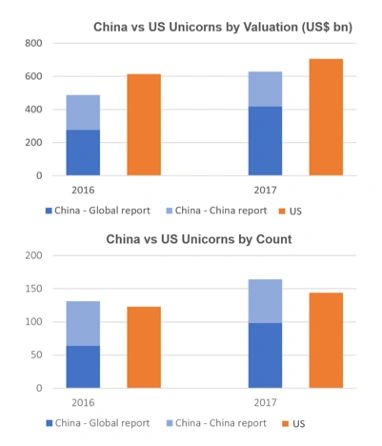
Figure 1: Venture Capital & Unicorns in China
Indeed, studies of Chinese capital markets routinely note their inefficient allocation to private sector entrepreneurs. Despite China’s massive banking system, a core problem “faced by Chinese entrepreneurs has been their limited access to credit. It is estimated that very few of China’s millions of SMEs obtain formal financing.”74David Ahlstrom & Zhujun Ding. Entrepreneurship in China; An overview. 2014. International Small Business Journal. http://sites.utexas.edu/chinaecon/files/2015/06/Scholarly_Entrepreneurship-in-China_2014-1.pdf Evidence indicates that despite ample subsidization and expenditures, the incentive system is such that banks principally allocate credit based upon moral hazard induced credibility signals and patronage.75“We find that government subsidies, especially the non-tax-based subsidies, lead to lower cost of debt, because debt investors view non-tax-based subsidies as implicit government guarantees, which reduce the probability of default by the borrowers.” Chu Yeong Lim, Jiwei Wang, Cheng Zeng. China’s “Mercantilist” government subsidies, the cost of debt and firm performance. Journal of Banking and Finance. https://ink.library.smu.edu.sg/cgi/viewcontent.cgi?article=2793&context=soa_research For sources of credibility: Logan Wright and Daniel Rosen. Credit and Credibility: Risks to China’s Economic Resilience. 2018. Center for Strategic and International Studies. https://www.csis.org/analysis/credit-and-credibility-risks-chinas-economic-resilience Firm’s debt-ratios are highly correlated with their tangible assets (especially property) and their size “while negatively correlated with profitability and growth opportunities”.76Yan Dong, Zhentao Liu, Zhe Shen, & Qian Sun. Political Patronage and Capital Structure in China. 2014. Emerging Markets Finance and Trade. https://www.tandfonline.com/doi/abs/10.2753/REE1540-496X500307?src=recsys Overall, the “central bank often releases liquidity into the banking system in the hope that banks will offer more to small businesses and rural households, but credit often flows into the pockets of state-owned enterprises, local government financing vehicles, as well as those determined to speculate.”77He Huifeng. Coronavirus: China’s bank loans intended to help small businesses are actually fanning Shenzhen’s property bubble. 2020. South China Morning Post. https://www.scmp.com/economy/china-economy/article/3081162/coronavirus-chinas-bank-loans-intended-help-small-businesses The Leninist focus on economic stability (esp. housing prices) and control over the ‘commanding heights’ of the economy helps instantiate an incentive system, laden with moral hazard, that funnels capital to well-connected entities while underserving unconnected entrepreneurs.
Governance and the Business Environment: Laws, Regulations, and the Rules of the Road
Over the last two decades, the entrepreneurial governance environment in China has improved in several ways. The CCP has improved contract enforcement, enabled ample access to broadband and electricity, and greatly diminished the overall time it takes to start a business.78“Doing Business 2020 – Economy Profile China,” Doingbusiness.org, https://www.doingbusiness.org/content/dam/doingBusiness/country/c/china/CHN.pdf A complicating factor limiting improvements in other governance indicators is the complex and overlapping spatial, administrative, and bureaucratic tiao-kuai (条块) relationships within the Leninist political system. The CCP promulgates many regulations at many levels, making it one of the most highly regulated economies in the world.79“2020 Index of Economic Freedom – China,” Heritage.org, https://www.heritage.org/index/country/china However, many regulations in China are simply not enforced, or enforced selectively. Corruption, as a result, abounds, and likely serves to ‘grease the wheels’ of oft over-worked and underpaid bureaucrats charged with enforcing conflicting mandates.80“China,” Transparency International, https://www.transparency.org/country/CHN
While high levels of regulation are often associated with a negative impact on entrepreneurialism, what makes the situation for entrepreneurs in China especially difficult is arbitrary enforcement that often disproportionately effects private sector and politically unconnected actors. Guanxi networks based upon “private detailed contracting, while important, do not render law and regulation entirely unnecessary, contrary to the Coasian view,” and may in fact exacerbate the unequal treatment connected and unconnected actors receive in China’s Leninist system.81Rajarishi Nahata, Sonali Hazarika, and Kishora Tandon. “Success in Global Venture Capital Investing: Do Institutional and Cultural Differences Matter?” Journal of Financial and Quantitative Analysis. 2014. https://www.cambridge.org/core/journals/journal-of-financial-and-quantitative-analysis/article/success-in-global-venture-capital-investing-do-institutional-and-cultural-differences-matter/2B0B630228DE989F093E42398F52E3B1 While entrepreneurs have been shown to succeed best in environments characterized by clear rules of the game that allow for maximal participation, China’s government continues to rank poorly in regulatory quality, control of corruption, and rule of law (see figure below). And unconnected actors disadvantaged by the Party continue to have little recourse.
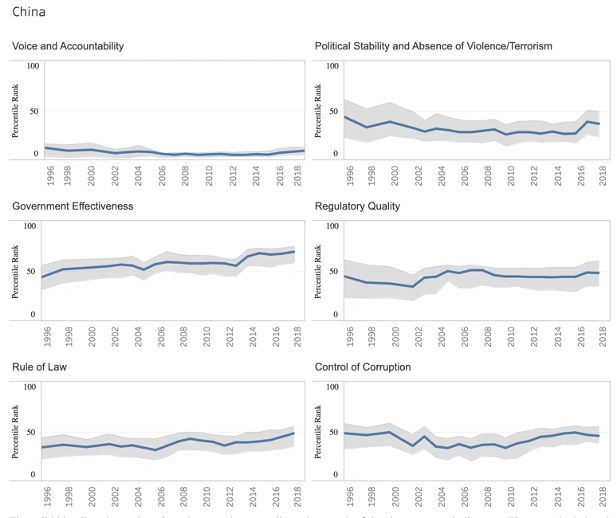
Figure 2: World Bank Worldwide Governance Indicators 2018
Overall
On several scores, such as prestige for entrepreneurial endeavor, government support for geographic clusters and educational institutions, and several aspects of governance, the entrepreneurial ecosystem in China is strong or improving. Yet other factors such as low human capital, limited access to financing, and capricious rules of the road work to undermine entrepreneurship in China. Overall, one overarching point is particularly worth highlighting: incentives and resources are highly skewed against unconnected actors in China. In particular, the evidence martialed here reflects that non-urban, non-Party members in China face steep obstacles to entrepreneurship.
The Evolving Entrepreneurial Ecosystem
Ultimately, incentives, in the form payoffs in wealth, power or prestige, matter for entrepreneurs. As Baumol argued, given entrepreneurs are always with us, focusing on the “allocation of entrepreneurship” between its productive and rent-seeking variants is crucial to understanding the nature and character of the entrepreneurship ecosystem. In China, as its political system routinely cycles through periods of loosening and tightening (放收)82David Shambaugh, Brad Carson. “Jaw-Jaw-Vicious Cycle: The Opening and Closing of Chinese Politics,” War on The Rocks. 2018. https://warontherocks.com/2018/12/jaw-jaw-vicious-cycle-the-opening-and-closing-of-chinese-politics/, so too does the entrepreneurial ecosystem appear to cycle between innovative and rent-seeking periods.
Under Xi, would-be innovative entrepreneurs face growing countervailing incentivizes in two important ways. First, given the Leninist resurgence Xi is engineering, the wealth, power, and prestige one accrues by joining the Party bureaucracy is growing, and may disincentivize ambitious entrepreneurs from pursuing innovative endeavors.83In 2016, Heilmann states that “Xi has reasserted Leninist-style party control over the economy, society, media and the security apparatus.” Since then, Xi’s Leninist-style resurgence has only deepened. Sebastian Heilmann. Xi Jinping’s China Leninism Upgraded: Xi Jinping’s Authoritarian Innovations. China Economic Quarterly 20 (4), Dec. 2016, GavekalDragonomics, 15-22. Rather, their payoffs are often higher by joining the ‘entrepreneurial state’ (重政轻商).84Jane Zheng. “The ‘Entrepreneurial State’ in ‘Creative Industry Cluster’ Development in Shanghai,” Journal of Urban Affairs (Vol. 32, Issue 2), November 30, 2016, https://www.tandfonline.com/doi/full/10.1111/j.1467-9906.2010.00498.x And second, government patronage and poor regulatory quality often results in otherwise productive entrepreneurs choosing to allocate entrepreneurial resources toward rent-seeking. For example, a recent study of Chinese tech entrepreneurs has found that, across measures of firms’ patents, R&D, and total factor productivity, “venture capitalists and entrepreneurs’ social capital impedes, rather than facilitates their firms’ technological innovation.” The authors further conclude that the CCP should “put more efforts [toward] creating a more efficient institutional environment… so that guanxi and social capital becomes less important and thus less likely to divert firms’ long-deserved attention to technological innovation.”85Zhenzhong Ma, Lei Wang, Keith Cheung. “The Paradox of Social Capital in China: Venture Capitalists and Entrepreneurs’ Social Ties and Public Listed Firms’ Technological Innovation Performance,” Asian Journal of Technology Innovation (Vol. 26, Issue 3), November 19, 2018, https://www.tandfonline.com/doi/full/10.1080/19761597.2018.1548288
As in imperial China, where the “most substantial rewards in wealth and prestige [were available] for those who climbed the ladder of imperial examinations, which were heavily devoted to subjects such as Confucian philosophy and calligraphy,” so today are those resources most available for those who climb the Party hierarchy. Between 20-30% of elite students time is still spent studying Marxism Leninism, while up to 70% of entrepreneurs time is spent schmoozing with cadres and high-ranking officials.86Michael Beckley. Unrivaled: Why America Will Remain the World’s Sole Superpower. 2018. pp 42 As Xi pioneers a resurgence in Leninism and state control, the importance of political entrepreneurialism is liable to increase, and therein divert resources away from innovative entrepreneurial endeavor.87For the incentives to appropriate state resources that is baked into the Party, see: https://www.ft.com/content/8309863e-ab39-11e6-9cb3-bb8207902122 On the revival of Marxism-Leninism, see: https://www.washingtonpost.com/news/global-opinions/wp/2017/10/16/xi-jinpings-quest-to-revive-stalins-communist-ideology/ and https://www.ft.com/content/766d2a42-419d-11e8-803a-295c97e6fd0b In imperial China, “as a result of recurrent intervention by the state to curtail the liberty and take over any accumulated advantages the merchant class had managed to gain for itself, ‘the merchant’s ambition turned to becoming a scholar-official and investing his profits in land.’” History, as they say, often rhymes. Today, we see the prominence of gaokao (高考), the fervent promotion of Marxism and Xi Jinping Thought, local officials profiteering from corrupt land requisitions, rampant property bubbles, and moral hazard-induced lending against property.88“In total, China’s six largest state-owned banks issued 2.53 trillion yuan (US$376.1 billion) in new personal housing mortgages in 2018, accounting for 49.4 per cent of total new loans (5.13 trillion yuan).” See more at Orange Wang, “China’s Banks Defy Beijing By Pumping Loans into Property, Despite Economic Slowdown,” South China Morning Post, April 5, 2019, https://www.scmp.com/economy/china-economy/article/3004855/chinas-banks-defy-beijing-pumping-loans-property-despite The siphoning of resources and incentives away from productive enterprise and would-be entrepreneurs is perhaps the key problem for the entrepreneurial ecosystem in China. While Xi Jinping pronounces his ambition to improve the “overall efficiency of the innovation system,”89Xuequan Mu. “Xi Urges Major Risk Prevention to Ensure Healthy Economy, Social Stability,” Xinhuanet.com, January 22, 2019, http://www.xinhuanet.com/english/2019-01/22/c_137763248.htm the Leninist system he is reinvigorating simultaneously undermines key parts of it.