History and Contemplation
A review of The Silks Roads by Peter Frankopan
Recently, my reading preference has shifted decidedly in favor of history. Why? Well, there is the trite but important reason that history allows us to avoid repeating the mistakes of the past. Definitely true, to some degree.
Another reason I have shifted to reading history, however, is to forestall the misapplication of it by others. In constructing policy or making arguments people often rely upon historical examples. Yet, there is a pandemic of selective historicity. People select from a limited range of historical examples, and generally focus disproportionately on those that help prove their point. (For this reason and more, reasoning by historical analogy, as Elliot Cohen warns us, can lead people into trouble.) My irritation at the malign use of history has prodded me to become a more informed historical observer; expanding the scope of my historical knowledge.
Thankfully, learning about history is fun! As fans of fiction often describe reading it as an exercise in getting lost in another time and place, so too is this true of reading well-written non-fiction history.
The Silk Roads by Peter Frankopan is an enticing book. The book makes sweeping claims for itself, saying it will “realign our understanding of the world” and offer a “truly revelatory history of the world.” Even the Wall Street Journal jumped on the hype train to say this book will make “you question your assumptions about the world.” Such sweeping and grandiose claims might elevate one’s expectations to such an extent that disappointment would seem inevitable. I dare say, however, that even after finishing this tome I was not in the least disappointed. Frankopan takes you on an edifying journey that truly enriches the reader. Indeed, as a product of a West-centric high-school and college system, this book was a beautiful resource (and served as a much-needed updating-mechanism).
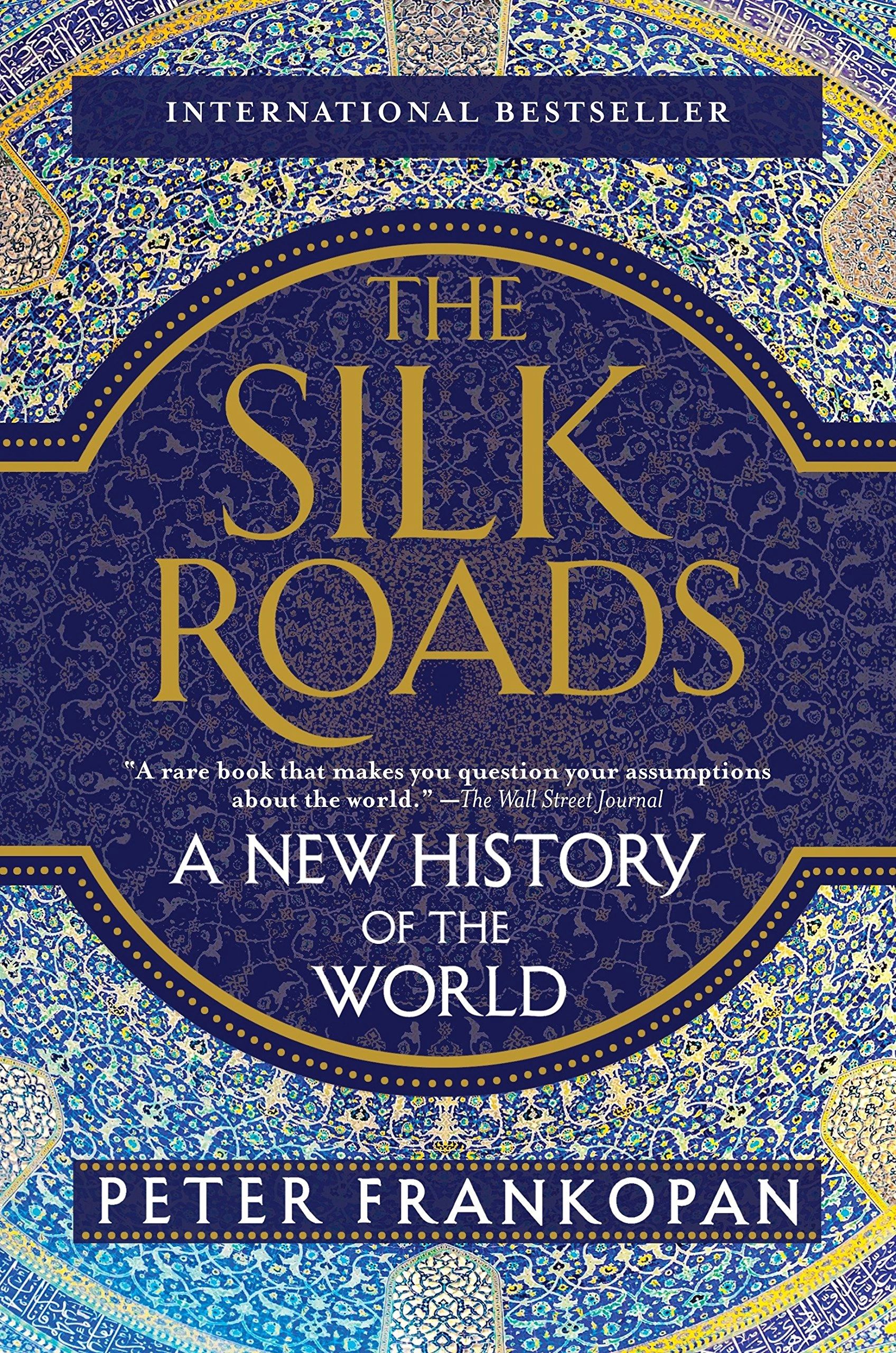
If one were to judge this book by its cover, one would still not be disappointed. The jacket properly implores the reader to indulge in the book’s contents: adorned by the deep-azure, lapis lazuli color and intricate patchwork design of the Dome of Imam Mosque in Isfahan, Iran, the book beckons the reader in. It simultaneously sets the readers expectations by capturing the theme of the book well: a beautiful and magisterial tale of the civilizations that have been at the crossroads of the worlds, and that have themselves become crossroads civilizations.
Given the nature of the book, any review/summary of it can be of only limited utility. The true value of the book is to be found in the long-hours of sitting quietly with it and contemplating in the mind’s eye the sweeping arc of real-world history this book documents. Along the way one is stunned by intricate details of historical events, left awestruck by the ingenuity of our forebears, struck with unease at the oft-expressed brutality of humanity, and made to laugh at unexpected things.
I want to a highlight a few interesting things I learned to back up the above.
In an early chapter entitled “The Slave Road” (the structure of the book is chronological, but crafted such that each chapter has a road-based theme, such as ‘The Road of Gold’ or ‘The Road to Revolution) we learn of the central role the slave trade played in medieval Europe (c700-1000). Historical records and archeology showed that goods from across the world poured into Europe at this time, in exchange almost exclusively for human bodies. We learn that the Viking Rus were in fact not mindless marauders, but rather ruthless enslavers. Indeed, so many slaves were captured by the Rus from Eastern Europe that the etymological origin of their ethnic name (Slavic) derives from the word slave. Jarringly, we also learn that the wind at the back of the sails of the merchant-marine city states of Italy came from the slave trade. As Frankopan puts it: “the spark for Venice’s growth came from its willingness to sell future generations into captivity.” Humans were sold from the unproductive and poor parts of the world (esp. Europe and parts of Africa below Egypt) into the productive wealthy parts of the world (esp. Abbasid Caliphate / Islamic world / Central Asia). It may surprise you to learn, as it did me, that the word “Ciao” does not mean “hello”; it means “I am your slave.” Before the West was importing slaves to the new world, the East was importing slaves into the old.
We can skip the interesting yet unspeakably bloody rise of the Mongols and the roads of trade and ultimately illness (bubonic plague, originating like the coronavirus from within China, would sweep across the world and reach Europe wherein it killed 30-60% of Europe’s population) they erected.
However, we should stop to reconsider, as Frankopan helps us to do, the rise of Europe following this devastating event as one fundamentally oriented around the East. The rise of first the Italian city states, then Portugal, then Spain, and then the Netherlands and England should be thought of as a brutal intra-European competition to benefit from the wealth of the East. The rise of these nations as powers was largely a side-effect of their increasing competition with one another for the ability to control trade with and exploit the resources of the far more developed and wealthy powers in the East (such as Siam, India, and China). Competition over access to the East made the West what it is. And, as is well known, the ‘new world’ of North and South America, responsible for so much of Europe’s wealth (unspeakable riches, mostly in the form of gold and silver, were pilfered from the Incans Mayans and Aztecs and brought back to Europe, esp. Spain) was ultimately due to the European desire to trade with India.
Once in the modern era, Frankopan helps deliver what was to me one of the most helpful correctives to conventional wisdom in the entire book. It is best explained in Frankopan’s own words:
“That Britain represented a threat to Germany—and vice versa—was, however, something of a red herring. Although modern historians talk insistently about the desire of the former to contain the latter, the jigsaw of competition across Europe was complex and multi-faceted. By 1918, the real causes of the conflict had become obscured, as a distorting emphasis was placed on the naval race that saw expenditure on shipbuilding spiral upwards; on aggressive attitudes behind the scenes demanding war; and on the blind bloodlust of the Kaiser and his generals as they sought to provoke a war in continental Europe. The reality of the story was very different Although the days that followed the assassination of Franz Ferdinand saw a series of misunderstandings, discussions, ultimata and permutations that would be all but impossible to recreate, the seeds of war grew out of changes and developments located many thousands of miles away. Russia’s rising ambition and the progress it was making in Persia, Central Asia and the Far East put pressure on Britain’s position overseas, resulting in the fossilization of alliances in Europe. All that stood in the way of further erosion of the enviable platform that Britain had built over the previous centuries was a series of mutual guarantees designed above all to keep Russia, the master-in-waiting, tied up.”
The chapter “The Road to War” convincingly demonstrates the veracity of the claim that Britain’s ultimate alignment with Russia in World War 1 was as much about its colonies in the Far East (especially in Iran and India) as anything else. Frankopan exposes first-hand correspondences from British civil servants demonstrating the overwhelming unease at Russia’s growing ability to cut-off British access to its colonial resource base (already struggling to keep control in these places with its mere thousands of service men). Without its colonies Britain was at risk of returning to a small backwater, a price it was afraid to accept. Thus did it prioritize relations with the brutal and autocratic Russian state over its somewhat more natural ally Germany. Frankopan again:
“And so, like a nightmarish game of chess where all possible moves are bad ones, the world went to war. As the initial euphoria and jingoism gave way to tragedy and horror on an unimaginable scale, a narrative developed that reshaped the past, and cast the confrontation in terms of a struggle between Germany and the Allies, a debate which has centered on the relative culpability of the former and the heroism of the latter.”
But as Queen Victoria foreshadowed decades earlier, it all ultimately came down to “‘a question of Russian or British supremacy in the world.’”
Finally, as the tale of history winds into our contemporary period, Frankopan highlights for the readers the uncomfortable situation facing the United States; for the US has inherited a world from the western powers characterized largely by imperialism and conflict. Uneasily, vaunted US values of liberalism and democracy (respect for the rule of law and for the people of the world) run up against the cold reality of interests. Frankopan lays bare the at times heroic differences between America and its more brazenly selfish and despicable British and French counterparts, such as American intervention during the Suez Crisis that effectively stopped Israel, British, and French coalition forces from militarily intervening against Nasser as he nationalized the Suez Canal (something that remained a colonial possession only accruing return to Britain right to the end). However, we also encounter a history of US actions running headlong against stated US values, as if politicians blinded by self-righteous ideas of American exceptionalism believed that the means would always justify the ends. As such we see ham-handed responses in the Iran-Iraq war, where the US first betrayed the Kurds (not the first time), supported at different times both Iran and Iraq, and contributed to untold death and destruction simply because it served our interests vis-à-vis the Soviets to ensure that no other power (whether Iran or Iraq as a proxy of the Soviets) assembled too much power in the region. Such a historical assessment is important, considering that our reputation was further undermined as a benevolent or trustworthy world leader by Presidents from Bill Clinton (savage response to Kenya and Tanzania embassy bombings), George Bush (the lies and fiasco of the Iraq invasion), and Barrack Obama (drone strikes). No other place besides the Middle East puts in such stark relief the trouble America has faced with reconciling our interests and our values. As our track record shows, far too often we speak righteously as the self-proclaimed democratic leader of the free world while acting like a self-interested imperial power.
Ultimately Frankopan’s book is a treasure trove of information and a repository of mind-blowing facts. It takes you a on wild ride of world history via one riveting story after another, with the common characteristic that so many world historical events can be profitably seen via recourse to their relation with the center of the world, where untold numbers of civilizations have met and will meet at a crossroads in Eurasia. He does a commendable job of providing objective historical analysis in such a way that you truly feel as if you are seeing historical events themselves unfurl. Historical edification like this provides us all with a base of knowledge, a sort of toolset, from which we can understand our own world a little bit more clearly. One cannot appreciate where one stands without appreciating where one has come from. History is a powerful tool. And it is frankly fun to learn about.