Founding Brothers
A review of Founding Brothers by Joseph J, Ellis
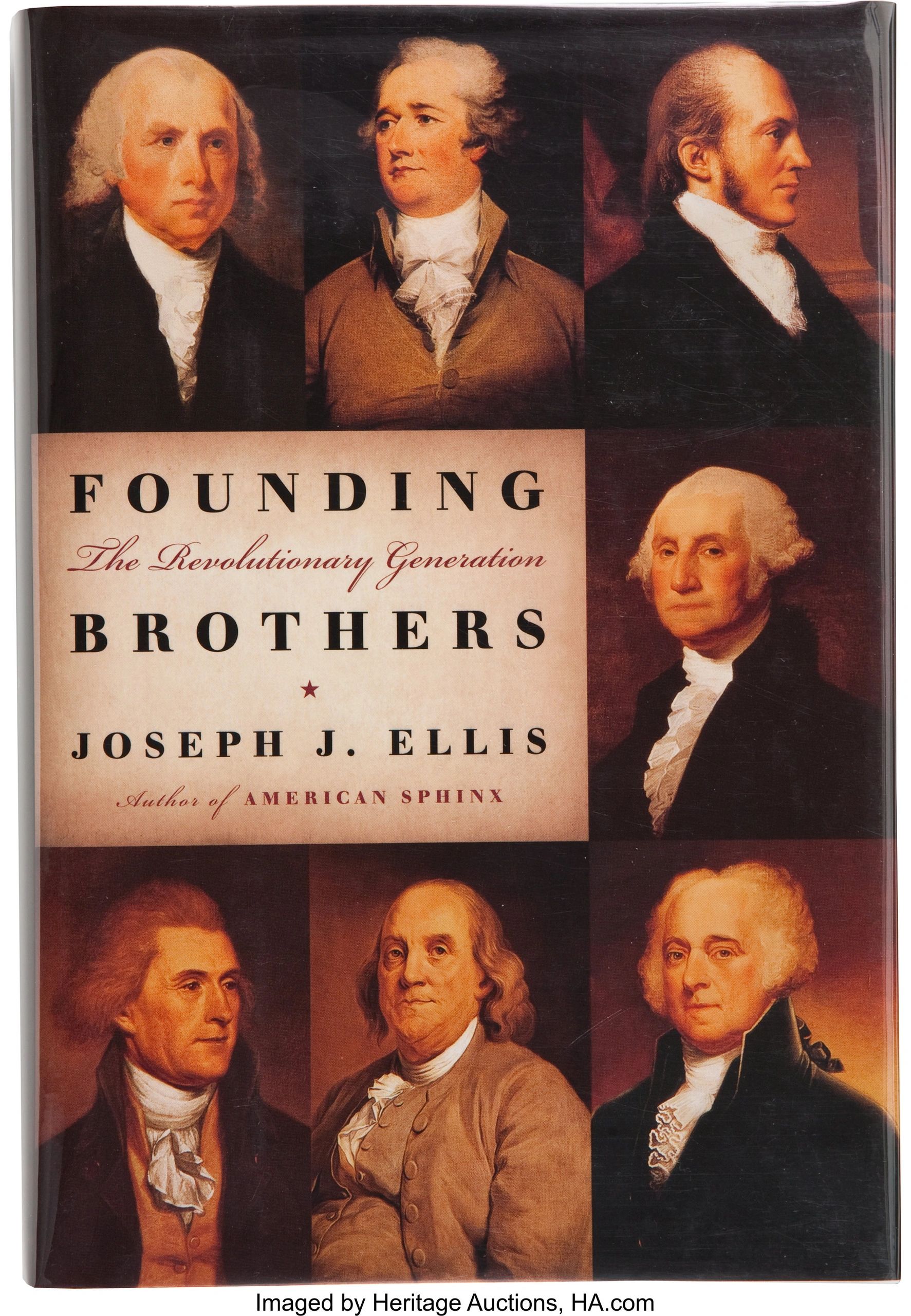
Founding Brothers offers an incisive education in early American history. In truth, this book could have extended to well over 1000 pages and still been enrapturing. Thankfully for modern readers such as myself who are often short on time, Ellis’ wisdom has been potently distilled into a mere 250 pages. The nuance captured within this book speaks to the author’s intimate familiarity with the book’s subjects.
For its subjects, Ellis’s book takes on the pantheon of America’s revolutionary generation. However, Ellis chooses to focus on what he considers to be the seven most prominent: Aaron Burr, Alexander Hamilton, James Madison, Thomas Jefferson, John Adams, Benjamin Franklin, and George Washington. Within the bindings these men come alive via superb storytelling. The books structure lends itself well to the author’s mission: 6 chapters, each telling the richly-detailed story of a particular event of importance during the revolutionary era (i.e. the 1770s-1820s).
What makes this book an incredible resource is, first, found in the ability of the author to tease out the parallels between contemporary American society and our founding era. Indeed, the poignant point is that so many debates that undergird the fabric of America were not only left unresolved during the foundational era of America, but that room for ambiguity was intentionally baked into the constitutional pie, and where ambiguity would not suffice, enforced silence reigned. The two issues herein referenced are, respectively, federal vs. state power and slavery – two issues that threatened to destroy the Union at the outset and beyond.
The book’s true majesty, however, is its power to bring to life the characters of the time. The book’s opening chapter, ‘The Duel’, exposes the discordant personalities of both Burr and Hamilton as well as the social milieu they found themselves in. Following that, ‘The Dinner’ discusses the lesser known of the foundational compromises in the Constitution, what Ellis calls the ‘compromise pf 1790,’ wherein Jefferson hosted Madison and Hamilton at his home in New York, and the latter two formalized a deal that would see Hamilton’s (then the first Treasury Secretary) desired federal assumption of state debts in exchange for facilitating agreement on the country’s capitol being permanently established on the Potomac in what is now DC (after 10 years of temporary residence in Philadelphia). To quote Ellis’ masterful telling:
“The agreement reached over Jefferson’s dinner table provides a momentary exposure of the sharp differences dividing the leadership of the revolutionary generation: sectional versus national allegiance; agrarian versus commercial economic priorities; diffusion versus consolidation as social ideals; an impotent versus a potent federal government. The compromise reached did not resolve these conflicts so much as prevent them from exploding when the newly created government was so vulnerable; it bought time during which the debate could continue.” Pg 78
Meanwhile, the chapter entitled ‘The Silence’ deciphered the founding fathers inability, or unwillingness, to address the issue of slavery head on. Indeed slavery became an unmentionable on both sides, to the country’s everlasting shame, as the issue was so explosive and divisive that, if lingered on, almost certainly would have prevented the formation of the Union. Whether or not the formation and preservation of the Union was worth the price of allowing slavery to continue for 100 more years (and the blood and shame therein associated) is still debated in certain quarters.
The final three chapters, roughly half of the book, focus mainly on the three men most deeply analyzed by Ellis: Washington, Adams, and Jefferson. Chapter four, ‘The Farewell’ analyzes the situation surrounding Washington’s decision to step down voluntarily from power in 1796 (most memorable for me: the phrase “avoiding foreign entanglements”, while spelled out in Washington’s Farewell Address, which was itself not actually an address but rather a printed essay for publication, were not authored by Washington but rather written later by Jefferson). The final two chapters chronicle the rise, fall, and rise again of the generation’s most memorable relationship: that between Jefferson and Adams.
A round up on each of the founding brothers:
Burr is depicted, both by Ellis but primarily by primary sources and quotations directly from the other founding fathers, as an egotistical and highly ambitious individual. In an era when ‘disinterestedness,’ deference, and virtue were prized, Burr seems to have stood out as a political character more similar to our own times (reminiscent of one Donald J Trump). Ellis’s take that stuck with me most was that Burr’s own political life was killed (due to popular disdain for him) at the same moment he killed Alexander Hamilton in the infamous duel in Weehawken, New Jersey.
Hamilton is portrayed, in contrast to Adams, as the more radical proponent of the Federalist position of strong central government. A quasi-alliance exists between Washington, Hamilton, and Adams as non-Virginian (except for Washington) proponents of a strong Federal government. His financial proposals, such as assumption of state debts and creation of a federal bank, while threatening and ominous to many anti-federalists, come across to moderns as eminently reasonable. However, we also see Hamilton’s descent into an over exuberant string-puller, working behind the scenes of the Adam’s presidency to advocate for a large standing army, which it appears he deigned to use for his own revolutionary purposes, not dissimilar to what was contemporaneously occurring in France. As Adam’s disparagingly remarked: he was as ambitious as Napoleon but without the courage.
Madison is the political player of the generation, the most astute wheeler and dealer. His diminutive and unthreatening stature allowed him to thrive working behind the scenes, sorting through the minutiae and forming alliances to get things accomplished. Often seen as the ground-level accomplice to Jefferson, Madison’s most notable contribution is transcending the parochial Virginia interest to serve as lead author of the Federalist papers (in conjunction with Hamilton).
Franklin gets the least air time in this book, but he is regarded as sitting on the pinnacle of the American pantheon just below Washington, perhaps the only other person who could even come close to rivaling Washington’s status. Franklin was truly a renaissance man, best displayed in Ellis’ recounting of Voltaire and Franklin’s rendezvous in France.
Ellis’s expose of Washington is truly insightful. In contrast to the vaunted image most American’s have in their minds of Washington, Ellis humanizes him and allows us to see the man himself. We see that Washington was not an avid reader, like the other founding fathers, nor was he a gifted intellectual. Indeed, somewhat disparagingly, Ellis describes Washington as the quintessential hedgehog, in reference to Berlin’s famous hedgehog vs. fox dichotomy (i.e. he knew one really big thing). Yet even when humanized, Washington still stands as a man above; someone worthy of our utmost admiration. This sentiment is captured by King George III (no friend to America, obviously), who upon reflecting on Washington’s exploits at the head of the continental army, said that if Washington rejects the ‘mantle of emperor’ upon defeating the British, “he will be the greatest man in the world (pg 130).” Washington floated above political squabbles; an exemplar of the virtues most highly valued at the time, he was a true statesman dedicated to steering the nascent Union towards preservation. After willingly surrendering his commission as commander of the continental army in 1783, he repeated the performance again in 1796 after willingly stepping down as President after two terms. Washington was a political realist (in international relations, as his writings describe, he is the definition of a realist, viewing states as inherently self-interested and incapable of forming alliances that transcend anything beyond material interest), a perfect opposite to the idealistic Thomas Jefferson. It is hard to imagine America surviving as a republic with any other leader than Washington at the helm during our founding period.
Jefferson comes across rather poorly in Ellis recounting. Perhaps the most gifted writer amongst the revolutionary generation, he was also the most deluded. Indeed, Ellis finds that Jefferson was not a liar, but rather so deluded that he did not even know himself to be untruthful. A committed advocate of state’s rights, his arguments laid the groundwork for slavery. A long time friend of John Adam’s, he financed hit pieces on him during Adam’s presidency (while Jefferson was himself serving as Vice President in the administration). When confronted via letter several years later by Abigail Adams, he denied having engaged in such activity, despite the fact that the historical record is very clear that he had, which Ellis explains as a part of his reality distortion field (not dissimilar to Steve Jobs). He was a vociferous critic of Jay’s Treaty (the shrewd compromise with the British that effectively bet upon their hegemony in Europe over France), an advocate of the French revolution (describing the blood shed as necessary and perhaps a model for America), and a devoted ideologue ensconced in a romantic vision often untethered from reality. While Jefferson’s prose may have been the most beautiful and soaring, it may have been so only because he did not appreciate nuance.
Finally, Adams receives something of a historical redemption via Ellis’s recounting. Adams, although a pugnacious and quarrelsome little (5’7) fellow, was a wise, fair and shrewd individual. He had the deeply unenviable position of serving as President immediately after Washington, and was perhaps the last President to serve, not as the leader of a political party, but as the leader of a nation. He attempted to transcend the increasingly fractious partisanship of the Federalists and Republicans, even inviting Jefferson and Madison (in a show of political grace and bipartisanship) to serve as special envoys to France (which, in a show of emerging partisanship, they both rejected). This transcendence, modeled on Washington, earned him the ire of both Jefferson on the one side and Hamilton on the other. The former, an obvious state’s right advocate opposed to Adams’s federalism, makes sense. Hamilton, however, viewed Adams’ views as not radical enough, and began advocating for open revolution while surreptitiously undermining his presidency via the legislature in such a way as would almost certainly be considered treacherous today (he seemed to want to command a new army). Adams, steadied by his wife Abigail in what is certainly greatest romantic relationship in American political history, remained almost dispositionally unable to ‘pose for history’ as Ellis phrases it. Adams’s views were rarely sweeping, always critical, and deeply pragmatic. In juxtaposition to his famous pen-pal Jefferson (whom he forgave transgressing reasonable bounds of propriety only after 12 years of steely silence), Adams was unlikely to be frequently cited by future generations. He, and his prose, simply did not pose for history in the same picturesque way that Jefferson, and Jefferson’s prose, did.
Founding Fathers is ultimately a book that ought to be foundational to any American’s understanding of the history of his own country. One will see that the debates that continue to animate contemporary society also animated the generation of our founders. One will also come to see the seeming improbability of the American experiment. As Ellis himself said, “no event in American history which was so improbable at the time has seemed so inevitable in retrospect as the American Revolution.” By some luck of circumstance, a coalition of extremely virtuous men formed together to establish a country founded upon enlightenment ideals of self-governance. Although grit and darkness embedded in American history comes to light –such as slavery, the exploitation of underclasses, the lack of representation or opportunity for women– it becomes evident that somehow these old white men, this band of brothers, fought back against the seemingly overbearing forces of tyranny to establish a framework of ideals (the transcendent American dream) that might someday blossom into the true realization of Jefferson’s hopeful statement that “all men are created equal.”