Politics and Pathogens
That politics and pathogens have an interconnection is now obvious to us moderns, thanks to COVID-19. But pathogens have a long history of interconnection with politics. Viruses and bacteria have, in key ways, shaped our...
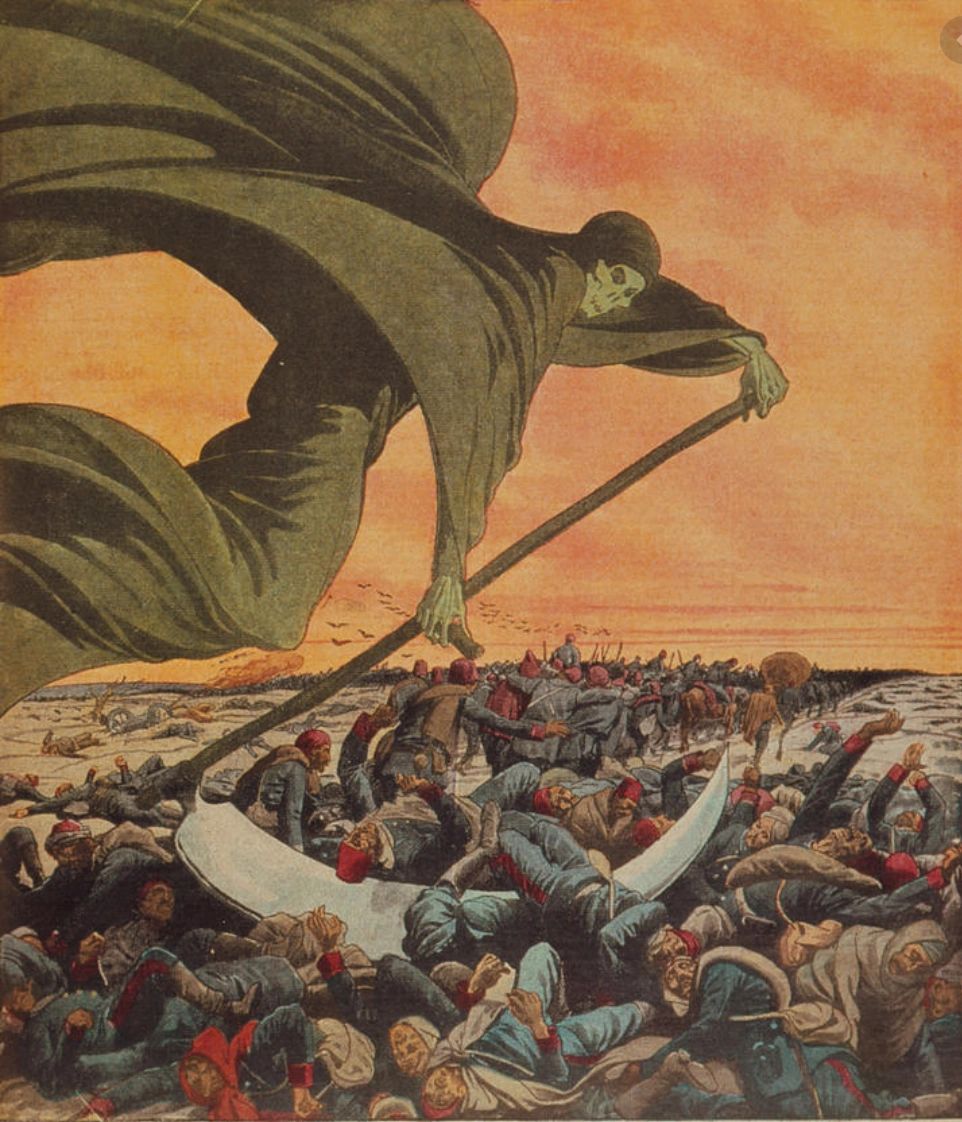
That politics and pathogens have an interconnection is now obvious to us moderns, thanks to COVID-19. But pathogens have a long history of interconnection with politics. Viruses and bacteria have, in key ways, shaped our species evolutionary trajectory, have played a role in shaping our personalities, and have impacted the nature of our political superstructures.
A recent paper titled _Pathogens and Politics: Further Evidence That Parasite Prevalence Predicts Authoritarianism_ discusses the ground-level impact of pathogens. The greater the prevalence of parasites in a locale, the study finds, the more likely authoritarian government is to emerge. This effect is mediated by changes in individual personalities: individuals, not just leaders, in places with greater pathogen prevalence tend to be more authoritarian. As the authors state:
“Why might there be a causal link between the prevalence of infectious diseases in the local ecology and an authoritarian system of governance? The hypothesis follows from an analysis of several defining characteristics of authoritarian political systems (such as institutionalized emphasis on social conformity, intolerance of dissent, and ethnocentrism) that may have implications for the spread of infectious disease. Because many disease-causing parasites are invisible, and their actions mysterious, disease control has historically depended substantially on adherence to ritualized behavioral practices that reduced infection risk [9]. Individuals who openly dissented from, or simply failed to conform to, these behavioral traditions therefore posed a health threat to self and others… At a psychological level of analysis, empirical evidence reveals that the subjective perception of infection risk causes individuals to be more conformist, to prefer conformity and obedience in others, to respond more negatively toward others who fail to conform, and to endorse more conservative socio-political attitudes… individuals who are—or who merely perceive themselves to be—more vulnerable to infection tend to endorse more xenophobic and ethnocentric attitudes.”
COVID-19 and Cultural Tightness
Furthermore, at a societal level, parasite prevalence is correlated with cultural ‘tightness’. Cultures that are tight demand conformity and enforce social norms to a far stricter extant than do loose cultures, which tend to be more open and less demanding of conformity. That is Michele Gelfand’s Tightness vs Looseness heuristic. As Gelfand et al explain:
“In 2011, we introduced a theory and measure of cultural tightness–looseness, which reflects the degree to which cultures have strict norms and punishments for deviance. Cultures that had tighter norms included Japan, China, Singapore, and Austria, whereas cultures that had looser norms included Italy, Spain, Brazil, and the USA. In this study, we found that variation in tightness–looseness is related to cultures’ histories of social and ecological threat. As compared with loose cultures, tight cultures generally have higher historical rates of natural disasters, disease prevalence, resource scarcity, and invasions, which has also been found among non-industrial societies. More generally, tight–loose theory suggests that strict rules—and the order and coordination they confer—help groups to survive collective threats.”
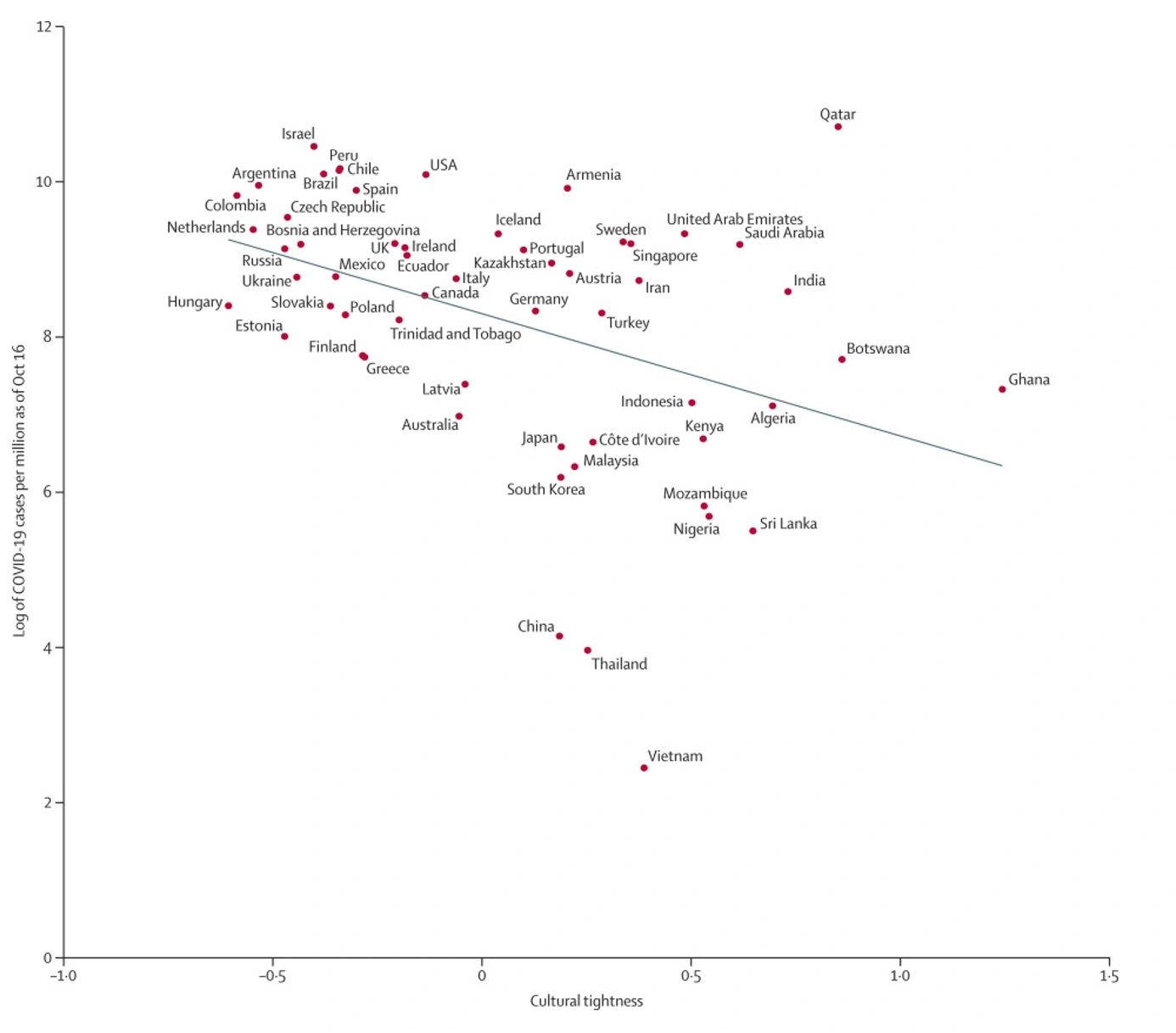
This explanation is, interestingly, taken from a new paper Gelfand just published (January 29, 2021) and co-authored, showing that tighter cultures have handled COVID-19 better.
Here’s the graph of cultural tightness (x-axis) vs COVID-19 cases per million (y-axis; log transformed):
Here’s the graph of cultural tightness (x-axis) vs COVID-19 deaths per million (y-axis; log transformed):
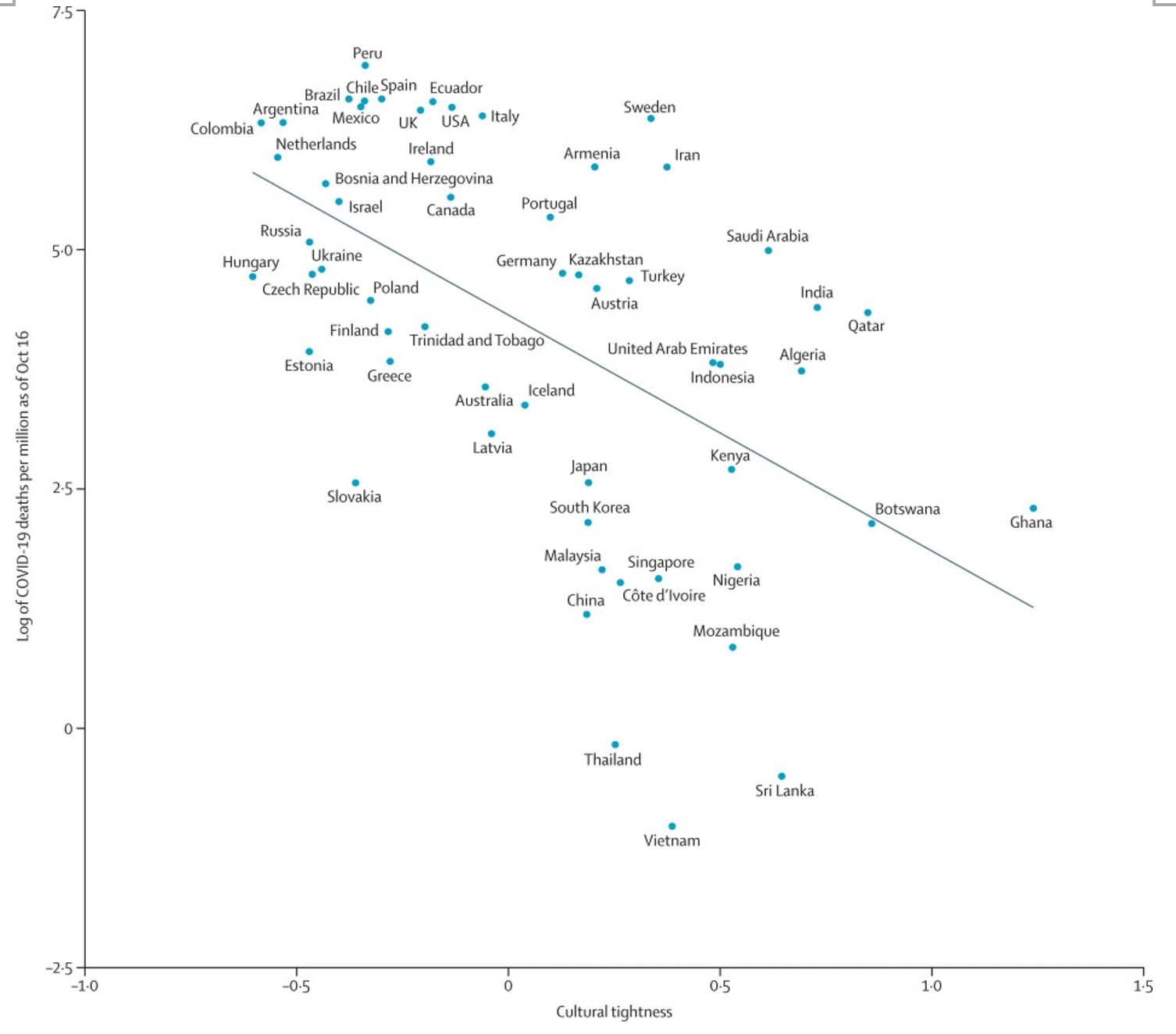
This supports the argument put forth in 2013 by the authors of Pathogens and Politics, wherein they state:
“At a societal level of analysis, empirical evidence reveals that in countries and cultures characterized by historically higher prevalence of parasitic diseases, people are less individualistic, exhibit lower levels of dispositional openness to new things, are more likely to conform to majority opinion, and more strongly endorse “binding” moral values that emphasize group loyalty, obedience, and respect for authority…countries characterized by higher prevalence of parasitic diseases are also characterized by stronger family ties, increased frequency of intrastate ethnic conflict, and several indicators of increased ethnocentrism.”
That cultural tightness, predicated on measuring what the authors above describe, was able to account in large portion for which countries would be successful vis-a-vis COVID-19 strongly suggests that pathogens have been a conditioning factor in human politics. That we can tie past prevalence of pathogens via the mediating variable of cultural tightness—and authoritarian personality disposition—to today’s responsiveness to COVID-19 is quite fascinating. And though not obvious, is quite intuitive.
Pathogens, Colonialism, and Modern Institutions?
These recent findings—that pathogens have an impact on institutions, and that those institutions in turn have an impact on human well-being—reminded me of two very influential, though controversial, studies conducted by economists Daron Acemoglu and James Robinson titled _The Colonial Origins of Comparative Development: An Empirical Investigation (2001)_ and Reversal of Fortunes: Geography and Institutions in the Making of the Modern World Income Distribution (2001). The relevant and fascinating point of the papers is their use of settler mortality statistics to predict institutional emergence. In both papers, Acemoglu and Robinson use the rate at which European settlers died of diseases—settler mortality—as an [instrumental variable](https://www.statisticshowto.com/instrumental-variable/#:~:text=An%20instrumental%20variable%20(sometimes%20called,for%20unexpected%20behavior%20between%20variables.) impacting GDP per capita today, operating via the mediating variable of ‘inclusive institutions’. As they put it in the first paper:
“Colonies where Europeans faced higher mortality rates are today substantially poorer than colonies that were healthy for Europeans. Our theory is that this relationship reflects the effect of settler mortality working through the institutions brought by Europeans… The regression shows that mortality rates faced by the settlers more than 100 years ago explains over 25 percent of the variation in current institutions. We also document that this relationship works through the channels we hypothesize: (potential) settler mortality rates were a major determinant of settlements; settlements were a major determinant of early institutions (in practice, institutions in 1900); and there is a strong correlation between early institutions and institutions today.”
Basically, a core part of their argument is that pathogens incentivized Europeans to create extractive and exclusive institutions in parts of the world that were previously richer—insofar as urbanization rates are a proxy for that—leading over time to a reversal of fortunes wherein the formerly rich became poor due to the bad institutions.
See graph of settle mortality (x axis) vs GDP per capita in 1995 below:
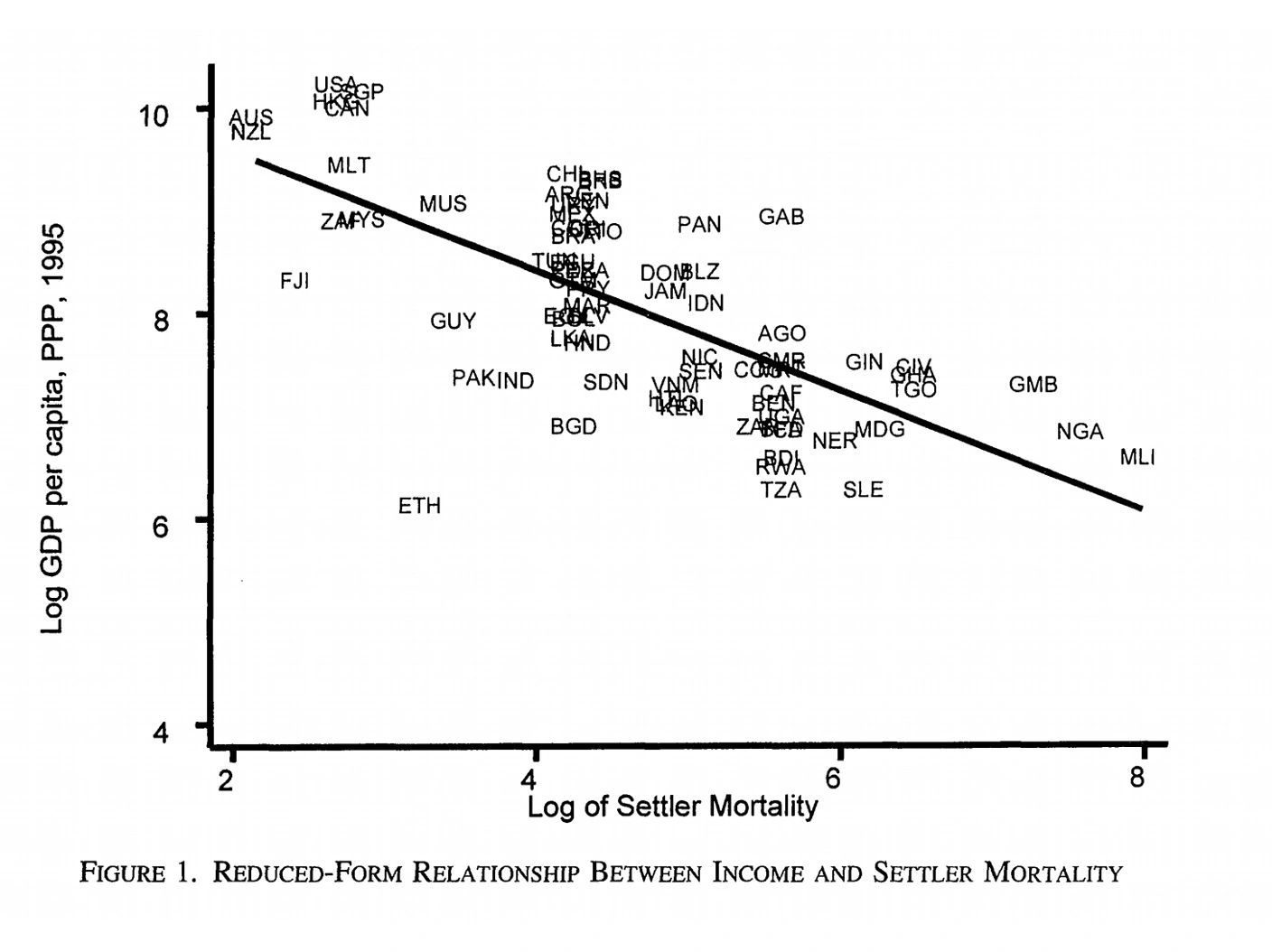
Whether or not this is exactly how history unfolded—there are valid critiques that point to initial conditions of inequality as determinative for institutional developmental trajectories, for example—these papers remind us that pathogen prevalence has been a fundamental issue shaping humans and their institutions for a long, long time.
The Invisible War: Bacteria vs Viruses
Bacteria and viruses predate humanity. In this time, over hundreds of millions of years, bacteria and viruses have been waging constant warfare against one another. The longevity of this warfare has resulted in evolutionary changes. Bacteria, typically on the defense against the viruses, have developed a panoply of weapons to stop the viruses from penetrating and reproducing inside of them. One of these tools is so fundamentally adaptive that it gets right to the source: it can alter the viral genome—genetic warfare.
This tool allows bacteria to selectively cut out parts of viral genomes, rendering them bunk. It is this tool that scientists call CRISPR, the now famous gene editing tool that several scientists last year won the Nobel in Chemistry over.
Here’s an overview: “CRISPR works to prevent viruses from destroying the cell. The bacterium clips a bit of the viral DNA and adds it into a CRISPR region of its own DNA. If the virus comes back, the bacterium makes RNA from the region of CRISPR specific for that virus. These RNA copies pair up with some casCRISPR-associated genes adjacent to CRISPR loci of spacers and repeats. cas9 is a cas gene. (CRISPR-associated) proteins. The RNA guides the cas protein to the invading viral DNA, so the protein can destroy it. No more viral DNA, no new viruses. These RNA copies pair up with some cas (CRISPR-associated) proteins, which are made from cas genesCRISPR-associated genes adjacent to CRISPR loci of spacers and repeats. cas9 is a cas gene.”
If this sounds a bit familiar, it’s because the same scientific inquiry into how viruses can be defeated interconnects with the bio-technology research undergirding mRNA that has enabled Moderna and Pfizer-BioNTech to make ultra-effective COVID-19 vaccines. Walter Isaacson describes the interconnection:
“The invention of easily reprogrammable RNA vaccines was a lightning-fast triumph of human ingenuity, but it was based on decades of curiosity-driven research into one of the most fundamental aspects of life on planet earth: how genes are transcribed into RNA that tell cells what proteins to assemble. Likewise, CRISPR gene-editing technology came from understanding the way that bacteria use snippets of RNA to guide enzymes to destroy viruses. Great inventions come from understanding basic science. Nature is beautiful that way.”
Moderna and Pfizer-BioNTech vaccines introduce messenger RNA that manipulate our cells to produce the spiked proteins characteristic of SARS-CoV-2. Our native immune system, detecting such an anomalous yet harmless presence, mobilizes antibodies to contain and surround the spiked proteins—preparing them for the day they will need to contain and surround the real coronavirus from infecting our cells with its viral DNA. It was in studying the epic struggle between bacteria and viruses that we got the clue that would change the course of this pandemic.
Humans and Pathogens
Humans have not only learned from pathogens how to shape our world. Humans have ourselves been actively shaped by pathogens. Returning to Gelfand’s cultural tightness and the arguments put forth by the authors of Pathogens and Politics, let’s finish up by introducing an important concept: the behavioral immune system. This system is a behavioral level manifestation of a deeply ingrained aversion to pathogens. Evolutionarily, those who developed pathogen avoidance were more likely to survive, thus making it adaptive. The behavioral immune system, however, can and often does go haywire. Acute disgust sensitivity, something closely linked with OCD, is likely a pathological outgrowth of the behavioral immune system. Even more disturbing, you can see the behavioral immune system playing out via the rhetoric of dehumanization. Hitler famously compared the Jews to a viral infection. A recent journal article has this to say:
“Like many other animals, human beings engage in behavioral defenses against infectious pathogens. The behavioral immune system consists of a suite of psychological mechanisms that (a) detect cues connoting the presence of infectious pathogens in the immediate environment, (b) trigger disease-relevant emotional and cognitive responses, and thus (c) facilitate behavioral avoidance of pathogen infection. However, the system responds to an overly general set of superficial cues, which can result in aversive responses to things (including people) that pose no actual threat of pathogen infection. In addition, the system is flexible, such that more strongly aversive responses occur under conditions in which perceivers are (or merely perceive themselves to be) more vulnerable to pathogen infection. Recent research reveals many provocative implications—for the experience of disgust, for extraversion and social interaction, for xenophobia and other prejudices, and for the origins of cultural differences.”
Our long engagement with pathogens has thus forced humans to develop a behavioral immune system. This is embodied in tightness and looseness. It can beneficially lead us to take proper precautions against potential exposure to viruses and bacteria. At a cultural and societal level, its emergence can even help countries deal effectively with pandemics. But it also manifests in outright harmful ways, such as dehumanization and xenophobia. Xenophobia, in particular, is a long standing feature of human societies. Allowing new people into your group can, and historically has, led to massive death from introduction of new viruses. Think about what happened when the Europeans came to the Americas. Contemporaneously, this concern may be refracted through issues related to immigration today. But let’s remember that being too tight, and too closed, can have very real opportunity costs. After all, both BioNTech (along with Pfizer) and Moderna—the companies who have pioneered the use of miraculously effective mRNA vaccines that are now putting an end to the COVID-19 pathogen’s reign—were both founded by recent immigrants: second generation Turks whose families had emigrated to Germany and a Beirut-born Armenian emigrant to America.
The incessant battle between man and pathogen has shaped our genome, it shapes our culture, it impacts the political institutions and systems we enact, and it still effects our political beliefs.