Reflexive Control
In the State and Revolution, Vladimir Lenin foreshadowed something sinister. He wrote:
“For when all have learned to administer and actually do independently administer social production, independently keep accounts, and exercise control over the parasites, the sons of the wealthy, the swindlers and other “guardians of capitalist traditions,” the escape from this popular accounting and control will inevitably become so incredibly difficult, such a rare exception, and will probably be accompanied by such swift and severe punishment (for the armed workers are practical men and not sentimental intellectuals, and they will scarcely allow anyone to trifle with them), that the necessity of observing the simple, fundamental rules of the community will very soon become a habit” (Lenin, State and Revolution, pp 383-384).
Lenin wrote of reflexive control.
Lenin was a man enamored with the idea of thought leadership. As Neil Harding put it, there has never been a movement more geared toward and more acceptable to the psychology of intellectuals than Marxism-Leninism.
He wrote “Of all modern ideologies, Leninism, more than any other, gives far more credence and authority to the role of intellectuals…As in no other ideology, their power is that of the word. No single Leninist leader has spent any considerable period in power without his selected or collected writings being trumpeted as major contributions to the theory of Marxism-Leninism. This is an ideology created wholly by intellectuals and, some would argue, not only by them, but for them and in their interests” (Harding, Leninism, pp 290).
Lenin believed that the masses must be guided—shepherded—by a ‘vanguard’ intellectual elite who can speak for the collective interests of the proletariat. Only problem, of course, is how do you corral the myriad different opinion of such a large body of people? The key, as Lenin foreshadowed, is reflexive control.
One must begin by imposing totalitarianism from the top down. But ultimately, the goal is to instill totalitarianism from the bottom up: to induce the population to control itself.
Sadly, reflexive control is not a hard game to figure out. Mass movements for generations have played it effectively. Humans, moreover, have evolved to play this game—perhaps it even accounts for our unprecedented success as a species. The bottom-up totalitarian impulse implores humans into a collective, mob like mentality. It induces a sense of assabiyah—Ibn Khaldun’s word for deep group interconnection—that readies them for the craziest of individual sacrifice for the collective. Reflexive control—bottom up monitoring of individual behavior according to internalized group norms—is what allows humans to cooperate in large numbers. Reflexive control exists on multiple sliding scales. It can be intense or lax. It can operate for benign or tragic purposes. From the perspective of this essay, though, reflexive control merely involves guiding our inbuilt group impulse to a leader’s desired ends.
The most critical element lies in ensuring that individuals either identify with the group—your group—or have no group identification whatsoever. An individual is either a part of the mighty team, or a weak outcast with no chance of acquiring any other group identity.
Lenin and Stalin’s primary focus in coming to power—no surprise—was to annihilate independent organizations. While rising to power, Lenin’s most extreme animus was directed at moderate—or less revolutionary—socialist organizations. These groups were, for him, the most dangerous because they most directly threatened the dichotomous, Manichean us vs them world view necessary for reflexive control to be effective. Lenin’s primary goal was to build a Party system wherein an individual was either with us or against us—something he said himself multiple times. An individual was either a worthy member of the collective, or a worthless isolated individual.
Importantly, Lenin made sure no other organization could exist to pick up these stragglers / potentially destabilizing free radicals. The most appalling and poignant demonstration was what he did to the Orthodox Church. He determined that the famine of 1921, induced largely by his delirious rush to communism and ‘War Communism’, was a unique opportunity to transition from merely tolerating the Church to brutally ‘liquidating’ it. He reasoned the starving people would now be too distracted and tired to protect this organization with which they had so long identified—an organization that was a potential rival source of social power and which people could find strength in identifying with. During the famine he directed the murder of thousands of priests, systematically looted their resources—land, gold, etc—and destroyed the Orthodox Church as a cohesive organization in Russia.
Lenin did not do this because he particularly hated the Church (though he may have). He did it because he recognized the challenges it presented him. If another mass member organization could give individuals a sense of strength and identity outside the confines of the Party, then enacting reflexive control would become much more difficult—perhaps impossible. Truly complete reflexive control—totalitarian reflexive control—necessitates that an individual be forced with a Manichean choice of identity: either unity with the party or forsaken individuality.
Stalin took this logic to its darker, but ultimately logical next level. One’s family was no longer an alternative source of identity. If Stalin or his lackeys determined you were no longer fit to be with the party, then your family, your friends, and everyone you’ve ever known must also turn against you. There would be no alternative organization, not even a friend, for a reject to meld with and find identity and respite. You would be utterly alone.
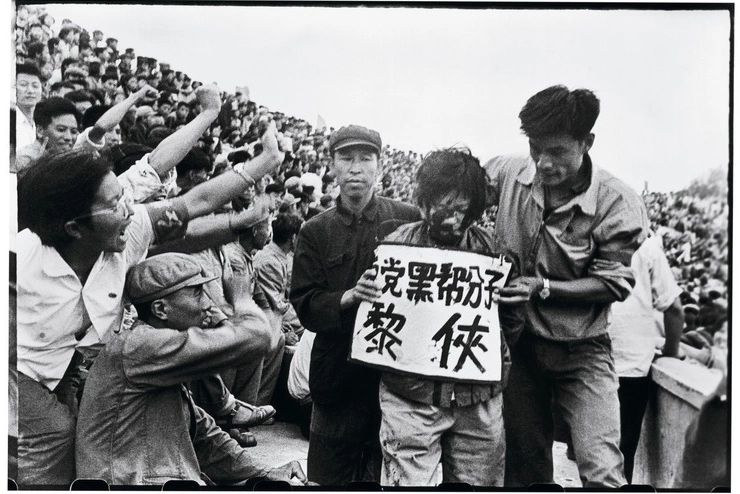
Reflexive control is what happens when this process starts to become bottom up. When your family members and friends begin monitoring you for signs of disloyalty to the party. When your loved ones are the ones who report you to the secret police. It is the internalized belief that the party comes first. And the fearful knowledge that without belonging to the party you are nothing. Lenin’s admonition to his hated rival Bernstein thus stands in a somewhat darker light than it was originally written in 1917: “Bernstein simply cannot conceive of the possibility of voluntary centralism, of the voluntary amalgamation of the communes into a nation, of the voluntary fusion of the proletarian communes, for the purpose of destroying bourgeois rule and the bourgeois state machine. Like all philistines, Bernstein pictures centralism as something which can be imposed and maintained solely from above, and solely by the bureaucracy and the military clique.”
Bernstein, in this caricature by Lenin, was clearly both right and wrong. He correctly recognized that reflexive totalitarian control can only be enforced, instilled, and maintained from the top-down. But he may not have understood how reflexive control can ultimately become bottom up as well.
The psychological key that makes reflexive control self-reinforcing is ridding a rebellious individual of the belief of the efficacy of action against the party. Not only will you and your rebellious act fail, but you will fail alone. Your failure will isolate you from everyone you love. There will be no others—no other group with which you can meld with—who will stand alongside you in your heroic quest. There won’t even be anyone to hear of you and your actions. If you transgress the party you will simply disappear, and no one will remember you. That is the feeling—deeply intrinsic to our biology— that reinforces reflexive control.
As Eric Hoffer wrote:
“In his purges of old Bolshevik leaders, Stalin succeeded in turning proud and brave men into cringing cowards by depriving them of any possibility of identification with the party they had served all their lives and with the Russian masses. These old Bolsheviks had long ago cut themselves off from humanity outside Russia. Thy had an unbounded contempt for the past and for history which could still be made by capitalistic humanity. They had renounced God. There was for them neither past nor future, neither memory nor glory outside the confines of holy Russia and the Communist party—and both of these were now wholly and irrevocably in Stalin’s hands. They felt themselves, in the words of Bukharin, “isolated from everything that constitutes the essence of life.””
Enacting totalitarian reflexive control is hard—it is the basis of many of the mass movements of the 20th century. But the game plan is surprisingly simple. To enact totalitarian reflexive control you must eradicate all sources of collective identity outside of your party/group/religious organization. Ultimately down to the family level. You have to begin developing the totalitarian tools from the top-down, as Lenin and Stalin did. But once all other groups have been destroyed, and once the party has become powerful enough, reflexive control can set in. Individuals are made to feel that only through connection with the party do their lives have meaning and worth. To separate from the party is not only a death sentence, it is also impossible: there are no other groups to meld with. The party is now your identity. As your friends and family members all internalize identification with the party, so do you. To be anti-party is to stand against your family and friends. If you stand against the party, you stand against your family. Top down control thus becomes bottom up control. Reflexive control reigns.