Power contra Prestige
A Dual Model of How States Attain Status and Influence in International Relations
Download PDFIntroduction
Intuition has long held that there are two main ways to acquire influence over human groups. One way is with the stick, via brutish Machiavellian stratagems. The other with the carrot, or a saint like virtue. Jesus and Confucius, or Machiavelli and Han Fei. This intuitionist approach to achieving social rank and influence in human groups has, in fact, been increasingly refined, empirically grounded, and achieved predictive utility in the life sciences. From evolutionary anthropology to neurobiology, findings are mounting that support a ‘Dual Model’ interpretation for how actors achieve status rank and influence in human social groups. One can become a ‘Big Man’—as the phrasing goes1Henrich 2015–via strategies of ‘prestige’ or ‘power’.
A review of the literature on achieving status in both international relations and the life sciences reveals a major disconnect between these two academic areas. Whereas the life sciences have made sizeable strides on a coherent research paradigm, furthering our understanding of how and why actors pursue and achieve status rank and influence, the work in international relations remains, by contrast, disjointed. Furthermore, most of the existing scholarship and theorizing in international relations does not draw upon work in the life sciences. International relations thus appears far from establishing a framework that coheres research on status and unifies the field’s many differing definitions of the term.
As questions in international relations invariably involve the human element, scholarly theory ought to be informed and updated with respect to work in the life sciences. This article seeks to apply the life science’s now well-developed ‘Dual Model’ of status rank pursuit— involving dual strategic typologies for status attainment, termed ‘prestige’ and ‘power’— to the international relations field. In particular, seeking to synthesize international relations with work in the life sciences to further analytic understanding of ‘status’ and ‘status competition’ in the international system. The article also advocates for centering the study of status, and status competition among states, in the international relations field. The article argues that status should be considered more encompassing than most of the literature thus far considers it to be.
Status Hierarchies in the Life Sciences
Status, while related to tangible attributes, is an inherently social, perceptual, relative, and positional rank ordering of individuals within a social grouping. Status hierarchies among social mammals, including primates, are ubiquitous features of organization that pre-date the emergence of our genus, homo, by many millions of years. Indeed, most social mammals exhibit some sort of formal or informal social status hierarchy. Amidst competing definitions in related fields (see Appendix 1), the simplest, operationalized, definition of status is simply “social rank in terms of social influence (i.e. the ability to modify others’ behaviors, thoughts, and feelings).”2Henrich 2013; see also Mesoudi 2019; Redhead 2018 Relevant research on social status hierarchies in the life sciences focuses on why and how individuals within status hierarchies achieve and pursue high rank. From an evolutionary perspective, the incentives for ‘why’ individuals strive for high social status ranking include: preferential access to mates, preferential access to contested resources, and extra influence in group decisions.3Von Vugt 2015; Sapolsky 2004 & 2005 As understood in the evolutionary psychology literature, ‘status’ thus tends to refer to the “relative degree to which an individual receives relatively unchallenged deference, influence, social attention, and access to valued resources.”4Henrich 2013 Fields including neuro-biology5Zink 2008, neuroscience6Mattan 2017, primatology7Sapolsky 2004 & 2005, evolutionary anthropology8Henrich 2001 and 2013, evolutionary psychology9Von Vugt 2015, and cultural evolution10Boyd 1985; Richerson 2003 converge in finding markers indicating that social animals—including humans—have an evolved cognitive and behavioral machinery that preferentially gears individuals, particularly males, to pursue relative social status ranking.11Anderson 2015; Smith 2016; von Reuden 2016 Findings on a wide range of animal and human subjects show that individuals of higher social rank demonstrate signs of superior mental health and physical wellbeing and achieve higher rates of reproduction.12Zink 2008; Majolo 2012; Smith 2016; Mesoudi 2019; Redhead 2019 From an ultimate, evolutionary perspective status hierarchies appear to solve group coordination problems and, as groups grow larger, hierarchies—very often informal ones— become increasingly necessary as group coordination problems intensify.13Henrich 2015; von Reuden 2015 Hierarchical organization allowed groups, and the individuals within them, to out-compete and thus preferentially survive and reproduce, ingratiating into our evolved psychology a predisposition for operating in hierarchies.14Boehm 1999; Anderson et al 2015; Ronay 2012; Smith 2016; Maner 2017; Mattan 2017 The ubiquitous presence of status hierarchies in our species and their important role in mediating who gets priority access to reproductive and fitness relevant resources indicates that evolutionary selection pressures are likely to have given rise to cognitive and physiological mechanisms that: “a) motivate individuals to advance their positions in status hierarchies (status improvement), b) convert advantageous status positions into fitness benefits (status capitalization), c) assess and monitor others’ positions in status hierarchies (status assessment) and d) manage and cope with changes in status positions in social hierarchies, both gains and losses (status management). These mechanisms are instantiated as coordinated interactions between hormonal, cognitive, emotional, and behavioral systems and they need not be consciously motivated.”15Van Vugt 2014 Although the widespread presence of social status hierarchies—and the desire for, and benefits accruing to, high social status rank—among social mammals is well established, recent research has homed in on a systematic paradigm for how hierarchies vary between and within species. In 2001, Joseph Henrich and Francisco Gil-White wrote a paper titled ‘The Evolution of Prestige.’ This paper initiated a new research framework on social status hierarchies by identifying and differentiating between two distinct strategic typologies for attaining social rank, namely ‘prestige’ and ‘dominance’.16Henrich 2001 Humans, the authors argue, have uniquely evolved a form of social hierarchy predicated on prestige. The authors define prestige-based status as the willing deference of subordinates, out of respect and desire to learn, to individuals who display and possess valued competencies and skills. According to Henrich et al, this stands in stark contrast to all other species—including social mammal species—whose sole form of hierarchical arrangement is predicated upon dominance, which they define as the use of force, coercion and threat to obtain obedience (forced deference) from subordinates. Because of our species unique penchant for social learning, the authors argue that humans uniquely adapted to favor this novel form of status based upon prestige. While more recent research has shed doubt on the idea that prestige hierarchies are, in-kind, a novel aspect of homo sapiens social organization—there is evidence, for example, of prestige in other pseudo-cultural species, such as orca whales, dolphins, elephants, and chimpanzees17Waal 2010; Henrich 2016—there is no question that, in degree, the prevalence of prestige-based strategies in human status hierarchies is unique.18Cheng 2020 Our historical heritage as hunter-gatherers is particularly important. As Boehm argues, amongst our ancestors weaker group members often banded together to prohibit—often by killing—powerful individuals from using dominance strategies to achieve status rank and influence (aided in particular both by evolutionary adaptions for social learning and an evolved ability to effectively use ranged weapons.19Bohem 1999; see also Hippel 2018 This enabled informal and ad-hoc (i.e. prestige) hierarchies to become increasingly prevalent features in hunter-gatherer groups.20Henrich 2015 Social norms, though, did and still do play an important role in determining whether prestige or dominance-based strategies are more or less likely to succeed: “in groups and societies that have developed strong norms that may either place a premium on prestige, or sanction dominance, the relationship that dominance has with social rank may be muted, whilst in groups and societies that lack these norms, dominance may remain an effective route to social rank.”21From Pandit & van Schaik 2003 quoted in Redhead 2019 Scholars employing the Dual Model’s typological distinction in status-attainment strategies have thus far largely confirmed Henrich et al’s framework.22See Mesoudi 2019, Van Vugt 2019, Redhead 2019 The dominance vs prestige typology has facilitated novel hypotheses and provided explanations for many behaviors that had formerly been difficult or impossible to consistently account for under the non-differentiated framework.23Mesoudi 2019 While there is ongoing research and potential contestations or additions (e.g. competence as the sole role and moral virtue as a separate pathway)24On competence see Chapais 2015, on moral virtue see Bai 2017, the findings thus far consistently and robustly support the utility of employing a typological distinction between prestige and dominance-based strategies as means for achieving status rank and influence [see Appendix 2 for figure]. In their 2019 review of the literature, Van Vugt and Smith conclude that “recognition of a dual model of leadership provides an answer to an old philosophical debate about the nature of leadership as either setting the right example or being an effective ruler. Due to a unique evolutionary legacy of being primates with a relatively steep dominance hierarchy and hunter–gatherers with a flatter, more egalitarian social hierarchy, humans have been able to create large cooperative communities around inspirational, charismatic, prestige-style leaders who are backed up by (physical) force and coercion whenever there was a substantial danger of coordination failures in the face of intra-or intergroup conflicts.”
While scholarship is and will remain ongoing, the evidentiary base substantiating the Dual Model is significant. Individuals following dominance and prestige strategies attracted more attention25Cheng 2013; Redhead 2018, individuals following both strategies achieved much greater reproductive success26Von Reuden 2016, Redhead 2018, Cheng 2013, and both dominant and prestigious individuals received greater deference than low social rank individuals27Mesoudi 2019. Similarly, important findings validate the differences in the two typologies. Dominant individuals are more likely than prestigious individuals to be aggressive28Mesoudi 2019; dominant individuals are more likely to demonstrate Machiavellian personality traits29Manor 2017; prestigious individuals were more likely to demonstrate ‘authentic’ pride whereas dominant individuals were more likely to demonstrate ‘hubristic’ pride30Bollo 2018; and prestigious individuals are more likely to be
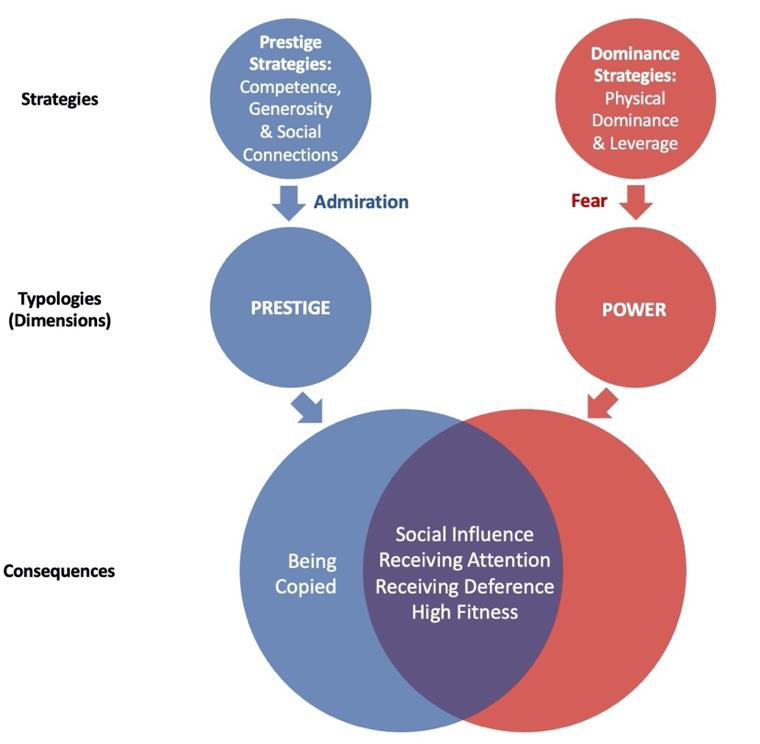
copied and watched as models of social learning.31Henrich 2010, Redhead 2019 Importantly, though, scholars make clear that while dominance-strategies occur both in formal and informal hierarchical settings, prestige is only operative in informal hierarchies.32Henrich 2013 and Mesoudi 2019 The graphic below thus shows prestige and dominance strategies as distinct typologies for achieving similar ends. Following Mesoudi (2019), I classify dominance strategies and prestige strategies as representing distinct typologies, or dimensions, labelled ‘prestige’ and ‘power’ respectively. Thus, while heeding Henrich et al (Henrich 2013) in holding to their definitions regarding dominance and prestige strategies, I employ Mesoudi’s application of a higher-level nominative ‘dimension’ to characterize prestige-based and dominance-based strategies as typologies termed ‘prestige’ and ‘power’ respectively. The utility of a ‘typological’ dimension is in its potential to foster synthesis with the international relations field, which widely utilizes— though with disjointed and unclear definitions—the terms prestige and power.
Figure created by author; based upon Mesoudi (2019) Individuals who favor utilizing one strategic typology over the other tend to have distinct cognitive and behavioral dispositions, “i.e., suites of subjective feelings, cognitions, motivations, and behavioral patterns that together produce certain outcomes” [see Appendix 3 for table].33Henrich 2013 This is likely due to the fact that these two strategic typologies entail reliance on very different means to achieve similar ends. Whereas the sine qua non of dominance strategies is inducing fear and obedience via coercion, force, threats, and leverage, prestige strategies rely upon inducing respect and willing deference via competence, altruism, and social connectedness (i.e. network building). Uniquely, only high-status individuals utilizing prestige strategies induce emulation from subordinates. Yet, whether one utilizes dominance or prestige type strategies, the ultimate aims are similar: deference (willing or coerced) from subordinates, increased mating opportunities, and priority access to fitness-relevant resources. Put simply: influence in and over human groups.
Status Hierarchies in International Relations
Hierarchy in International Relations In order to understand the international relations literature on status, one first needs to review how hierarchy has been conceptualized in the discipline. Owing to a widely shared assumption in international relation—stemming from the historically dominant fields of realism and liberal internationalism—that the international system is fundamentally anarchic, scholarly research regarding the complexities of hierarchy has been limited. Recently, though, the field has seen a growth in focus on hierarchy.
Writing in 1996, David Lake argued that “the discipline of international relations has focused too much on the fact of systemic anarchy and has been insufficiently attentive to variations in hierarchy among polities.” Within the field of international relations, the already limited analysis of hierarchy tended to focus narrowly on either alliances or empires.34Lake 1996 Yet, as Lake argues, order in the international system is more complex than pure anarchy or hierarchy; than either unalloyed coequality and sovereignty of states or pure subjugation under empire. Lake shifts this dualistic view of flat vs pure hierarchies into a spectrum (see Appendix 5). However, Lake’s, and much of the recent work on hierarchy in international relations, scholarship is undergirded by: “theories of relational contracting, first developed in economics but now finding increasing application in political science, to examine the alternative relations available to all states.”35Lake 1996; see Mattern 2016 for a further critique along these lines Recent work on hierarchy in international relations thus relies upon a rationalist, contractual bargaining understanding, drawn from economics, of why states in hierarchical systems sacrifice autonomy—for Lake, as a way of ensuring security. However, as Nexon & Musgrave (2018) note in their review of the international relations research on hierarchy, Lake’s differentiation between anarchy and hierarchy may risk “mistaking the distinction between ‘formal’ and ‘informal’ [hierarchy] for one between consequential and inconsequential.” In other words, Lake may mistake informal hierarchy as being an inconsequential, or anarchic, form when in fact informal hierarchies can themselves have very distinctive and important consequences (and as the life sciences literature makes clear, prestige-strategies operate uniquely within informal hierarchies). Importantly, though, Lake and Nexon et al align in agreement that “scholars often allow juridical sovereignty to obscure actual practices and relations of investiture. When studying states, scholars recognize that governance operates through a wide variety of mechanisms: norms, practices, orchestration, delegation, coercion, and the channeling of collective mobilization, to name only a few. Yet many still shy away from seeing the same mechanisms in international politics as evidence of governance hierarchy… the field lacks almost any systematic theoretical inquiry outside of the study of empires.”36Nexon et al 2018 Developing theories of hierarchy in international relations are thus transgressing and updating the foundations of the neorealist and neoliberal paradigm. These theories attempt to explain what traditional anarchic theories have struggled to explain, namely how and why states allow, or are forced to allow, other states to exert influence over their decision making—i.e. on their sovereign and autonomous prerogatives. The recent literature on hierarchy in international relations has gone a long way in remedying a substantial lacuna in the field, and simultaneously helping seed the study of status in the international system(s).37Nexon 2018; Lake 1996, 2003, 2007, 2020; Messer 2016; Kwan 2016; Cooley 2008; Kang 2010; Buzan 1996 Yet, there has been no explicit attempt to incorporate into this burgeoning study of hierarchy in international relations a life science’s Dual Model, wherein prestige (respect and willing deference) is understood to operate via informal hierarchy and power (fear and coerced obedience) to operate via both informal and formal hierarchies.
Status in International Relations In 1963, David J. Singer wrote: “Without laboring the need for an empirically based theory of inter-nation influence, it should not be amiss to note that its lack is both a cause of intellectual embarrassment to political science and a menace to the human race… And as long as the nations continue to base their policies on so flimsy a foundation, our understanding will be incomplete, our predictions unreliable, and our policies deficient.” In that article, Singer attempted to further international relation’s understanding of the term ‘power’ in world politics, which he believed did not provide operational utility. Singer believed that the goal of amassing power is ultimately to enact influence, thus coming to define power as “the capacity for influence.” Singer’s analysis, nonetheless, completely neglected status as an avenue through which states attain and enact influence in international affairs.
The international relations field would experience a minor pique in interest in status during the 1960s and 70s. A lull, however, would soon set in just at the time when research on status in the life sciences was beginning to blossom. A paucity of frameworks for studying status competition in international relations was a notable consequence. This was specifically due to the fact “[r]esearch on the international politics of status-seeking simply did not fit the field-shaping debates of the 1980s and 1990s, which featured the “paradigm wars” of neorealism, liberal institutionalism, and constructivism…”.38Paul, Larson, Wohlforth et al 2014 More recently, international relations scholarship on status, status competition, and social status hierarchies has undergone a somewhat disjointed expansion. The two primary research paradigms involving status revolve around the ‘power transition paradigm’ in the realist school and ‘status dissatisfaction’ theory that brings in constructivist perspectives.39On the first see: Allison 2017, Pu 2020, Khong 2019. On the second see: Paul, Larson, Wohlforth et al 2014; Duque 2018; Laveschenko 2010; Pu 2020 As a starting point, the status-focused literature in international relations is terminologically confused. Terms like status, prestige, reputation, and power are reliably used interchangeably. To borrow from David Singer, the international relations literature on status rests on a ‘flimsy foundation.’ Steve Wood notes the muddled terminological landscape in his 2013 review of prestige: “Prestige belongs to an extended conceptual family that includes honour (O’Neill, 1999; Joshi, 2008; Lebow, 2008), status (Weber, 1922; Reinhold, 1969), reputation (Tang, 2005; Sharman, 2007; Wylie, 2009), respect (Wolf, 2008), glory (Slomp, 2000), credibility, pride and legitimacy…These terms are not synonymous but have abundant, intergenerational connections. They frequently evoke the same underlying sentiment, for which prestige signifies the upper echelon.”40Wood 2013 The most routine—and for the purpose of applying a Dual Model framework, consequential— terminological confusion in the international relations literature is the conflation of status with prestige. Following closely, the next most common, particularly in realist literature, is for prestige—and thus status—to be considered a mere by-product of a state’s material power and capabilities. Wood notes this, saying: “Most commonly, prestige is [seen as] an epiphenomenon of material power. Wealth, advanced technology and military strength are among the resources that can endow this type of prestige (Niebuhr, 1962; Morgenthau, 1978; Gilpin, 1981). Wanting it stimulates the acquisition of relevant assets. Various states and populations consider having a nuclear arsenal to be very prestigious (Kinsella and Chima, 2001; O’Neill, 2006; Frey, 2007; Baktiari, 2010). Political actors will, sooner or later, attempt to correct imbalances between their material power and their imputed prestige quotient.”41Wood 2013 Marina Duque, working via a constructivist approach, concurs, finding that conventional views of status in international relations tend to reduce status to a by-product of material attributes (Duque provides a typology of attributes that international relations scholars often view as indicative of a state’s status (see table in Appendix 4)). In her view, this degrades the analytic utility of status as a concept, saying: “Conventional approaches define status as a state’s ranking on attributes, especially material attributes like wealth and military capability. In this view, status is a function of a state’s attributes: the richer or militarily stronger a state is, the higher standing it achieves (Gilpin 1981, 31; Wohlforth 2009, 39). This approach contrasts with research on status in the social sciences more broadly, which considers status to be fundamentally social. The conventional international-relations approach does not deny that status is social. But it substantively conflates social relations with the attributes of actors, leads to material reductionism, and separates status from state practices. As such, the concept of status does not differ enough from material capabilities to prove analytically useful.42Duque 2018 Duque’s constructivism sees traditional materialist views as too reductionist, arguing that status cannot be reduced to ‘attributes’ but rather that “status recognition depends on a state’s relations and only indirectly on its attributes [while] the relevance of a given attribute for status recognition is socially defined.”43Duque 2018 The constructivist view of status thus privileges the social, relational, and contextual elements of status. Indeed, the constructivist literature highly discounts the role that attributes and tangible capacities (economic and military strength) play in determining status, focusing intently on discursive norms and social power (in particular social networks).
Other authors have noted that international relations scholarship on status had largely ignored the social aspect of status. As Paul, Larson, Wohlforth et al lament, a constructivist update was likely necessary, for while “Mid-twentieth-century classical realists considered prestige [i.e. status] a key factor in interstate relations but generally treated it as a reflection of a state’s military capabilities, especially as demonstrated in war, precluding any investigation into nonmaterial determinants of status.”44Paul, Larson, Wohlforth et al 2014 However, the recent surge in influence of social constructivism in international relations—Alexander Wendt, for example, is considered the ‘most influential’ thinker amongst international relations scholars (Avey 2014)—means there is no longer a lacuna of work on status from a constructivist lens. Indeed, perhaps the most widely utilized definition of status in international relations follows a constructivist framing: “We define status as collective beliefs about a given state’s ranking on valued attributes (wealth, coercive capabilities, culture, demographic position, sociopolitical organization, and diplomatic clout). In international politics, status manifests itself in two distinct but related ways: as membership in a defined club of actors, and as relative standing within such a club.” (Woflforth Larson et al 2014) Such a definition may in fact be indicative of an overemphasis on constructivism in the field. This definition, while not contradicting the life science’s definition a priori, is incomplete. While dealing with the social, subjective, and relative ranking aspects, it does not directly engage the “relative degree to which an individual [in this case a state] receives relatively unchallenged deference, influence, social attention, and access to valued resources”.45Henrich 2013 Insofar as the authors engage this explicitly, they submit that “status is manifested in voluntary deference directed toward the higher-status actor”.46Paul, Larson, Wohlforth et al 2014 This view, however, offers only a limited understanding of status, as it cannot adequately countenance a Dual Model’s prestige and power dimensions. The international relations definition, as is routine in international relations, conflates status with the life science’s definition of prestige and thereby focuses solely on inducing voluntary deference. This effectively forestalls consideration of how power can lead to status by inducing obedience via fear. The most widely used definition in international relations thus incidentally precludes a Dual Model framework for understanding how states attain status rank and influence. This is a fundamental issue in the literature.
Singular Models of Status While status is widely recognized as a fundamental motivation—both for individuals and for states in the international system—there is only very limited engagement with the mushrooming and extremely promising life sciences literature.47As evidence, see: Wohlforth 2009; Renshon 2014, 2017; Mercer 2017; Wood 2013; Larson Schevchenko 2010; Paul, Larson, Wohlforth et al 2014; Wang 2019; Pu 2014, 2020 International relations scholars are thus missing potentially important insights and clarifying frameworks. An emergent problem, as a result, is that status in international relations is typically conceptualized as unidimensional, i.e. in a way that accords with only the prestige or, as is most often the case, the power typology in the life science’s Dual Model.
Larson and Shevchenko (2010), for example, discuss status dissatisfaction theory in a way consonant only with the life science’s definition of prestige. The authors identify three “strategies” that status disaffected powers can use to increase their status (framing status via identity), saying: “When a group’s identity is no longer favorable, it may pursue one of several strategies: social mobility, social competition, or social creativity. Social mobility emulates the values and practices of the higher-status group with the goal of gaining admission into elite clubs. Social competition tries to equal or surpass the dominant group in the area on which its claims to superior status rest. Finally, social creativity reframes a negative attribute as positive or stresses achievement in a different domain. Applied to international relations, SIT suggests that states may improve their status by joining elite clubs, trying to best the dominant states, or achieving preeminence outside the arena of geopolitical competition.” These distinctive “strategies” for increasing social status ranking effectively presuppose a prestige-based typology. The authors focus on either emulating ‘high-status’ groups (mobility) or attempting to demonstrate superior competence (via competition & creativity). Indeed, the authors focus is explicitly on how Russia and China are trying to “develop new, more positive images by contributing to global governance while maintaining distinctive identities.” Such an analysis presupposes status competition occurs via a prestige-biased paradigm. As previously noted, this is the same issue present in the definition of status from Paul, Larson, Wohlforth et al.
In juxtaposition, other work on status competition views the route to status in international relations as operating singularly via the power dimension. In his book Fighting for Status, Jonathan Renshon demonstrates how states suffering from ‘status dissatisfaction’—i.e. unhappy with their perceived status vis-à-vis their desired status—have, historically, resorted to violence and conflict to increase their status-rank. Focusing singularly on increasing status via force, though, implies a singular power-based status attainment strategy for increasing social rank.
Similarly, Youngho Kim, as with much of the literature in the realist paradigm, similarly falls into a singular power-based view of status attainment. Kim provides a useful etymological run-down of the realist view (similar to Wood 2013), saying: “Practitioners such as Richelieu, Bismarck, Stalin, Kennan, and Acheson take prestige seriously. Acheson, for example, defines prestige as the “shadow cast by power.”
Theorists in the realist tradition also take questions of prestige seriously (Thucydydes; Machiavelli, Hobbes, Weber; Carr; Nicolson; Aron; Gilpin). Reinhold Neibuhr conceives of prestige as an “indispensable source of power.” Martin Wight calls it the “halo round power.”48Kim 2004 Kim makes a case, for instance, that “prestige as reputation for strength may even forestall war” (Kim 2004). Similarly to Wood (2013) and Kunz (2010), Kim argues that there are both positive and negative sources of prestige wherein “positive ones include past achievements or success” and “negative sources of prestige involve deception and trickery.” But such an argument simply compounds a conflation of terms, as prestige—already synonymous with status—now becomes tantamount to one’s reputation. Kim’s view of prestige as power thus not only demonstrates a conflation of terms typical in the international relations literature on status, but importantly also further exemplifies the tendency to see strategies for attaining status as unidimensional.
Yuen Khong’s 2019 article ‘Prestige as Power in World Politics’ is one additional, and prominent, example of singular models of status attainment in international relations. Khong deploys Robert Gilpin’s famous phraseology regarding “prestige as a reputation for power.” Using this unitary definition, Khong describes competition in contemporary international relations thusly: “China seeks the top seat in the hierarchy of prestige, and the United States will do everything in its power to avoid yielding that seat, because the state with the greatest reputation for power is the one that will govern the region: it will attract more followers, regional powers will defer to and accommodate it, and it will play a decisive role in shaping the rules and institutions of international relations. In a word, the state at the top of the prestige hierarchy is able to translate its power into the political outcomes it desires with minimal resistance and maximum flexibility.”49Khong 2019 Such a singular view of prestige is incapable of countenancing important nuances captured in the life science’s Dual Model, wherein willing deference occurs out of respect and admiration, while obedience comes out of fear and coercion.
Overall, where Larson and Schevchenko and Paul, Larson, Wohlforth et al see peaceful ways in which ‘status inconsistency’ can be resolved, Khong joins with “Renshon, Gilpin and others [in finding that] ‘status inconsistency’ is usually not settled by negotiations; it tends to be resolved through war.”50Khong 2019 Although neither perspective is wrong, both are incomplete. The existing literature does not appear to posit anything approaching a framework similar to that of the Dual Model of prestige and power. Returning to Singer, it appears that international relations is still missing out on an “empirically based theory of international influence” inclusive of the important variable of status.
A 2014 study of practitioners and policymakers found that: “[while] policymakers do want scholarly expertise … they also call into question when and how often the techniques of the modern science of international relations are directly useful to policymakers.” Might the disconnect between policy and scholarship in international relations be improved by learning from the life sciences? This article, in the spirit of Goddard and Nexon, seeks to apply a unifying framework of analysis that transcends parochial paradigms and “misleading baseline assumption[s].”51Goddard and Nexon 2016 In particular, it looks toward the life science’s Dual Model as a framework for thinking about how states pursue status rank and influence that is both intuitive, empirically grounded, and capacious enough to be inclusive of the various international relations paradigms.
Power vs Prestige: The Dual Model for International Relations
As Henrich argued, status should not be conflated with either prestige or power (Henrich used ‘dominance’ but keep in mind we are using Mesoudi’s framework). Rather, as Mesoudi contends, prestige and power are two distinct strategic typologies that actors can use to attain status—they are distinct means states can use to achieve the ultimate end of status rank and influence. Status is thus an umbrella term denoting one’s pursuit of, desire for, and capacity to enact influence. Power and prestige are distinct dimensions through which actors attain status.
Power refers to a state’s use of force, coercion, threats, and leverage to attain, maintain, and achieve status rank and influence. Power can be conceptualized as the ‘negative’ strategic typology through which states pursue status rank and enact influence. Prestige, by contrast, is defined as a state’s use of competence, altruism, and social connectivity to pursue status rank and enact influence. Prestige can be conceptualized as the ‘positive’ strategic typology (i.e. dimension) through which states may pursue status rank and enact influence. There are, within the dimensions of power and prestige, a multitude of strategies (see Appendix 6 for table of dominance and prestige strategy examples). Gilpin’s well-known quote “prestige is the reputation for power” precisely conflates prestige and power and is unfortunately prevalent in the international relations literature on status. It is necessary to jettison this phrase and analytically separate power and prestige, just as dominance and prestige are separated in the life science’s literature.
In the context of modern international relations, increasing one’s influence reflects upon one’s ability to shape the norms and institutions that prevail in the international system (whether via power or prestige), the ability to influence other states to take actions in accordance with one’s preferences (whether by obedience or deference), and the ability to have priority access to mutually desired and contested resources (whether out of fear or respect). From a consequentialist perspective (i.e. observable outcomes), the most salient empirical difference we should expect to observe is that states primarily employing dominance-based strategies will not induce emulation from others whereas states primarily employing prestige-based strategies should routinely induce wide-ranging emulation. As Henrich et al write: “The influence of Prestigious individuals is unique in that subordinates shift their views and opinions closer to those of the Prestigious (an example of emulation) and heed their wishes out of deference even when they do not agree with them (an example of seeking favor, in order to be granted greater access to Prestigious leaders to facilitate their own copying or learning).”52Henrich 2013 Differentiation of status-seekers along the lines of power and prestige must therefore occur via analysis of means used, intended, and perceived, and not via the consequences (except for emulation, which should uniquely arise via prestige).
Dual Model Framework Drawing on Singer, I argue that status may be best understood as the highest-level umbrella term referring to a state’s ability to enact influence in the international arena. Status, as Duque pointed out, must be understood more broadly than merely an ‘epiphenomena’ of material capabilities. It must include the social dynamic of how states relate, ascribe value, cooperate with, resist, and defer to one another. Yet, status ought not be construed merely as a social construct. While status is indeed inherently social and perceptual, and not merely reducible to material capacity, the social and the material are intrinsically interrelated. While material resources have tangible and unequivocal real-world impact, how they are used, and how others
perceive their use, is a social phenomenon. Thus, status ought to be construed as encapsulating the totality of a state’s material and social influence capacity. This involves amalgamating ‘material power’ and ‘social power’ (or as Chinese policymakers and scholars aptly call it, ‘discourse power’)53Rolland 2020 into a single dimension of ‘influence’. Under such a unified metric, a state with objectively low material power may have high status—that is, greater overall influence—if its discourse’ power (via ideology, social connections and groupings, and overall normative influence) is great.
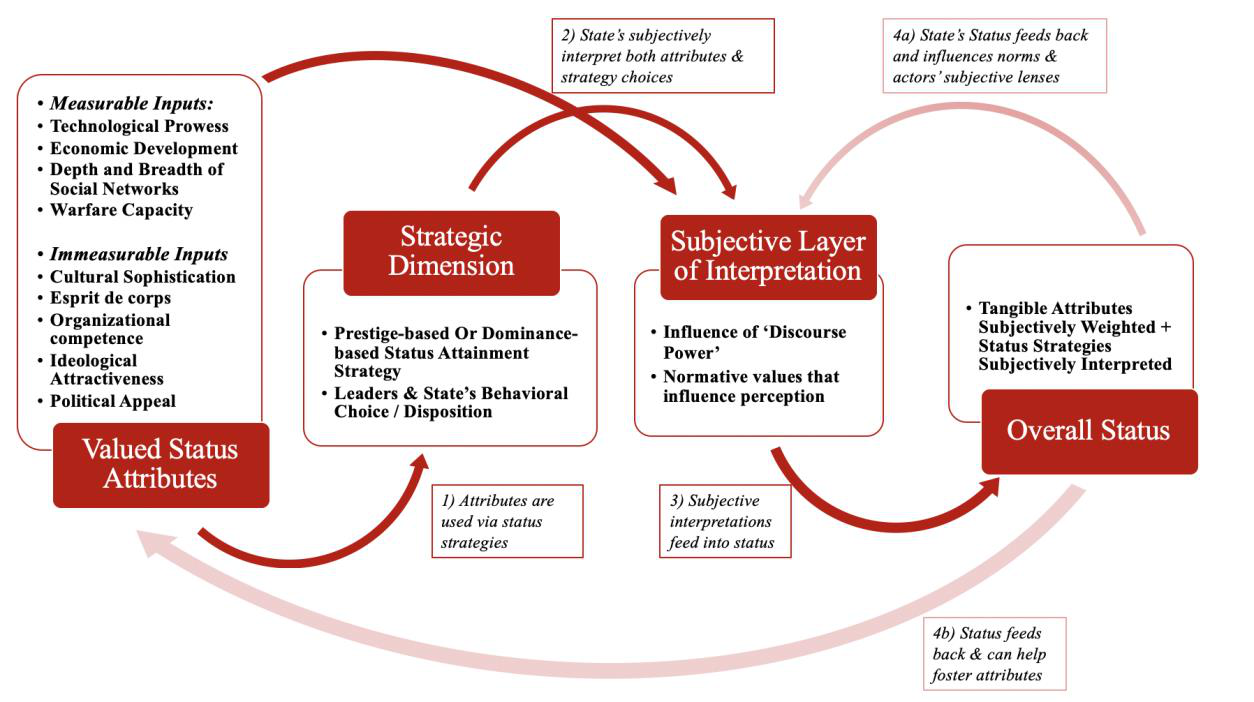
Status rank in international relations, therefore, should refer to a state’s ordinal capacity to broadly enact influence, i.e. the ability to instantiate one’s preferences. This accords with the life science’s broad definition of status as “social influence (i.e., the ability to modify others’ behaviors, thoughts, and feelings)”.54Henrich 2013 Combining materialist, rationalist, and constructivist literature with that of the life sciences, this diagram proposes a status framework for international relations.
Figure made by author This framework accounts for attributes that a state possesses, whether material such as economic capacity or immaterial such as cultural sophistication. In accordance with the Dual Model, the framework also recognizes that states can utilize power-based strategies and/or prestige-based to gain status via fear and coercion (power) or respect and admiration (prestige). In turn, states subjectively interpret both the attributes and the status attainment strategies of other states. This subjective interpretation of a state’s relevant attributes by other actors, as well as the means the state is perceived as using to further its influence, culminates in a state’s overall status. Status also operates via feedback loop such that acquiring status can help actors improve their attribute endowments, as well as influence the way in which other actors perceive and interpret those attributes (i.e. via instantiating new norms, values, and ideologies into a system).
Importantly, while overall status rank and concomitant influence capacity is a discernible feature in its own right, as Musgrave and Nexon recognize with respect to hierarchies, a state’s status and influence will also vary situationally.55Musgrave and Nexon 2018 As status is a social, perceptual, and comparative feature of social groups, who one compares oneself with is of great importance. Thus, as identified by Renshon, status communities are an important aspect of status in international relations. It must be recognized that state’s do not all share the same relevant communities.56Renshon 2017 The major powers, middle powers, and regional powers will have distinctive status communities—even a matrix of status communities—within which they will respectively strive to gain higher rank and influence. Network based analyses can help inform precisely how state’s might view their relevant status community.
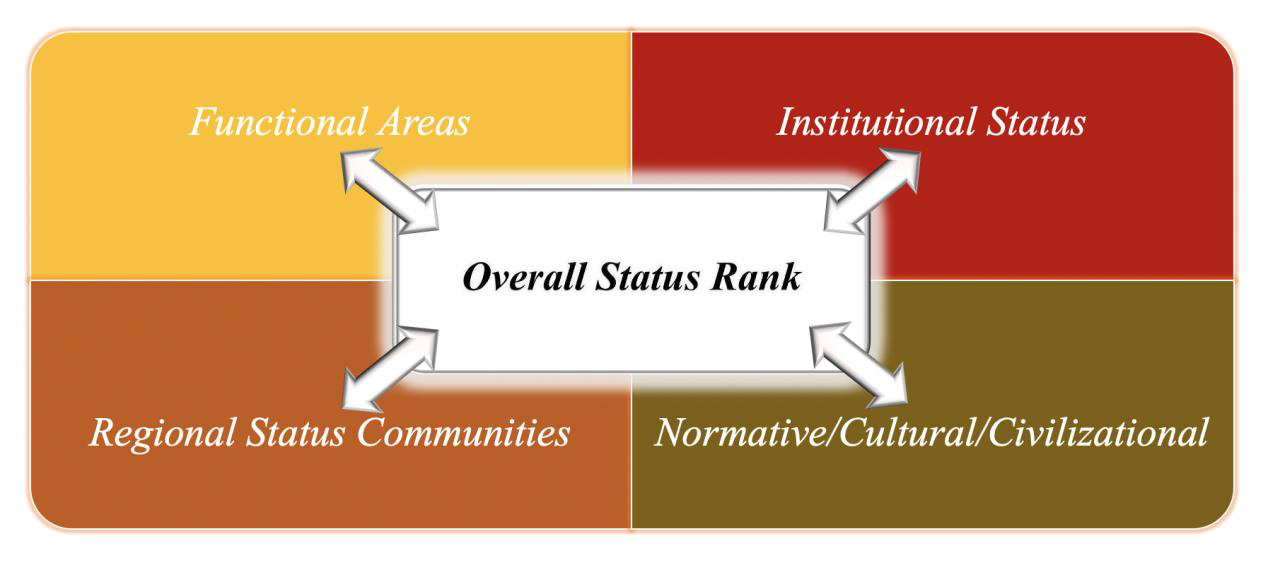
Additionally, a state’s status and influence will vary depending upon how such things as functional area (e.g. technological prowess), geographic region (e.g. Southeast Asia), the institutional setting (e.g. within the UN), and normative features (e.g. with respect to human rights) intersect in any given situation. These varied sub-domains will, nonetheless, intrinsically interconnect with a state’s overall status such that one’s influence in a single domain cannot be analyzed entirely independently of aggregate capacity for influence. Status hierarchies can form an interwoven, matrix like structure, involving feedback mechanisms between sub-domains and aggregate status (see Appendix 7 for graphic representation).
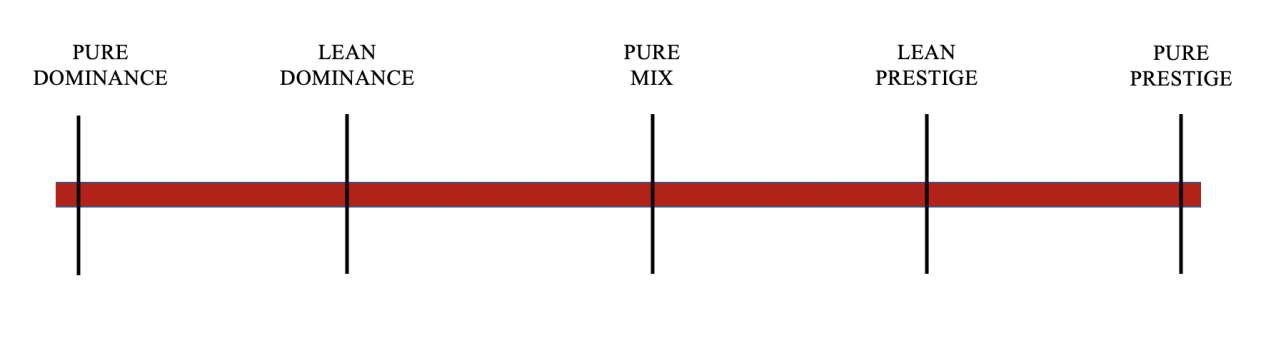
With all this in mind, questions arise regarding how states choose which status attainment strategies, or mix of strategies, to utilize. A major challenge awaiting research in this area in international relations will be empirically and analytically identifying whether states are disproportionately inclined, due to intrinsic and/or extrinsic factors, to favor the use of power or prestige-based strategies to acquire influence. As with individuals, we should not expect states to exclusively deploy dominance or prestige strategies. Rather, we will likely find that states’ status enhancement strategies fall along a spectrum, wherein some states hew more toward dominance/power-based strategies for achieving status rank and influence, and others hew more toward prestige-based strategies (see Appendix 8). Understanding where states fall along this spectrum will both require an understanding of, and offer predictive information about, how states’ leaders think, behave, and enact influence in the international system and in various sub-domains.
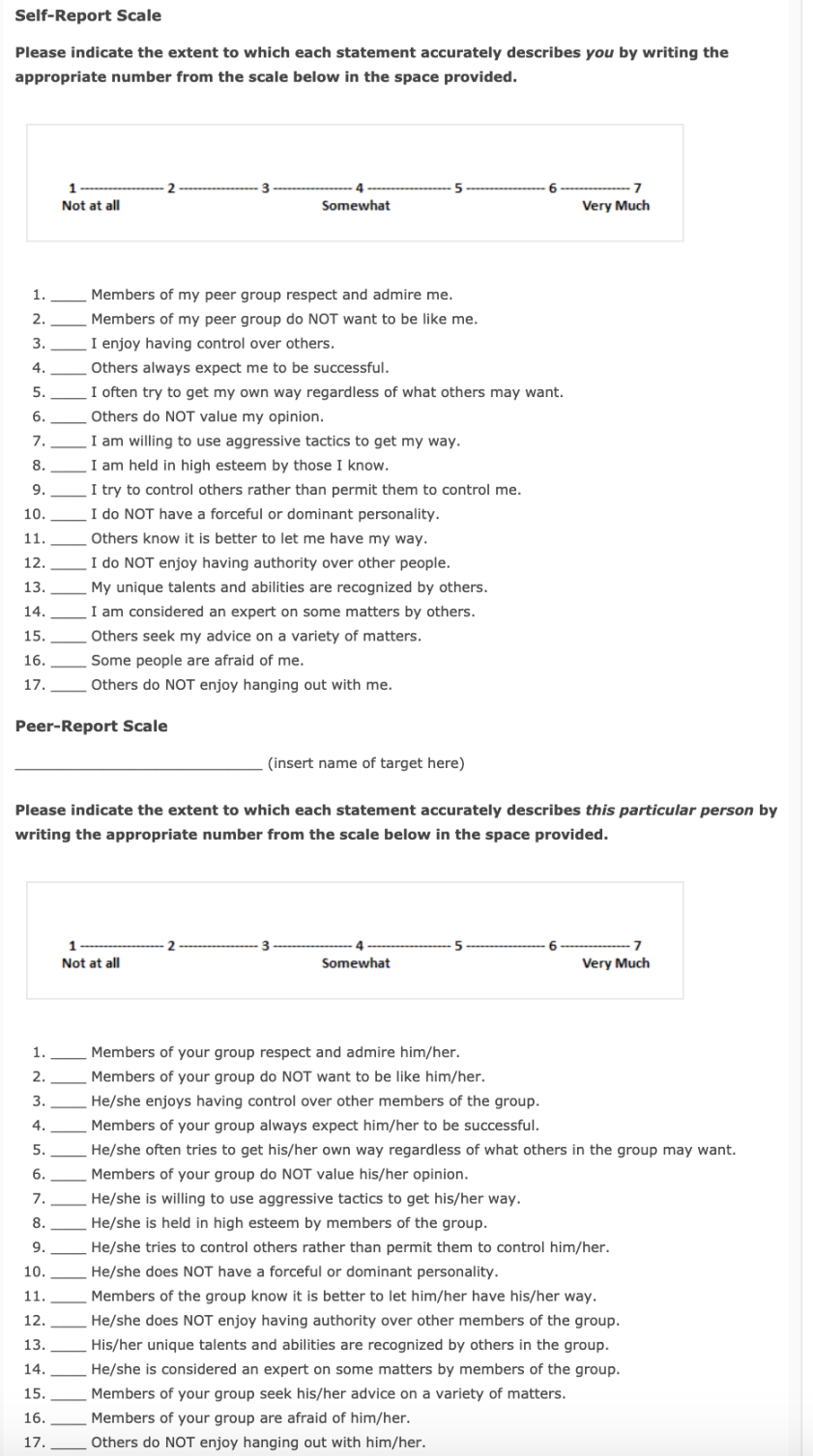
At the same time, we have to consider how individual politicians, diplomats, and leaders impact the status and status-enhancement strategies of their states. Individual leaders bring personalities, behavioral dispositions, and identities that may correspond with pursuing and favoring one status enhancement strategy over another, or may foster a perception of their country as pursuing one more than another. Henrich and Cheng utilize a self and peer reporting scale that can be used to determine an actor’s prestige versus dominance orientation (see Appendix 9 for questionnaire).57Henrich 2010 Future research in international relations may profit from analyzing cohorts of policymakers and leaders in various countries via such questionnaires to understand their status-attainment dispositions. In a similar vein, Zhaotian Luo and Jingyan Jiang use a unique dataset drawn from the Chinese Communist Party’s Central Organization Department to analyze a cohort of Chinese Provincial Party Secretaries leadership styles.58Luo and jiang 2019 The authors find an emergent statistical best-fit that roughly proxies the distinction between dominance and prestige drawn by Henrich et al. Further work in this vein explicitly utilizing tools drawn from the power vs prestige framework may prove fruitful in analyzing and predicting state behaviors.
Additionally, we should heed Jonathan Mercer’s challenge to the field to think more creatively about how we measure status rank and influence in international relations.59Mercer 2017 While a few studies in the 1960s attempted to comprehensively undertake such an endeavor, there has been a noticeable lacuna since.60Shimboria et al 1963; Singer and Small 1966 And, as Mercer also pointed out, those scholars that have undertaken status ordering work tend to rely upon analyses of diplomats, which may not offer an especially clear way to measure status as influence.61See for example Renshon 2017 and Duque 2018 Drawing from the life sciences, there may be a better way to measure status in the international system. It is well established that those with higher status attract attention—typically measured via markers of visual attention—from subordinates.62Henrich 2013 Utilizing natural language processing (NLP), we can analyze each country’s local media ecosystem (as well as official government documents) to establish a rank order of which countries receive the most coverage and attention in aggregate. Such an analysis would be concordant with attention-mediated signals of status from the life sciences and arguably track status rank and influence more accurately than an analysis of diplomats. Furthermore, in conjunction with the aforementioned questionnaires, we might also use NLP, via word associations, to ascertain whether states tend to be perceived as using power or prestige-based status-attainment strategies. We can also use NLP to contextualize when and how states are discussed to establish status rank across various sub-domains of status.
Finally, an extremely important element relevant to application in international relations, and still being explored at the life sciences level, is what environmental, sociological, and geopolitical conditions incentivize power versus prestige strategies. Several studies have been done indicating that high levels of inequality and threatening external environments induce preferences in populations for group leaders to exhibit dominance-oriented strategies.63Ronay, Maddux, von Hippel 2020 Others note that intergroup competition interplays with the prestige-dominance framework such that dominance-oriented leaders are increasingly favored.64Halevy et al 2012 A recent volume on peaceful change in the international system brings into relief the characteristics that incentivize certain status-attainment strategies at the international level. In particular, Pu Xiaoyu’s article on Status Quest and Peaceful Change submits that “to fundamentally transform the international system into a more peaceful one, great powers must promote new norms and a new culture of status symbols in the international system.” This begs the questions: has an evolution within the international system already occurred such that positive status-attainment strategies have become not only increasingly plausible but, in fact, incentivized?
More work will have to be done, but one interesting extension to international relations may be in considering how, over the last two-hundred years, the overall international system has evolved away from geopolitics and toward geo-economics. As globalization has increasingly united the world into one community, economic and technological development has made acquiring land by force a relatively less lucrative—and potentially existentially costly given the existence of nuclear weapons—enterprise from a material perspective, at the same time global normative opinion has evolved such that colonization and imperialism are increasingly anathema. Similarly, lower-tier nation states may be, more than ever before, empowered and internally coherent actors with greater ability to fend off would-be dominators—in a manner not dissimilar to the evolution of our own species as recounted by Boehm. Has the international system changed in such a way that incentives today, perhaps for the first time, disproportionately favor prestige-based rather than dominance-based strategies for acquiring status rank?
Conclusion While it has been widely agreed that states desire status in international relations, the field still lacks a clear framework to understand how states pursue, achieve, and maintain their status. The life science’s prestige and dominance Dual Model, developed mostly within the last two decades, offers a robust and empirically grounded reprieve. This paper has argued that the field of international relations can gain analytic purchase and clarity by utilizing this framework and adopting the definitions and terminology set forth within it. This perspective appreciates that policymakers and scholars need both useful scholarship but are also humans who rely upon intuitive heuristics to make decisions in complex circumstances. Thinking of prestige and power as two distinct ways to gain and enact status rank and influence in the international system may be of utility in this regard to both scholars and practitioners.
Although most people, and most states, endeavor to increase their status rank and influence, the means by which people and states do so can be quite different. Applying the power versus prestige framework to status-rank pursuit in international relations has important implications for our ability to understand and predict how states will behave in the international arena. Will a state operate principally by inducing fear via force, threats, and coercive leverage? Or will a state primarily strive to induce respect and admiration via demonstrations of competence, altruism, and loyalty? In other words, will the status-enhancement strategy rely upon primarily positive or negative means? How will the status-pursuing state go about changing the norms, values, institutions, and overall relational characteristics of the global, social order? This article has attempted to offer scholars and policymakers in international relations a common-sensical heuristic, grounded in empiricism, for analyzing these questions.
Appendices
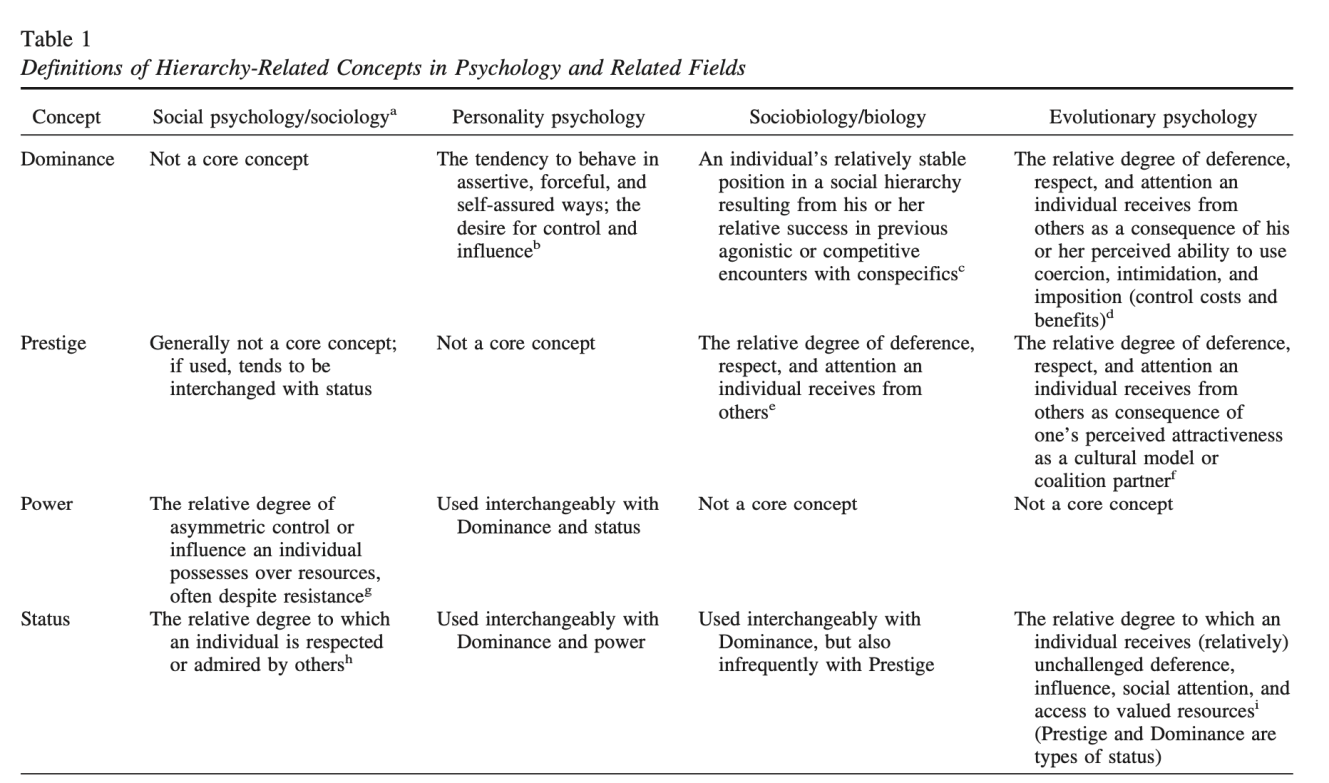
Appendix 1 Table from Henrich et al (2013)
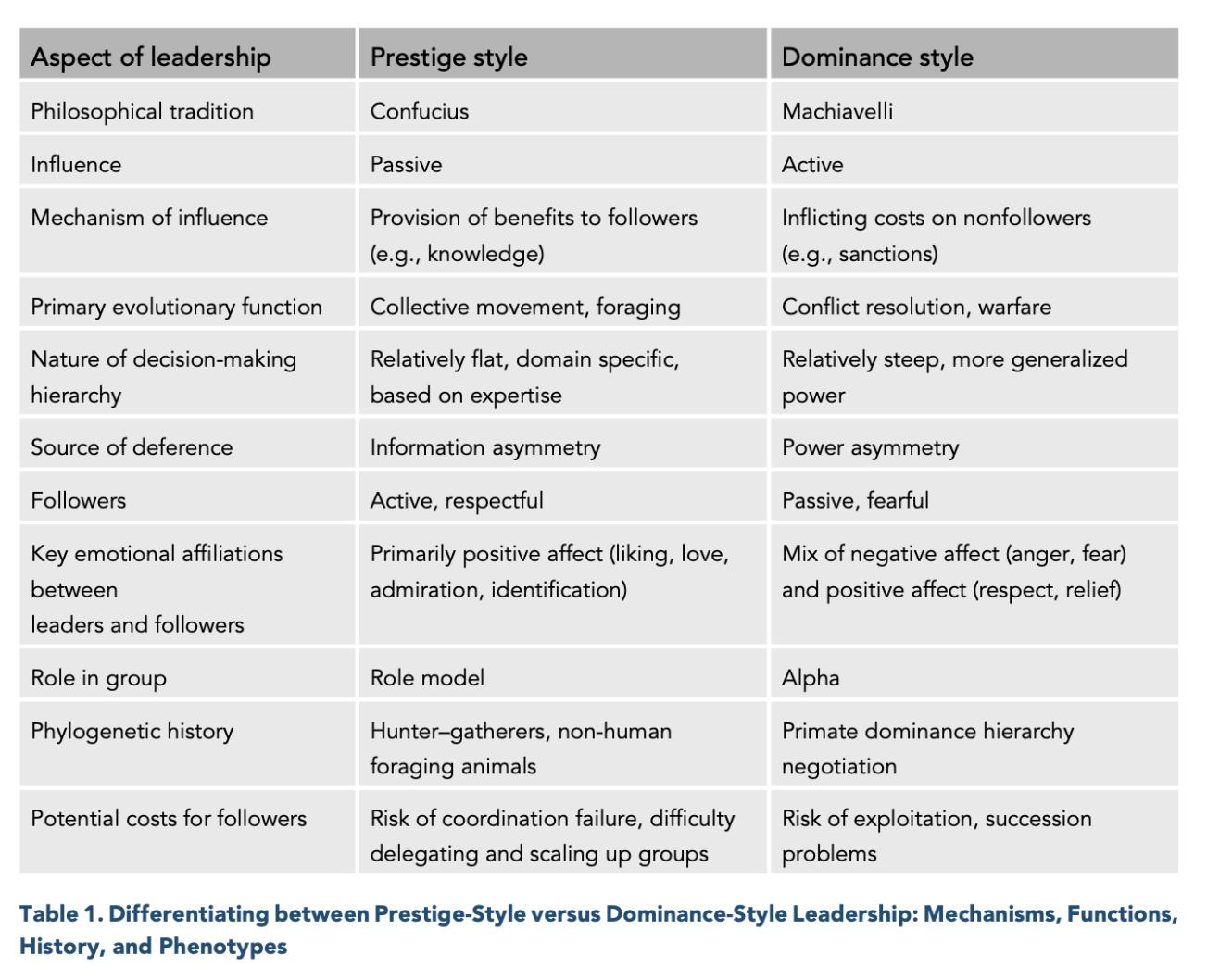
Appendix 2 Table from Van Vugt and Smith (2019)
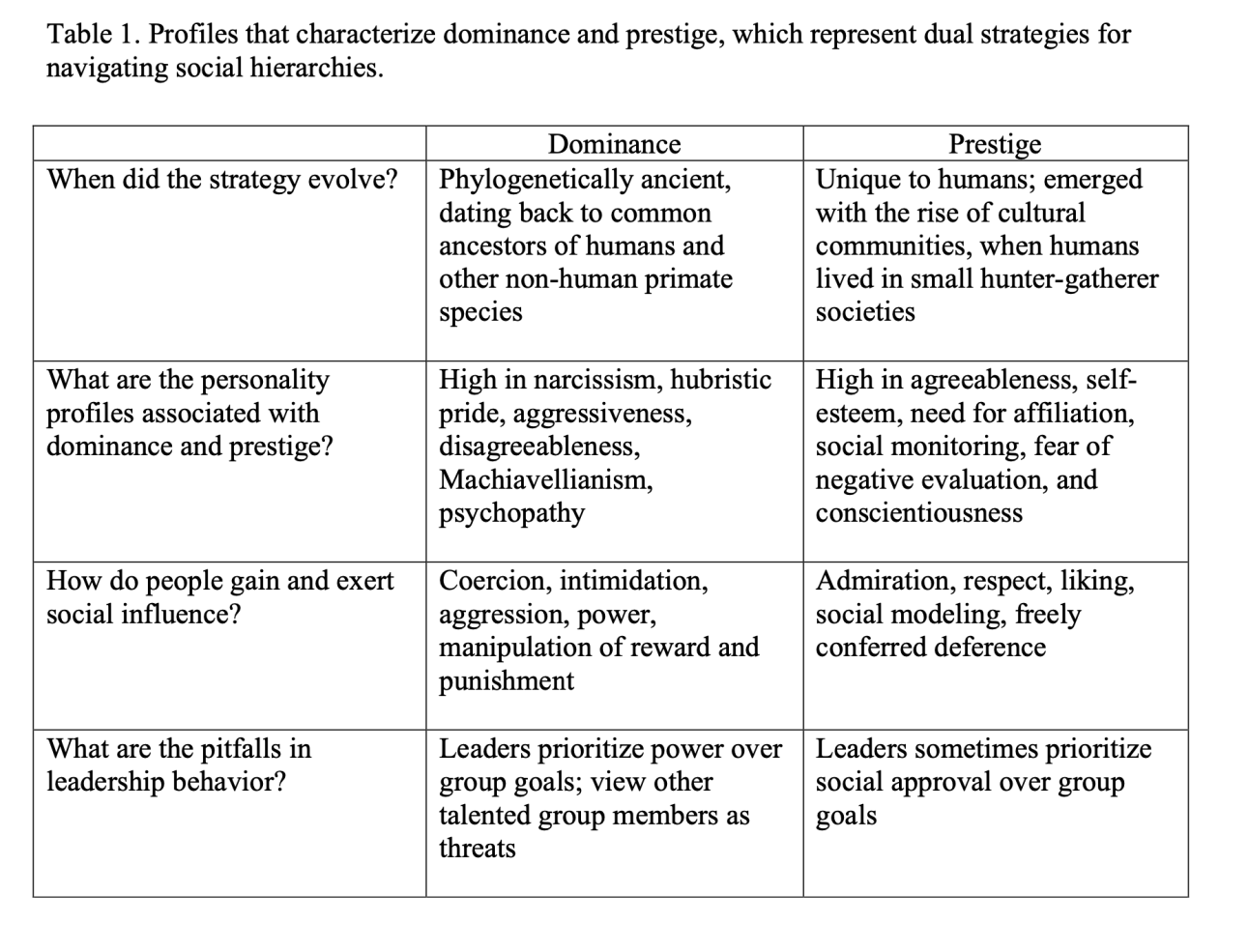
Appendix 3 Table from Manor 2017
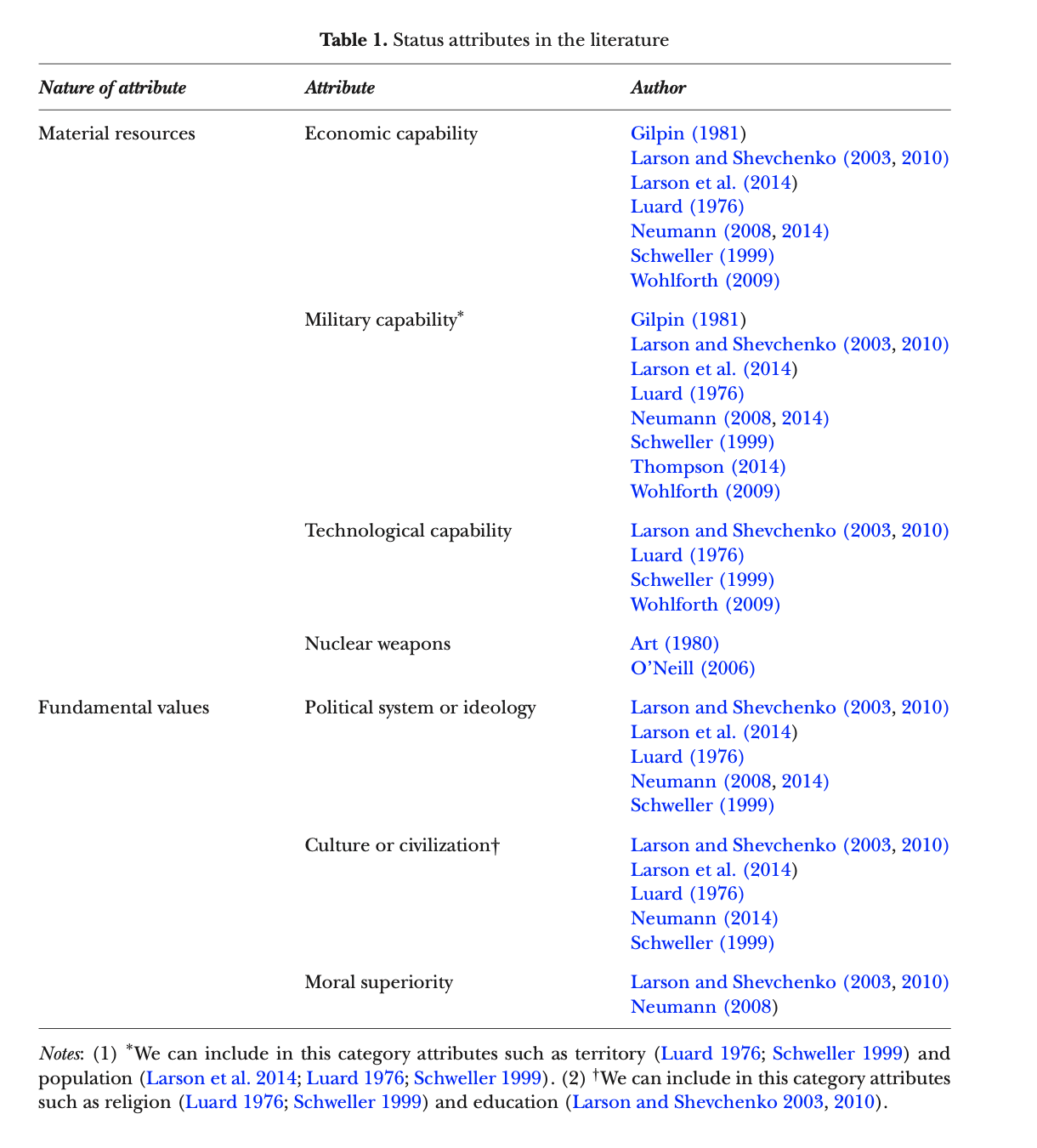
Appendix 4 Table from Duque (2018)
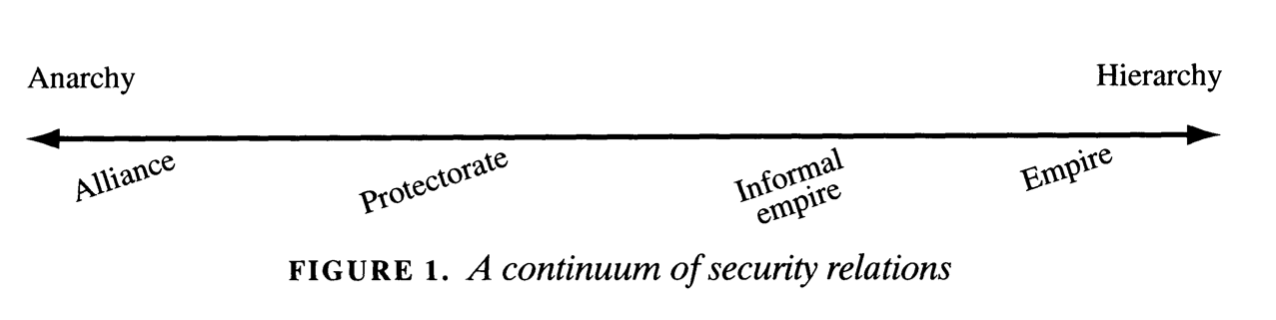
Appendix 5 Figure from Lake (1996)
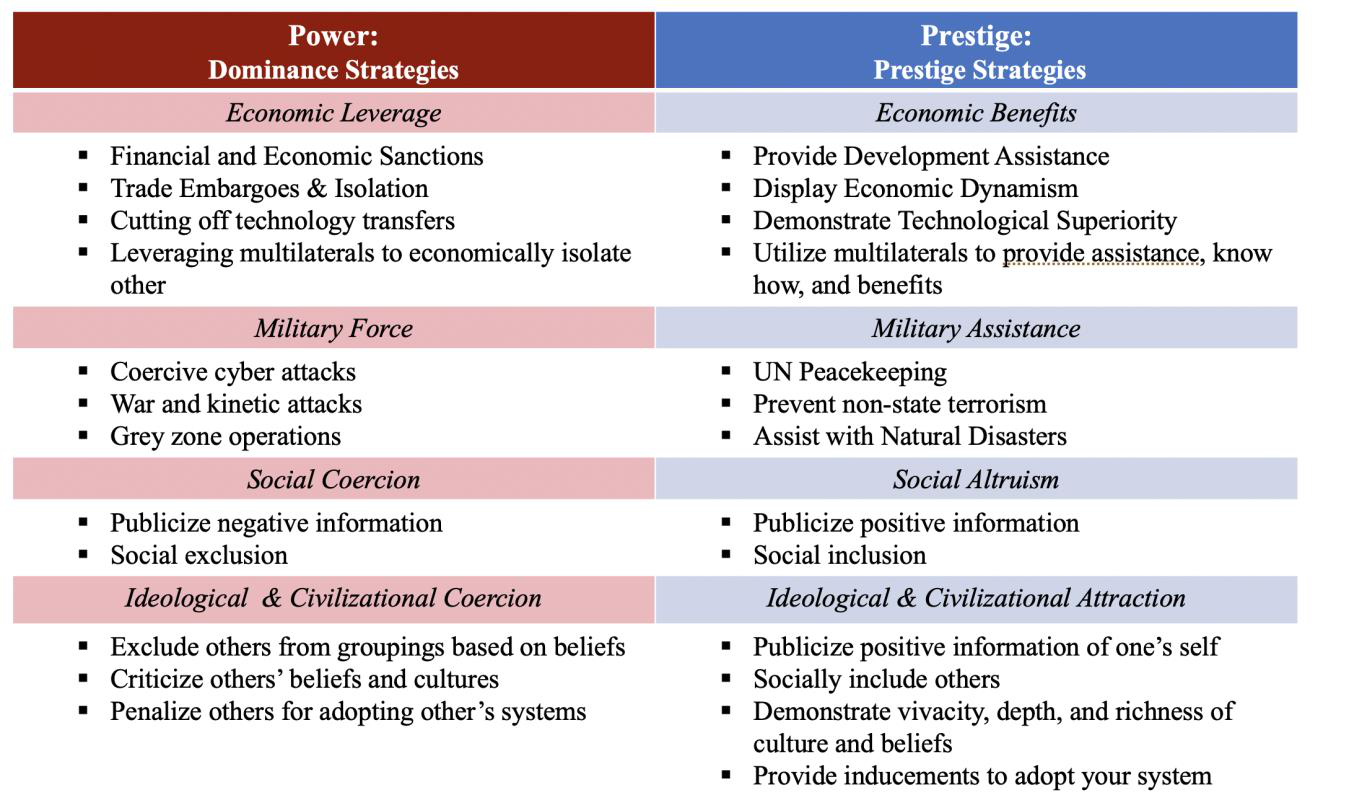
Appendix 6 Figure made by author
Appendix 7 Figure made by author
Appendix 8 Figure made by author
Appendix 9 Dominance-Prestige Scales. From UBC Emotion & Self Lab. http://ubc-emotionlab.ca/research-tools/dominance-prestige-scales/
Bibliography
Life Sciences References
Abbink, Klaus, and Donna Harris. 2019. “In-Group Favouritism and out-Group Discrimination in Naturally Occurring Groups.” PLOS ONE 14 (9): e0221616. https://doi.org/10.1371/journal.pone.0221616.
Alami, Sarah, Christopher von Rueden, Edmond Seabright, Thomas S. Kraft, Aaron D. Blackwell, Jonathan Stieglitz, Hillard Kaplan, and Michael Gurven. 2020. “Mother’s Social Status Is Associated with Child Health in a Horticulturalist Population.” Proceedings of the Royal Society B: Biological Sciences 287 (1922): 20192783. https://doi.org/10.1098/rspb.2019.2783.
Alexander, Scott. 2015. “Contra Simler on Prestige.” Slate Star Codex. October 21, 2015. https://slatestarcodex.com/2015/10/21/contra-simler-on-prestige/.
Anderson, Cameron, John Angus D. Hildreth, and Laura Howland. 2015. “Is the Desire for Status a Fundamental Human Motive? A Review of the Empirical Literature.” Psychological Bulletin 141 (3): 574–601. https://doi.org/10.1037/a0038781.
Anderson, Cameron, and Gavin J. Kilduff. 2009. “The Pursuit of Status in Social Groups.” Current Directions in Psychological Science 18 (5): 295–98. https://doi.org/10.1111/j.1467-8721.2009.01655.x.
Aplin, Lucy. 2016. “Understanding the Multiple Factors Governing Social Learning and the Diffusion of Innovations.” Current Opinion in Behavioral Sciences, Behavioral ecology, 12 (December): 59–65. https://doi.org/10.1016/j.cobeha.2016.09.003.
Archer, John. 2009. “Does Sexual Selection Explain Human Sex Differences in Aggression?” Behavioral and Brain Sciences 32 (3–4): 249–66. https://doi.org/10.1017/S0140525X09990951.
Bai, Feng. 2017. “Beyond Dominance and Competence: A Moral Virtue Theory of Status Attainment.” Personality and Social Psychology Review 21 (3): 203–27. https://doi.org/10.1177/1088868316649297.
Bai, Feng, Grace Ching Chi Ho, and Jin Yan. 2020. “Does Virtue Lead to Status? Testing the Moral Virtue Theory of Status Attainment.” Journal of Personality and Social Psychology 118 (3): 501–31. https://doi.org/10.1037/pspi0000192.
Baldassarri, Delia, and Guy Grossman. 2011. “Centralized Sanctioning and Legitimate Authority Promote Cooperation in Humans.” Proceedings of the National Academy of Sciences 108 (27): 11023–27. https://doi.org/10.1073/pnas.1105456108.
Barkow, Jerome H., Leda Cosmides, and John Tooby. 1995. The Adapted Mind: Evolutionary Psychology and the Generation of Culture. Oxford University Press.
Benenson, Joyce F. 2013. “The Development of Human Female Competition: Allies and Adversaries.” Philosophical Transactions of the Royal Society B: Biological Sciences 368 (1631): 20130079. https://doi.org/10.1098/rstb.2013.0079.
Boehm, C. 2000. “Conflict and the Evolution of Social Control.” Journal of Consciousness Studies 7 (1–2): 79–101.
BOEHM, Christopher, and Christopher Boehm. 2009. Hierarchy in the Forest: The Evolution of Egalitarian Behavior. Harvard University Press.
Bøggild, Troels, and Michael Bang Petersen. 2016. “The Evolved Functions of Procedural Fairness: An Adaptation for Politics.” In The Evolution of Morality, edited by Todd K. Shackelford and Ranald D. Hansen, 247–76. Evolutionary Psychology. Cham: Springer International Publishing. https://doi.org/10.1007/978-3-319-19671-8_12.
Bolló, Henrietta, Beáta Bőthe, István Tóth-Király, and Gábor Orosz. 2018. “Pride and Social Status.” Frontiers in Psychology 9 (October). https://doi.org/10.3389/fpsyg.2018.01979.
Boyce, W. Thomas. 2004. “Social Stratification, Health, and Violence in the Very Young.” Annals of the New York Academy of Sciences 1036 (December): 47–68. https://doi.org/10.1196/annals.1330.003.
Boyd, Robert, and Peter J. Richerson. 2009. “Culture and the Evolution of Human Cooperation.” Philosophical Transactions of the Royal Society B: Biological Sciences 364 (1533): 3281–88. https://doi.org/10.1098/rstb.2009.0134.
Bramble, Dennis M., and Daniel E. Lieberman. 2004. “Endurance Running and the Evolution of Homo.” Nature 432 (7015): 345–52. https://doi.org/10.1038/nature03052.
Brand, C. O., and A. Mesoudi. n.d. “Prestige and Dominance-Based Hierarchies Exist in Naturally Occurring Human Groups, but Are Unrelated to Task-Specific Knowledge.” Royal Society Open Science 6 (5): 181621. https://doi.org/10.1098/rsos.181621.
Brown, Donald E. 2004. “Human Universals, Human Nature & Human Culture.” Daedalus 133 (4): 47–54. https://doi.org/10.1162/0011526042365645.
Byrne, Richard W., Andrew Whiten, and Both at the Psychological Laboratory Andrew Whiten. 1988. Machiavellian Intelligence: Social Expertise and the Evolution of Intellect in Monkeys, Apes, and Humans. Clarendon Press.
Chapais, Bernard. 2010. “The Deep Structure of Human Society: Primate Origins and Evolution.” In Mind the Gap: Tracing the Origins of Human Universals, edited by Peter M. Kappeler and Joan Silk, 19–51. Berlin, Heidelberg: Springer. https://doi.org/10.1007/978-3-642-02725-3_2.
———. 2015. “Competence and the Evolutionary Origins of Status and Power in Humans.” Human Nature 26 (2): 161–83. https://doi.org/10.1007/s12110-015-9227-6.
Cheng, Joey T., Olga Kornienko, and Douglas A. Granger. 2018. “Prestige in a Large-Scale Social Group Predicts Longitudinal Changes in Testosterone.” Journal of Personality and Social Psychology 114 (6): 924–44. https://doi.org/10.1037/pspi0000126.
Cheng, Joey T., and Jessica L. Tracy. 2013. “The Impact of Wealth on Prestige and Dominance Rank Relationships.” Psychological Inquiry 24 (2): 102–8. https://doi.org/10.1080/1047840X.2013.792576.
———. 2020. “Why Social Status Is Essential (But Sometimes Insufficient) for Leadership.” Trends in Cognitive Sciences 24 (4): 261–63. https://doi.org/10.1016/j.tics.2019.12.008.
Damasio, Antonio, and Gil B. Carvalho. 2013. “The Nature of Feelings: Evolutionary and Neurobiological Origins.” Nature Reviews Neuroscience 14 (2): 143–52. https://doi.org/10.1038/nrn3403.
Fowler, James H., and Darren Schreiber. 2008. “Biology, Politics, and the Emerging Science of Human Nature.” Science 322 (5903): 912–14. https://doi.org/10.1126/science.1158188.
Garfield, Zachary H., Christopher von Rueden, and Edward H. Hagen. 2019. “The Evolutionary Anthropology of Political Leadership.” The Leadership Quarterly 30 (1): 59–80. https://doi.org/10.1016/j.leaqua.2018.09.001.
Gat, Azar. 2015. “Proving Communal Warfare among Hunter-Gatherers: The Quasi-Rousseauan Error.” Evolutionary Anthropology: Issues, News, and Reviews 24 (3): 111–26. https://doi.org/10.1002/evan.21446.
Glowacki, Luke, and Chris von Rueden. 2015. “Leadership Solves Collective Action Problems in Small-Scale Societies.” Philosophical Transactions of the Royal Society B: Biological Sciences 370 (1683): 20150010. https://doi.org/10.1098/rstb.2015.0010.
Glowacki, Luke, Michael L. Wilson, and Richard W. Wrangham. 2020. “The Evolutionary Anthropology of War.” Journal of Economic Behavior & Organization 178 (October): 963–82. https://doi.org/10.1016/j.jebo.2017.09.014.
Griskevicius, Vladas, Joshua M. Tybur, Steven W. Gangestad, Elaine F. Perea, Jenessa R. Shapiro, and Douglas T. Kenrick. 2009. “Aggress to Impress: Hostility as an Evolved Context-Dependent Strategy.” Journal of Personality and Social Psychology 96 (5): 980–94. https://doi.org/10.1037/a0013907.
Haidt, Jonathan, and Sara B. Algoe. 2009. “Witnessing Excellence in Action: The ‘Other-Praising’ Emotions of Elevation, Gratitude, and Admiration.” The Journal of Positive Psychology 4 (2): 105–27. https://doi.org/10.1080/17439760802650519.
Halevy, Nir, Eileen Y. Chou, Taya R. Cohen, and Robert W. Livingston. 2012. “Status Conferral in Intergroup Social Dilemmas: Behavioral Antecedents and Consequences of Prestige and Dominance.” Journal of Personality and Social Psychology 102 (2): 351–66. https://doi.org/10.1037/a0025515.
Halevy, Nir, Eileen Y. Chou, Taya Cohen, and Robert W. Livingston. 2004. “Status Conferral in Intergroup Social Dilemmas: Behavioral Antecedents and Consequences of Prestige and Dominance.,” July. https://doi.org/10.1184/R1/6708179.v1.
Henrich, Joseph. 2020. The WEIRDest People in the World: How the West Became Psychologically Peculiar and Particularly Prosperous. Farrar, Straus and Giroux.
Henrich, Joseph, Joey T. Cheng, and Jessica L. Tracy. 2010. “Pride, Personality, and the Evolutionary Foundations of Human Social Status.” Evolution and Human Behavior 31 (5): 334–47. https://doi.org/10.1016/j.evolhumbehav.2010.02.004.
Henrich, Joseph, Joey T. Cheng, Jessica L. Tracy, Tom Foulsham, and Alan Kingstone. 2013. “Two Ways to the Top: Evidence That Dominance and Prestige Are Distinct yet Viable Avenues to Social Rank and Influence.” Journal of Personality and Social Psychology 104 (1): 103–25. https://doi.org/10.1037/a0030398.
Henrich, Joseph, Maciej Chudek, and Robert Boyd. 2015. “The Big Man Mechanism: How Prestige Fosters Cooperation and Creates Prosocial Leaders.” Philosophical Transactions of the Royal Society B: Biological Sciences 370 (1683): 20150013. https://doi.org/10.1098/rstb.2015.0013.
Henrich, Joseph, and Francisco J Gil-White. 2001. “The Evolution of Prestige: Freely Conferred Deference as a Mechanism for Enhancing the Benefits of Cultural Transmission.” Evolution and Human Behavior 22 (3): 165–96. https://doi.org/10.1016/S1090-5138(00)00071-4.
Hippel, William von. 2018. The Social Leap: The New Evolutionary Science of Who We Are, Where We Come From, and What Makes Us Happy. Illustrated edition. New York: Harper Wave.
Jiménez, Ángel V., Adam Flitton, and Alex Mesoudi. 2020. “When Do People Prefer Dominant over Prestigious Political Leaders?” OSF Preprints. https://doi.org/10.31219/osf.io/68zca.
Jiménez, Ángel V., and Alex Mesoudi. 2019. “The Integrated Dual Evolutionary Model of Social Hierarchy.” PsyArXiv. https://doi.org/10.31234/osf.io/sh7mg.
Johnson, Ryan T., Joshua A. Burk, and Lee A. Kirkpatrick. 2007. “Dominance and Prestige as Differential Predictors of Aggression and Testosterone Levels in Men.” Evolution and Human Behavior 28 (5): 345–51. https://doi.org/10.1016/j.evolhumbehav.2007.04.003.
Kakkar, Hemant, and Niro Sivanathan. 2017. “When the Appeal of a Dominant Leader Is Greater than a Prestige Leader.” Proceedings of the National Academy of Sciences, June, 201617711. https://doi.org/10.1073/pnas.1617711114.
Kakkar, Hemant, Niro Sivanathan, and Matthias S. Gobel. 2019. “Fall from Grace: The Role of Dominance and Prestige in the Punishment of High-Status Actors.” Academy of Management Journal 63 (2): 530–53. https://doi.org/10.5465/amj.2017.0729.
Krause, Jens, Graeme D. Ruxton, and Stefan Krause. 2010. “Swarm Intelligence in Animals and Humans.” Trends in Ecology & Evolution 25 (1): 28–34. https://doi.org/10.1016/j.tree.2009.06.016.
Majolo, B., J. Lehmann, A. de Bortoli Vizioli, and G. Schino. 2012. “Fitness-Related Benefits of Dominance in Primates.” American Journal of Physical Anthropology 147 (4): 652–60. https://doi.org/10.1002/ajpa.22031.
Maner, J. K., and C. R. Case. 2016. “Chapter Three - Dominance and Prestige: Dual Strategies for Navigating Social Hierarchies.” In Advances in Experimental Social Psychology, edited by James M. Olson and Mark P. Zanna, 54:129–80. Academic Press. https://doi.org/10.1016/bs.aesp.2016.02.001.
Maner, Jon K. 2017. “Dominance and Prestige: A Tale of Two Hierarchies.” Current Directions in Psychological Science 26 (6): 526–31. https://doi.org/10.1177/0963721417714323.
Mark, Noah P., Lynn Smith-Lovin, and Cecilia L. Ridgeway. 2009. “Why Do Nominal Characteristics Acquire Status Value? A Minimal Explanation for Status Construction.” American Journal of Sociology 115 (3): 832–62. https://doi.org/10.1086/606142.
Mattan, Bradley D., Jennifer T. Kubota, and Jasmin Cloutier. 2017. “How Social Status Shapes Person Perception and Evaluation: A Social Neuroscience Perspective.” Perspectives on Psychological Science 12 (3): 468–507. https://doi.org/10.1177/1745691616677828.
Mehta, Pranjal H., Nicole M. Lawless DesJardins, Mark van Vugt, and Robert A. Josephs. 2017. “Hormonal Underpinnings of Status Conflict: Testosterone and Cortisol Are Related to Decisions and Satisfaction in the Hawk-Dove Game.” Hormones and Behavior, Hormones and Human Competition, 92 (June): 141–54. https://doi.org/10.1016/j.yhbeh.2017.03.009.
Mesoudi, Alex. 2011. Cultural Evolution: How Darwinian Theory Can Explain Human Culture and Synthesize the Social Sciences. Illustrated Edition. Chicago; London: University of Chicago Press.
Muñoz-Reyes, J. A., P. Polo, N. Valenzuela, P. Pavez, O. Ramírez-Herrera, O. Figueroa, C. Rodriguez-Sickert, D. Díaz, and M. Pita. 2020. “The Male Warrior Hypothesis: Testosterone-Related Cooperation and Aggression in the Context of Intergroup Conflict.” Scientific Reports 10 (1): 375. https://doi.org/10.1038/s41598-019-57259-0.
Petersen, Michael Bang, Daniel Sznycer, Aaron Sell, Leda Cosmides, and John Tooby. 2013. “The Ancestral Logic of Politics: Upper-Body Strength Regulates Men’s Assertion of Self-Interest Over Economic Redistribution.” Psychological Science, May. https://doi.org/10.1177/0956797612466415.
Pinker, Steven. 2003. The Blank Slate: The Modern Denial of Human Nature. Penguin.
Redhead, Daniel, Joey T. Cheng, Charles Driver, Tom Foulsham, and Rick O’Gorman. 2019. “On the Dynamics of Social Hierarchy: A Longitudinal Investigation of the Rise and Fall of Prestige, Dominance, and Social Rank in Naturalistic Task Groups.” Evolution and Human Behavior 40 (2): 222–34. https://doi.org/10.1016/j.evolhumbehav.2018.12.001.
Renshon, Jonathan, Gary D. Sherman, Jennifer S. Lerner, Robert A. Josephs, and James J. Gross. 2016. “The Interaction of Testosterone and Cortisol Is Associated with Attained Status in Male Executives.” Journal of Personality and Social Psychology 110 (6): 921–29. https://doi.org/10.1037/pspp0000063.
Richerson, Peter J., Robert T. Boyd, and Joseph Henrich. 2003. “Cultural Evolution of Human Cooperation.” In Genetic and Cultural Evolution of Cooperation, 357–88. Dahlem Workshop Report. Cambridge, MA, US: MIT Press.
Ronay, Richard, Katharine Greenaway, Eric M. Anicich, and Adam D. Galinsky. 2012. “The Path to Glory Is Paved With Hierarchy: When Hierarchical Differentiation Increases Group Effectiveness.” Psychological Science 23 (6): 669–77. https://doi.org/10.1177/0956797611433876.
Ronay, Richard, William W. Maddux, and William von Hippel. 2020. “Inequality Rules: Resource Distribution and the Evolution of Dominance-and Prestige-Based Leadership.” The Leadership Quarterly 31 (2): 101246. https://doi.org/10.1016/j.leaqua.2018.04.004.
Rueden, Chris von, Sarah Alami, Hillard Kaplan, and Michael Gurven. 2018. “Sex Differences in Political Leadership in an Egalitarian Society.” Evolution and Human Behavior 39 (4): 402–11. https://doi.org/10.1016/j.evolhumbehav.2018.03.005.
Rueden, Christopher R. von, and Adrian V. Jaeggi. 2016. “Men’s Status and Reproductive Success in 33 Nonindustrial Societies: Effects of Subsistence, Marriage System, and Reproductive Strategy.” Proceedings of the National Academy of Sciences 113 (39): 10824–29. https://doi.org/10.1073/pnas.1606800113.
Rueden, Christopher von, Michael Gurven, and Hillard Kaplan. 2011. “Why Do Men Seek Status? Fitness Payoffs to Dominance and Prestige.” Proceedings of the Royal Society B: Biological Sciences 278 (1715): 2223–32. https://doi.org/10.1098/rspb.2010.2145.
Rueden, Christopher von, and Mark van Vugt. 2015. “Leadership in Small-Scale Societies: Some Implications for Theory, Research, and Practice.” The Leadership Quarterly 26 (6): 978–90. https://doi.org/10.1016/j.leaqua.2015.10.004.
Sapolsky, Robert M. 2004. “Social Status and Health in Humans and Other Animals.” Annual Review of Anthropology 33 (1): 393–418. https://doi.org/10.1146/annurev.anthro.33.070203.144000.
———. 2005. “The Influence of Social Hierarchy on Primate Health.” Science 308 (5722): 648–52. https://doi.org/10.1126/science.1106477.
Sasaki, Takao, and Dora Biro. 2017. “Cumulative Culture Can Emerge from Collective Intelligence in Animal Groups.” Nature Communications 8 (1): 15049. https://doi.org/10.1038/ncomms15049.
Shultz, Susanne, and Mark Maslin. 2013. “Early Human Speciation, Brain Expansion and Dispersal Influenced by African Climate Pulses.” PLOS ONE 8 (10): e76750. https://doi.org/10.1371/journal.pone.0076750.
Simler, Kevin. 2015a. “Social Status: Down the Rabbit Hole | Melting Asphalt.” October 2015. https://meltingasphalt.com/social-status-down-the-rabbit-hole/.
———. 2015b. “Social Status II: Cults and Loyalty | Melting Asphalt.” November 2015. https://meltingasphalt.com/social-status-ii-cults-and-loyalty/.
Smith, Eric Alden. 2016. “Status Effects on Men’s Reproductive Success.” Proceedings of the National Academy of Sciences 113 (39): 10739–41. https://doi.org/10.1073/pnas.1613351113.
Smith, J Maynard. 1974. “The Theory of Games and the Evolution of Animal Conllkts,” 13.
Smith, Jennifer E., Sergey Gavrilets, Monique Borgerhoff Mulder, Paul L. Hooper, Claire El Mouden, Daniel Nettle, Christoph Hauert, et al. 2016. “Leadership in Mammalian Societies: Emergence, Distribution, Power, and Payoff.” Trends in Ecology & Evolution 31 (1): 54–66. https://doi.org/10.1016/j.tree.2015.09.013.
Spencer, Charles S. 1993. “Human Agency, Biased Transmission, and the Cultural Evolution of Chiefly Authority.” Journal of Anthropological Archaeology 12 (1): 41–74. https://doi.org/10.1006/jaar.1993.1002.
Suessenbach, Felix, Steve Loughnan, Felix D. Schönbrodt, and Adam B. Moore. 2019. “The Dominance, Prestige, and Leadership Account of Social Power Motives.” European Journal of Personality 33 (1): 7–33. https://doi.org/10.1002/per.2184.
“The Role of Physical Formidability in Human Social Status Allocation. - PsycNET.” 2016. 2016. /doiLanding?doi=10.1037%2Fpspi0000042.
Van Vugt, Mark. 2006. “Evolutionary Origins of Leadership and Followership.” Personality and Social Psychology Review 10 (4): 354–71. https://doi.org/10.1207/s15327957pspr1004_5.
Van Vugt, Mark, and Michael E. Price. 2014. “The Evolution of Leader–Follower Reciprocity: The Theory of Service-for-Prestige.” Frontiers in Human Neuroscience 8. https://doi.org/10.3389/fnhum.2014.00363.
Van Vugt, Mark, and Jennifer E. Smith. 2019. “A Dual Model of Leadership and Hierarchy: Evolutionary Synthesis.” Trends in Cognitive Sciences 23 (11): 952–67. https://doi.org/10.1016/j.tics.2019.09.004.
Vugt, Mark Van. 2016. “Evolutionary Origins of Leadership and Followership:” Personality and Social Psychology Review, December. https://doi.org/10.1207/s15327957pspr1004_5.
Vugt, Mark van, and Joshua M Tybur. 2014. “The Evolutionary Foundations of Hierarchy:” In The Handbook of Evolutionary Psychology, 40.
Waal, Frans B. M. de, Victoria Horner, Darby Proctor, Kristin E. Bonnie, and Andrew Whiten. 2010. “Prestige Affects Cultural Learning in Chimpanzees.” PLOS ONE 5 (5): e10625. https://doi.org/10.1371/journal.pone.0010625.
Zink, Caroline F., Yunxia Tong, Qiang Chen, Danielle S. Bassett, Jason L. Stein, and Andreas Meyer-Lindenberg. 2008. “Know Your Place: Neural Processing of Social Hierarchy in Humans.” Neuron 58 (2): 273–83. https://doi.org/10.1016/j.neuron.2008.01.025.
International Relations References
Buzan, Barry. 2010. “Culture and International Society.” International Affairs 86 (1): 1–25. https://doi.org/10.1111/j.1468-2346.2010.00866.x.
BUZAN, BARRY, and RICHARD LITTLE. 1996. “Reconceptualizing Anarchy:: Structural Realism Meets World History.” European Journal of International Relations 2 (4): 403–38. https://doi.org/10.1177/1354066196002004001.
Buzan, Barry, and Richard Little. 2000. International Systems in World History: Remaking the Study of International Relations. Oxford, New York: Oxford University Press.
Castano, Emanuele, Simona Sacchi, and Peter Hays Gries. 2003. “The Perception of the Other in International Relations: Evidence for the Polarizing Effect of Entitativity.” Political Psychology 24 (3): 449–68. https://doi.org/10.1111/0162-895X.00336.
Cooley, Alexander. 2008. Logics of Hierarchy: The Organization of Empires, States, and Military Occupations. 1st Edition. Ithaca, NY: Cornell University Press.
Deng, Yong. 2011. “The Power and Politics of Recognition: Status in China’s Foreign Relations.” In Major Powers and the Quest for Status in International Politics: Global and Regional Perspectives, edited by Thomas J. Volgy, Renato Corbetta, Keith A. Grant, and Ryan G. Baird, 77–95. Evolutionary Processes in World Politics. New York: Palgrave Macmillan US. https://doi.org/10.1057/9780230119314_4.
Dore, R. P. 1975. “The Prestige Factor in International Affairs.” International Affairs (Royal Institute of International Affairs 1944-) 51 (2): 190–207. https://doi.org/10.2307/2617232.
Dreyer, June Teufel. 2015. “The ‘Tianxia Trope’: Will China Change the International System?” Journal of Contemporary China 24 (96): 1015–31. https://doi.org/10.1080/10670564.2015.1030951.
Duque, Marina G. 2018. “Recognizing International Status: A Relational Approach.” International Studies Quarterly 62 (3): 577–92. https://doi.org/10.1093/isq/sqy001.
Gelfand, Michele J., Jana L. Raver, Lisa Nishii, Lisa M. Leslie, Janetta Lun, Beng Chong Lim, Lili Duan, et al. 2011. “Differences Between Tight and Loose Cultures: A 33-Nation Study.” Science 332 (6033): 1100–1104. https://doi.org/10.1126/science.1197754.
Hafner-Burton, Emilie M., Stephan Haggard, David A. Lake, and David G. Victor. 2017. “The Behavioral Revolution and International Relations.” International Organization 71 (S1): S1–31. https://doi.org/10.1017/S0020818316000400.
Halevy, Nir, and Taya R. Cohen. 2019. “Intergroup Conflict 2020.” Negotiation and Conflict Management Research 12 (2): 161–73. https://doi.org/10.1111/ncmr.12148.
Hall, Todd H. n.d. Emotional Diplomacy: Official Emotion on the International Stage. Emotional Diplomacy. Cornell University Press. Accessed October 21, 2020. https://cornell.universitypressscholarship.com/view/10.7591/cornell/9780801453014.001.0001/u pso-9780801453014.
Hobson, John M., and J. C. Sharman. 2005. “The Enduring Place of Hierarchy in World Politics: Tracing the Social Logics of Hierarchy and Political Change.” European Journal of International Relations 11 (1): 63–98. https://doi.org/10.1177/1354066105050137.
III, F. Gregory Gause. 2019. “‘Hegemony’ Compared: Great Britain and the United States in the Middle East.” Security Studies 28 (3): 565–87. https://doi.org/10.1080/09636412.2019.1604987.
Ikenberry, G. John, and Charles A. Kupchan. 1990. “Socialization and Hegemonic Power.” International Organization 44 (3): 283–315.
Ikenberry, G. John, and Daniel H. Nexon. 2019. “Hegemony Studies 3.0: The Dynamics of Hegemonic Orders.” Security Studies 28 (3): 395–421. https://doi.org/10.1080/09636412.2019.1604981.
Inglehart, Ronald F. 2018. Cultural Evolution: People’s Motivations Are Changing, and Reshaping the World. Cambridge University Press.
Jacobi, Daniel. 2020. “Human Nature in International Relations.” Obo. 2020. https://www.oxfordbibliographies.com/view/document/obo-9780199743292/obo-9780199743292-0286.xml.
Jiang, Junyan, and Zhaotian Luo. 2019. “Leadership Styles and Political Survival of Chinese Communist Party Elites.” Journal of Politics.
Kacos, Samantha Anne. 2011. “Reconstructing Respect: The Quest for Prestige in the International System,” 150.
Kang, David C. 2010. “Hierarchy and Legitimacy in International Systems: The Tribute System in Early Modern East Asia.” Security Studies 19 (4): 591–622. https://doi.org/10.1080/09636412.2010.524079.
———. 2020. “International Order in Historical East Asia: Tribute and Hierarchy Beyond Sinocentrism and Eurocentrism.” International Organization 74 (1): 65–93. https://doi.org/10.1017/S0020818319000274.
Kertzer, Joshua D., and Kathleen M. McGraw. 2012. “Folk Realism: Testing the Microfoundations of Realism in Ordinary Citizens.” International Studies Quarterly 56 (2): 245–58. https://doi.org/10.1111/j.1468-2478.2011.00715.x.
Khong, Yuen Foong. 2019. “Power as Prestige in World Politics.” International Affairs 95 (1): 119– 42. https://doi.org/10.1093/ia/iiy245.
Kim, Youngho. 2004. “Does Prestige Matter in International Politics?” Journal of International and Area Studies 11 (1): 39–55.
Kunz, Barbara. 2010. “Hans J. Morgenthau’s Political Realism, Max Weber, and the Concept of Power.” Max Weber Studies 10 (2): 189–208.
Kwan, Alan Shiu Cheung. 2016. “Hierarchy, Status and International Society: China and the Steppe Nomads.” European Journal of International Relations 22 (2): 362–83. https://doi.org/10.1177/1354066115598385.
Lake, David. 2020. “Hierarchies in International Relations.” Obo. 2020. https://www.oxfordbibliographies.com/view/document/obo-9780199743292/obo-9780199743292-0285.xml.
Lake, David A. 1996. “Anarchy, Hierarchy, and the Variety of International Relations.” International Organization 50 (1): 1–33.
———. 2003. “The New Sovereignty in International Relations.” International Studies Review 5 (3): 303–23.
———. 2007. “Escape from the State of Nature: Authority and Hierarchy in World Politics.” International Security 32 (1): 47–79. https://doi.org/10.1162/isec.2007.32.1.47.
———. 2017. “Hierarchy and International Relations: Theory and Evidence.” In Oxford Research Encyclopedia of Politics, by David A. Lake. Oxford University Press. https://doi.org/10.1093/acrefore/9780190228637.013.324.
Lanoszka, Alexander. 2013. “Beyond Consent and Coercion: Using Republican Political Theory to Understand International Hierarchies.” International Theory 5 (3): 382–413. https://doi.org/10.1017/S1752971913000249.
Larson, Deborah Welch, T. V. Paul, and William C. Wohlforth. 2014. “Status and World Order.” In Status in World Politics, edited by T.V. Paul, Deborah Welch Larson, and William C. Wohlforth, 3–30. Cambridge: Cambridge University Press. https://doi.org/10.1017/CBO9781107444409.002.
Larson, Deborah Welch, and Alexei Shevchenko. 2010. “Status Seekers: Chinese and Russian Responses to U.S. Primacy.” International Security 34 (4): 63–95.
Lebow, Richard Ned. 2008a. “Identity and International Relations.” International Relations 22 (4): 473–92. https://doi.org/10.1177/0047117808097312.
———. 2008b. A Cultural Theory of International Relations. Cambridge University Press.
Markey, Daniel. 1999. “Prestige and the Origins of War: Returning to Realism’s Roots.” Security Studies 8 (4): 126–72. https://doi.org/10.1080/09636419908429388.
Mastanduno, Michael. 2019. “Partner Politics: Russia, China, and the Challenge of Extending US Hegemony after the Cold War.” Security Studies 28 (3): 479–504. https://doi.org/10.1080/09636412.2019.1604984.
Mattern, Janice Bially, and Ayşe Zarakol. 2016. “Hierarchies in World Politics.” International Organization 70 (3): 623–54. https://doi.org/10.1017/S0020818316000126.
McDermott, Rose, and James W. Davis. 2020. “The Past, Present, and Future of Behavioral IR.” International Organization, September, 1–31. https://doi.org/10.1017/S0020818320000272.
McDermott, Rose, and Anthony C. Lopez. 2012. “Adaptation, Heritability, and the Emergence of Evolutionary Political Science.” Political Psychology 33 (3): 343–62. https://doi.org/10.1111/j.1467-9221.2012.00880.x.
Mercer, Jonathan. 2017. “The Illusion of International Prestige.” International Security 41 (4): 133– 68. https://doi.org/10.1162/ISEC_a_00276.
Morgenthau, Hans, and Kenneth Thompson. 1948. Politics Among Nations, Brief Edition. 1st Edition. New York: McGraw-Hill Humanities/Social Sciences/Languages.
Musgrave, Paul, Meghan Mcconaughey, and Daniel H. Nexon. 2018. “Beyond Anarchy: Logics of Political Organization, Hierarchy, and International Structure.” International Theory 10 (2): 181– 218. https://doi.org/10.1017/S1752971918000040.
Musgrave, Paul, and Daniel H. Nexon. 2018. “Defending Hierarchy from the Moon to the Indian Ocean: Symbolic Capital and Political Dominance in Early Modern China and the Cold War.” International Organization 72 (3): 591–626. https://doi.org/10.1017/S0020818318000139.
Nexon, Daniel H., and Stacie E. Goddard. 2016. “The Dynamics of Global Power Politics: A Framework for Analysis.” Journal of Global Security Studies 1 (1): 4–18. https://doi.org/10.1093/jogss/ogv007.
Nexon, Daniel H., and Thomas Wright. 2007. “What’s at Stake in the American Empire Debate.” American Political Science Review 101 (2): 253–71. https://doi.org/10.1017/S0003055407070220.
Nye, Joseph S. 1990. “Soft Power.” Foreign Policy, no. 80: 153–71. https://doi.org/10.2307/1148580.
Paul, T. V., and Mahesh Shankar. 2014. “Status Accommodation through Institutional Means: India’s Rise and the Global Order.” In Status in World Politics, edited by T.V. Paul, Deborah Welch Larson, and William C. Wohlforth, 165–91. Cambridge: Cambridge University Press. https://doi.org/10.1017/CBO9781107444409.011.
Paul, T. V., Deborah Welch Larson, and William C. Wohlforth, eds. 2014. Status in World Politics. Cambridge: Cambridge University Press. https://doi.org/10.1017/CBO9781107444409.
Paul, T.V. 2019. “OUP-Handbook-on-Peaceful-Change-Proposal-Web.Pdf.” 2019. https://www.grenpec.com/wp-content/uploads/2019/07/OUP-Handbook-on-Peaceful-Change-Proposal-Web.pdf.
Pu, Xiaoyu. 2020. “Status Quest and Peaceful Change.” The Oxford Handbook of Peaceful Change in International Relations. October 8, 2020. https://doi.org/10.1093/oxfordhb/9780190097356.013.24.
Renshon, Jonathan, Allan Dafoe, and Paul Huth. 2014. “Reputation and Status as Motives for War.” Annual Review of Political Science 17 (1): 371–93. https://doi.org/10.1146/annurev-polisci-071112-213421.
Renshon, Jonathan. 2017. Fighting for Status: Hierarchy and Conflict in World Politics. Princeton, New Jersey: Princeton University Press.
Reus-Smit, Christian. 2017. “Cultural Diversity and International Order.” International Organization 71 (4): 851–85. https://doi.org/10.1017/S0020818317000261.
Rolland, Nadège. 2020. “China’s Vision for a New World Order.” National Bureau for Asian Research, January, 68.
Rosen, Stephen Peter. 2007. War and Human Nature. Annotated Edition. Princeton, NJ: Princeton University Press.
Sherif, Muzafer. 1958. “Superordinate Goals in the Reduction of Intergroup Conflict.” American Journal of Sociology 63 (4): 349–56.
Shifrinson, Joshua. 2020. “Realism and Peaceful Change.” The Oxford Handbook of Peaceful Change in International Relations. October 8, 2020. https://doi.org/10.1093/oxfordhb/9780190097356.013.6.
Shimbori, Michiya, Hideo Ikeda, Tsuyoshi Ishida, and Motô Kondô. 1963. “Measuring a Nation’s Prestige.” American Journal of Sociology 69 (1): 63–68. https://doi.org/10.1086/223511.
Singer, J. David. 1963. “Inter-Nation Influence: A Formal Model.” The American Political Science Review 57 (2): 420–30. https://doi.org/10.2307/1952832.
Singer, J. David, and Melvin Small. 1966. “The Composition and Status Ordering of the International System: 1815-1940.” World Politics 18 (2): 236–82. https://doi.org/10.2307/2009697.
Sinno, Abdulkadeer. 2007. “Review of Logics of Hierarchy: The Organization of Empires, States, and Military Occupations & War and State Formation in Ancient China and Early Modern Europe.” Perspectives on Politics 5 (1): 186–87. https://doi.org/10.1017/S153759270707048X.
Tajfel, Turner. 1979. “An Integrative Theory of Intergroup Conflict (Social Identity Theory).” 1979. http://www.ark143.org/wordpress2/wp-content/uploads/2013/05/Tajfel-Turner-1979-An-Integrative-Theory-of-Intergroup-Conflict.pdf.
Tanabe, Shunsuke. 2009. “An Exploratory Analysis of National Prestige Scores.” Social Science Japan Journal 12 (2): 267–75. https://doi.org/10.1093/ssjj/jyp031.
“USNews Best Countries 2019.” n.d. Accessed October 12, 2020. https://www.usnews.com/media/best-countries/overall-rankings-2019.pdf.
Waltz, Kenneth N. 1979. Theory of International Politics.
Wang, William Ziyuan. 2019. “Destined for Misperception? Status Dilemma and the Early Origin of US-China Antagonism.” Journal of Chinese Political Science 24 (1): 49–65. https://doi.org/10.1007/s11366-018-09596-6.
Wohlforth, William C. 2009. “Unipolarity, Status Competition, and Great Power War.” World Politics 61 (1): 28–57.
Wood, Steve. 2013. “Prestige in World Politics: History, Theory, Expression.” International Politics 50 (3): 387–411. https://doi.org/10.1057/ip.2013.13.
Zhang, Ketian. 2019. “Cautious Bully: Reputation, Resolve, and Beijing’s Use of Coercion in the South China Sea.” International Security 44 (1): 117–59. https://doi.org/10.1162/isec_a_00354.