Financialization: America’s Dutch Disease
Financialization: America’s Dutch Disease
A year ago, I wrote an essay trying to explain why populism is on the rise. I made the case that it is linked to three rising trends from the last 50 years: neo-liberalization, globalization, and technologization. Many readers are likely familiar with those terms, but if not I encourage you to read that essay. These three ‘ization’ trends resulted in seismic dislocations for the median person and their community. America’s managerial and technocratic elite encouraged, oversaw, and benefitted from these trends. The intellectual roots of that essay can be found in two similarly named books: New Class War by Michael Lind and Trade Wars are Class Wars by Michael Pettis (see my review of the latter for an overview).
Financialization
In this piece I will expand on another ‘ization’ of American political economy that is contributing to the rise of populism: Financialization. Financialization could be classified as a sub-set of neo-liberalization (in truth all the ‘izations’ intersect anyway), but it is worth breaking out on its own to discuss. In its simplest definition, financialization is simply a term to describe financial aspects of the economy growing in importance relative to the overall economy. More specifically, financialization means that profits accrue primarily via financial channels, such as interest payments or asset inflation, rather than through trade and commodity production. By this definition, financialization has indeed come to characterize the US economy. As of 2017, Finance, Insurance, and Real Estate (FIRE!) represent the category with the largest contribution to GDP at 20%. (Professional and business services, closely linked, is the next largest at 12.6%.)
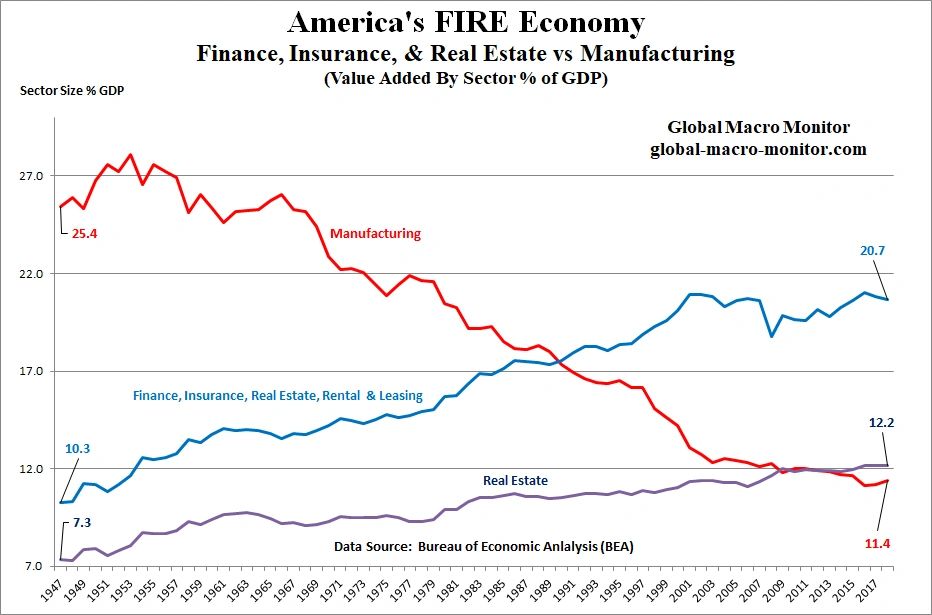
(Real Estate is broken out in the graph above to show that it is the largest subset of FIRE!, in fact it’s the largest single contributor to US GDP)
Financialization of the economy also entails pervasiveness. As a recent paper (explored below) finds, wealthy benefactors and pioneers of financialization hold an increasing concentration of debt claims on the household, corporate, and government sectors of society. The holdings and returns are mediated via a diverse arsenal:
“For example, holdings of business equity by rich Americans represent a substantial claim on such debt. The reason is that non-financial businesses have increased their holdings of money market funds and time deposits substantially since the mid 1990s, and these time deposits and money market funds are claims on debt through the financial system. More generally, government and household debt have been financed by rich Americans through direct bond holdings, bond mutual fund holdings, business equity, time deposits, money market funds, and defined contribution pensions.”
GE under Jack Welch, whose financialization of the company played a major role in its epic fall from grace, is exemplary of how ostensibly nonfinancial corporations increasingly act as financial players themselves and in so doing increase returns to wealthy shareholders while neglecting their actual business.“Portfolio income, or the income companies derive from financial assets, increasingly dominates total cash flow for all nonfinancial firms.”
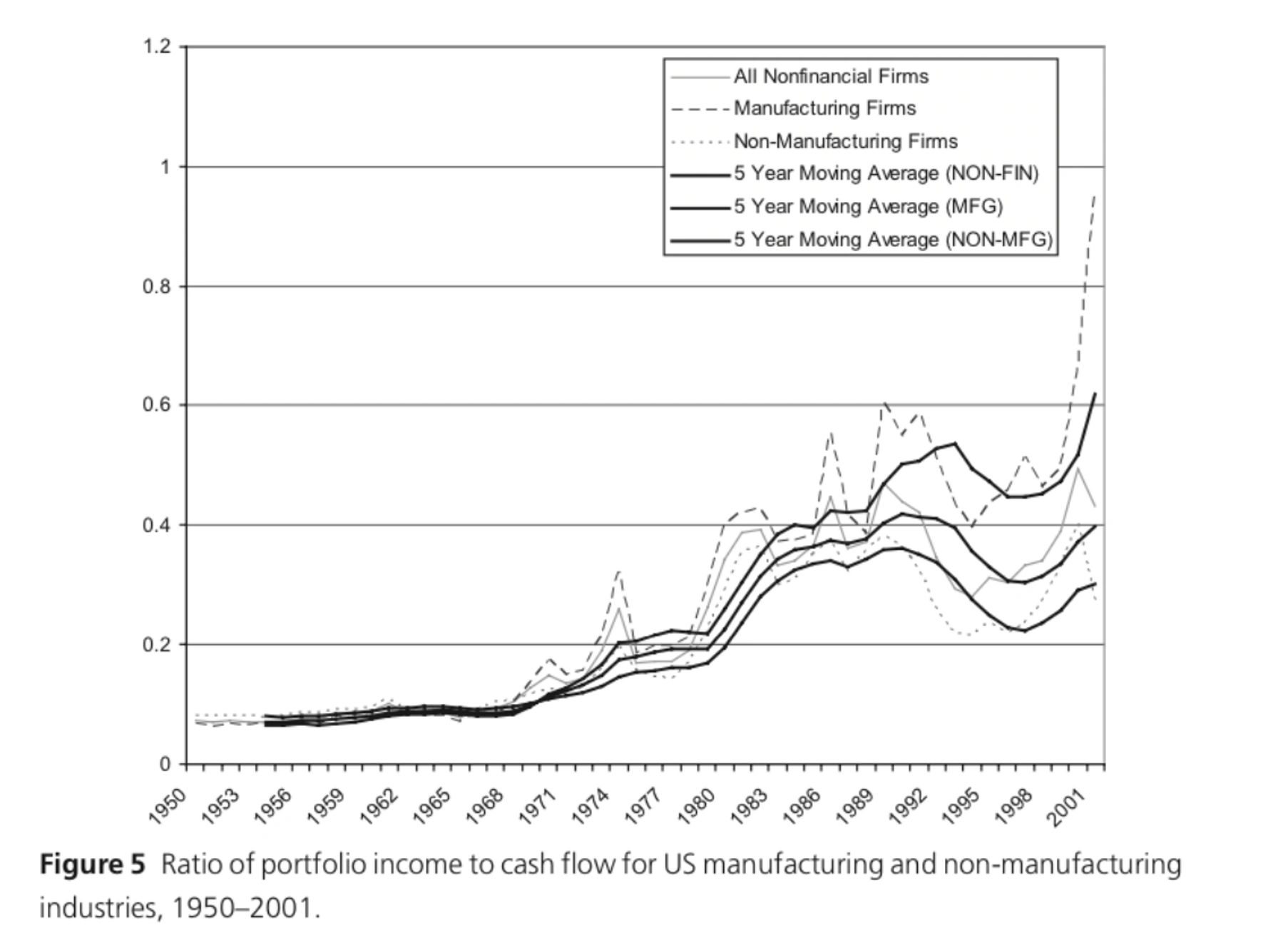
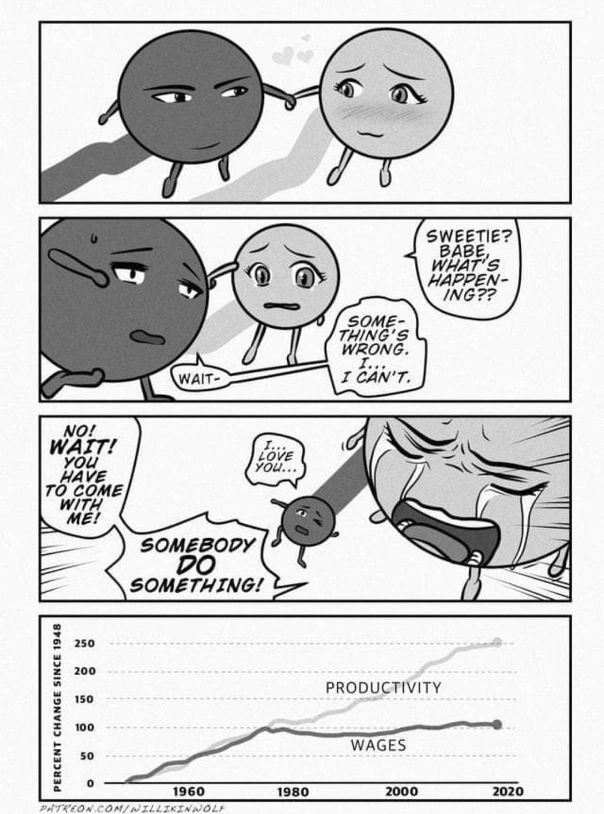
“All companies, financial and nonfinancial, have reallocated capital toward financial ends. American companies have seen a contemporaneous relationship between capital and labor: wages stagnate despite increasing productivity, with the residual accruing to financial interests.” The truth of this is captured in one of the saddest memes of all time:
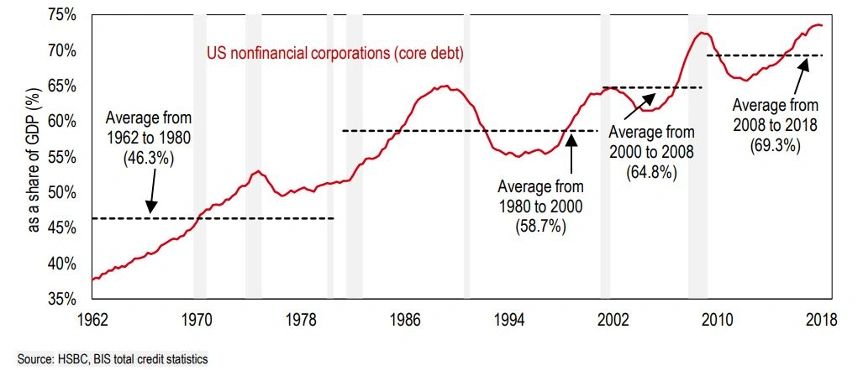
Over the last 50 years, non-financial corporations have—by any measure—taken on increasing debt loads. Whether you want to implicate the private equity industry for levering up companies it acquires, the Federal Reserve for easing interest rates to near zero levels, the federal tax code for privileging debt via interest deductions, companies themselves for privileging shareholders and financial interests, academics for selling the ideology, or some other actor is less important than recognizing the overall convergence. Non-financial corporate debt loads are now nearly double the level they were in the 1960s—from 35% up to 70%.
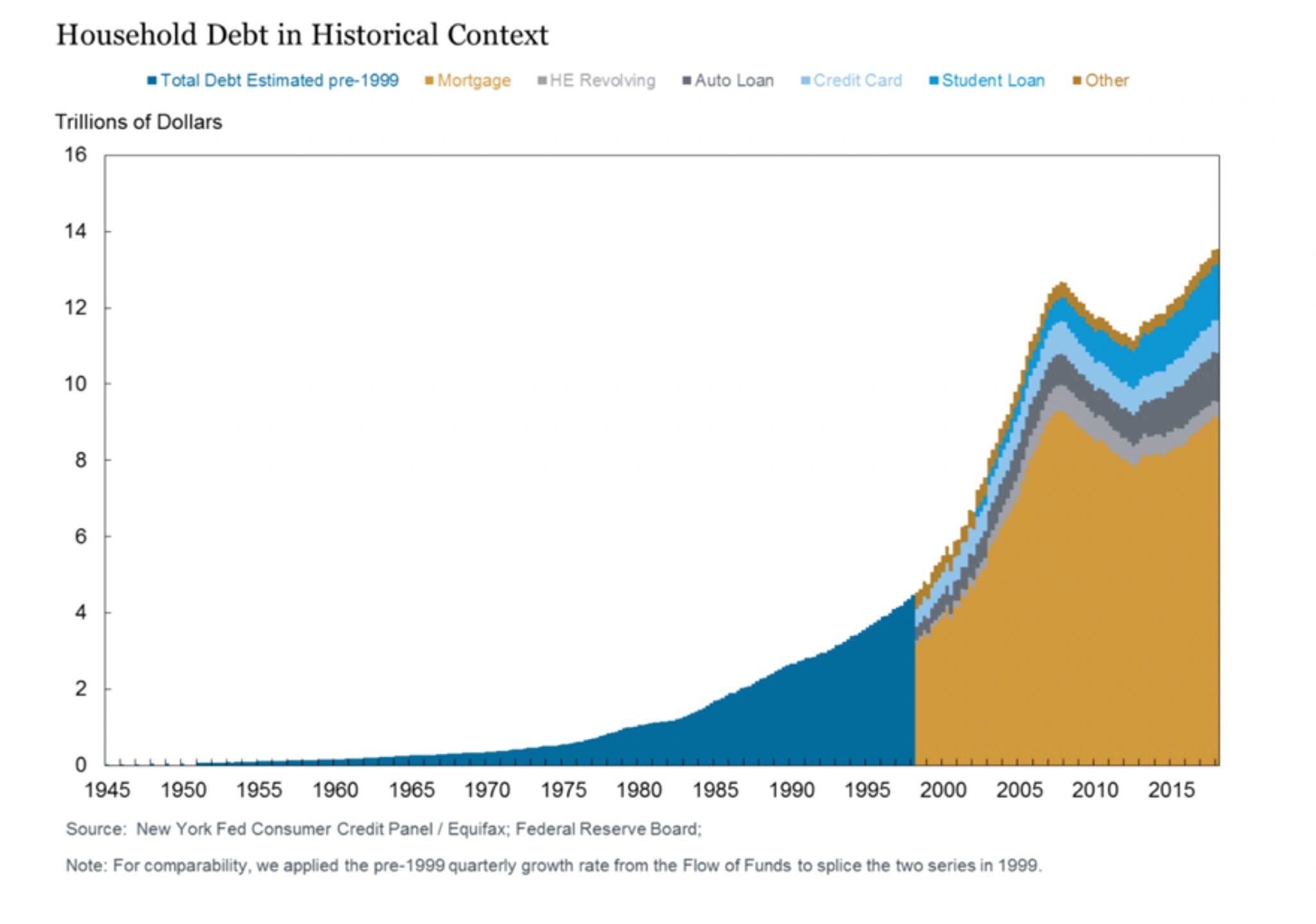
One can also see financialization’s impact on individuals and households. The FIRE! economy has expanded in lockstep with individuals increasingly taking on mortgages and debt of various forms, in particular student and credit card debt. Since the 1960s, household debt is up 16 fold.
We seem to be living in a Generalized Asset Bubble™. Housing prices basically serve as the bedrock of our increasingly financialized economy. They have been inflated by exorbitant lending—from the rich, from GSEs, and from overseas lenders—and the securitization of the loans. The median person’s asset portfolio, moreover, is basically just their house (see Edward Wolff’s paper for details). So borrowing against it is what allows them to live and cover their daily expenses. As one of the authors of a recent paper on how this has impacted the bottom 90% of the income distribution put it plainly in a tweet thread:
“debt exploded for low income growth middle class households, but there is a twist: as these were also the households with large rises in wealth-to-income levels. How is this possible? Asset prices can drive a wedge between the income and the wealth distribution. For middle class America house prices rose faster than income –> large wealth for homeowners who then borrowed against higher wealth. With stagnant income and rising debt, one can still become richer over time if asset prices are favorable.”
That turned out fabulously in 2008, right? Wait..
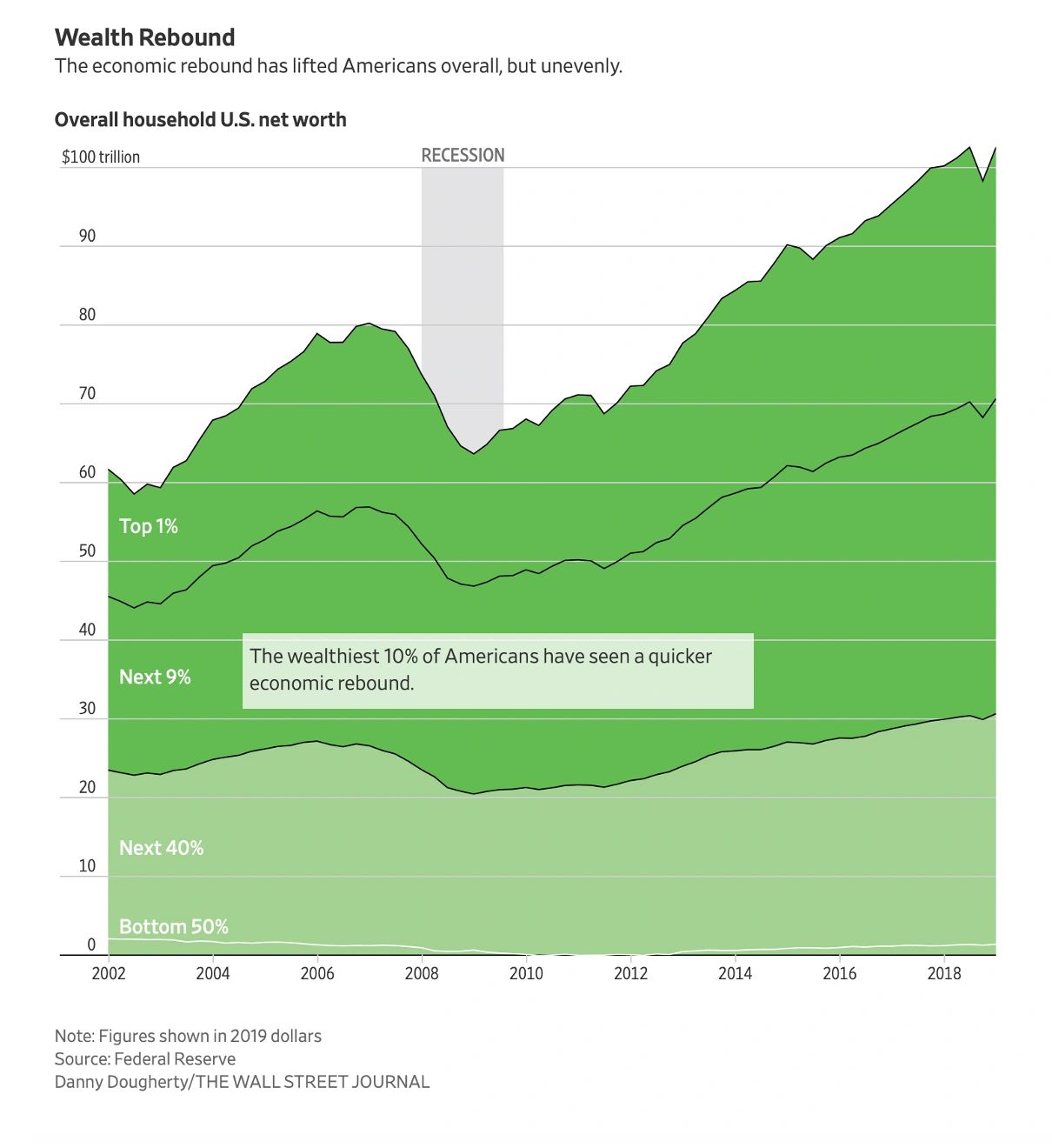
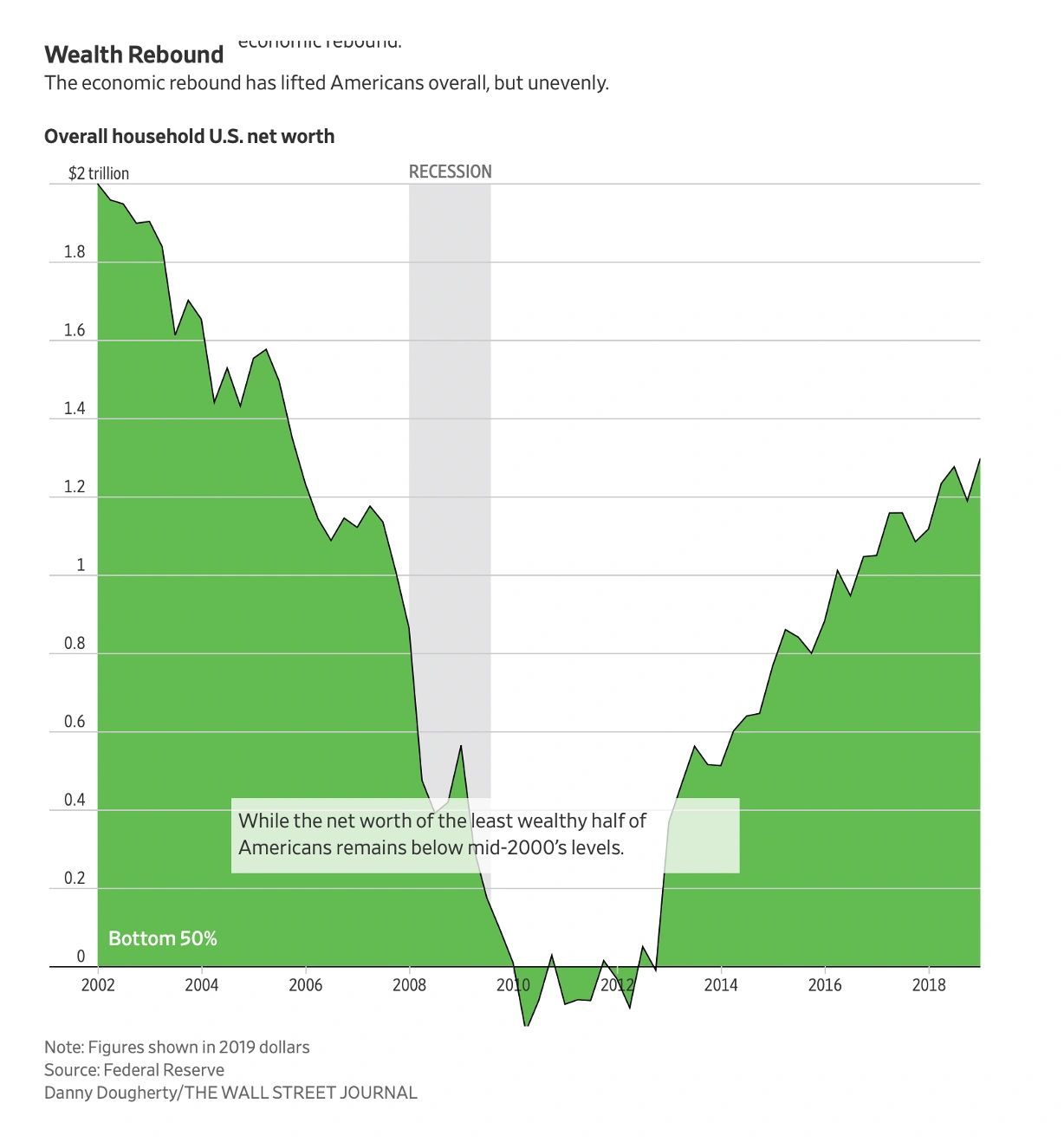
Oh…the bottom 50% of Americans net worth still hasn’t recovered despite the massive income shocks—and the next 40% is barely above pre-recession levels. Whoops.
Meanwhile, as we saw during the Great Financial Crisis, mortgage-backed securities are basically only surpassed by Treasuries in terms of their desirability as safe assets for transnational investors. So popular are they that Chinese, German, Japanese, British, Irish (you name it) banks were lining up to hold them. Ben Bernanke’s original hypothesis, i.e. the global savings glut hypothesis was more or less correct—but refined and updated in Trade Wars Are Class Wars as: a global hunt for ‘safe’ assets with decent returns as a key outgrowth of imbalanced economies exporting their savings (more on this very important phenomena later).
The most prevalent, though not most significant, element of the Generalized Asset Bubble™ is of course the stock market. As most analysts suspected, increased corporate savings stemming from the ‘Tax Cuts and Jobs Act’—i.e. Trump’s big tax cuts—would not likely go into increased business investment, owing to aggregate demand shortage. Rather, as was the case, they went straight into the stock market (~90% of the savings) and thus to shareholders via stock repurchases. It is this phenomena that most poignantly captures the downside of the political-economic logic of financialization: financial circulation up-ends real circulation. As Keynes identified, ‘industrial’ circulation and ‘financial circulation’ are very different beasts. This is a key part of the paradox of thrift: if one takes income out of circulation via saving and does not productively re-invest it in the economy we actually experience a net drag on economic growth.
The rise of the FIRE!™ economy, the leveraging up of corporations and individuals, and the Generalized Asset Bubble™ are all incarnations of financialization. Income is increasingly siphoned from the real economy—via the debt payments of corporations and individuals + share repurchases—and fed into the savings of the rich, which rather than being productively invested further pumps the Generalized Asset Bubble™ and feeds into the ‘financial circulation.’ The logic isn’t too complicated: foreign-and-domestic-inequality-fueled savings flood financial assets, at the same time the Federal Reserve piles on unlimited quantitative easing—ensuring that parking savings in ‘financial circulation’ delivers higher returns than investment in ‘industrial circulation.’
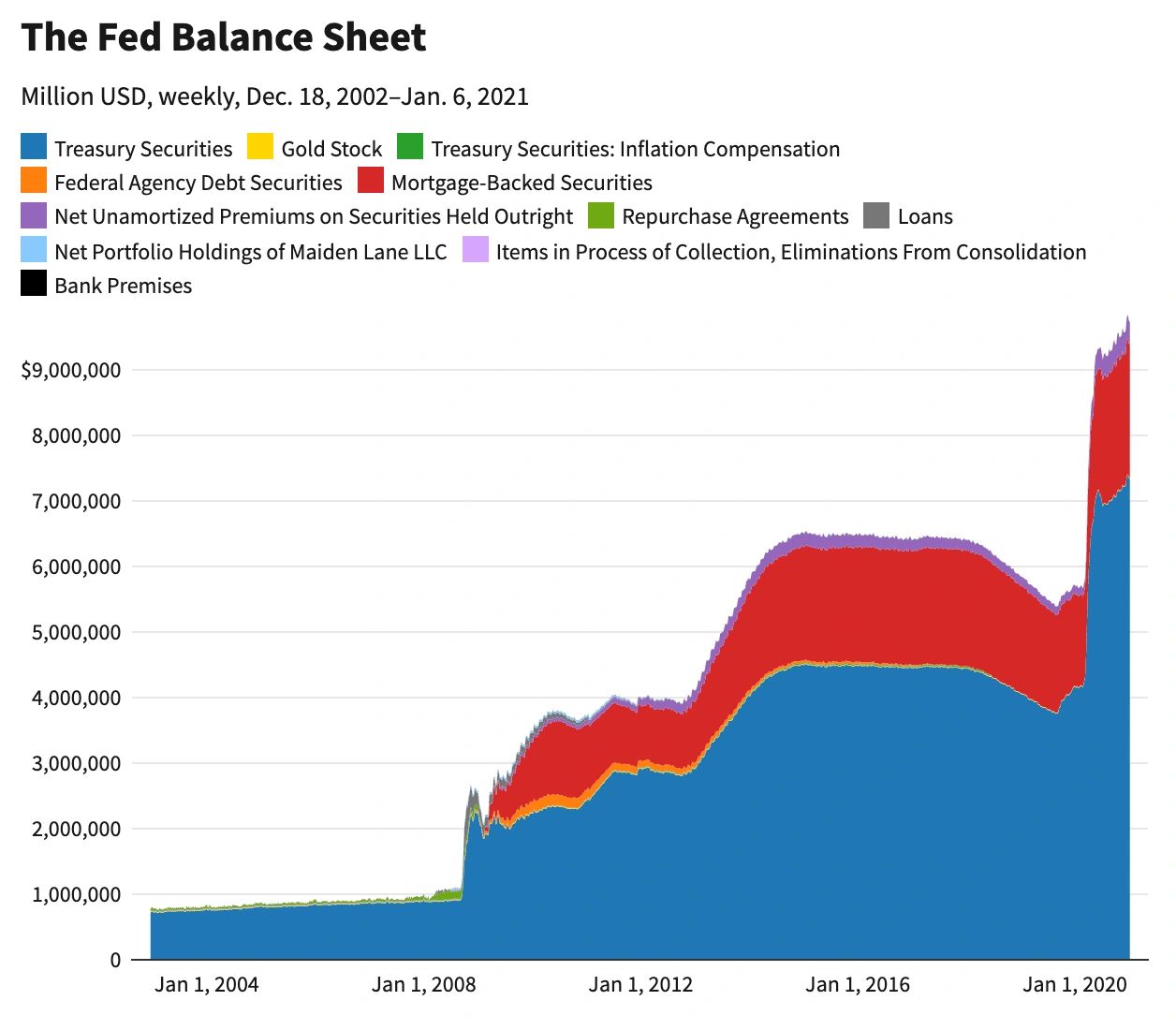
In particular the Fed monetized trillions of dollars worth of Treasury bonds during the coronavirus crisis as well as moving up its holdings of mortgage-backed securities (which it originally began purchasing in 2008). These moves helped ensure sufficient liquidity to prevent a massive implosion of our currently instantiated financial system via runs in repo markets—i.e. large short term loans between banks. For as we’ve seen before this just-in-time wholesale funding system is all too precariously constituted. Inevitably, though, such cash infusions lead to inflation of the Generalized Asset Bubble™ by introducing more resources into financial circulation.
The first order perverse effect is that income that could be used productively instead contributes to further inflating the Generalized Asset Bubble™, creating a positive feedback loop (or doom loop) wherein inequality AND the FIRE! economy in tandem grow and grow. The second order, and more perverse, effect is that the median person’s economic wellbeing AND the United States’ real economy withers and withers as a result of ‘Financialized Dutch Disease.’
What’s the ground level impact?
The fact that growth over the last 60 years has not benefitted the bottom 60% at all. The American dream is in tatters, and deaths of despair are on the rise. The problem is so bad that America, for the last two years, has actually experienced a decline in its average lifespan. That is basically unheard of in a developed democracy. As one of the papers below argues: Under the financialization regime, “The economy, as an institution, has failed to create prosperity for most Americans.”
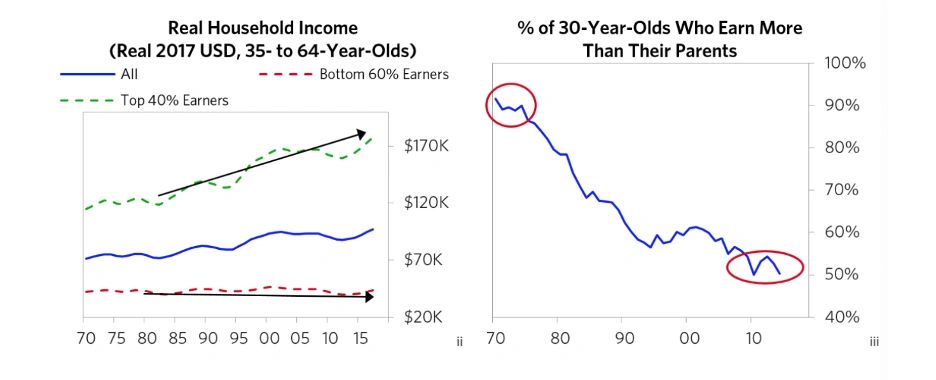
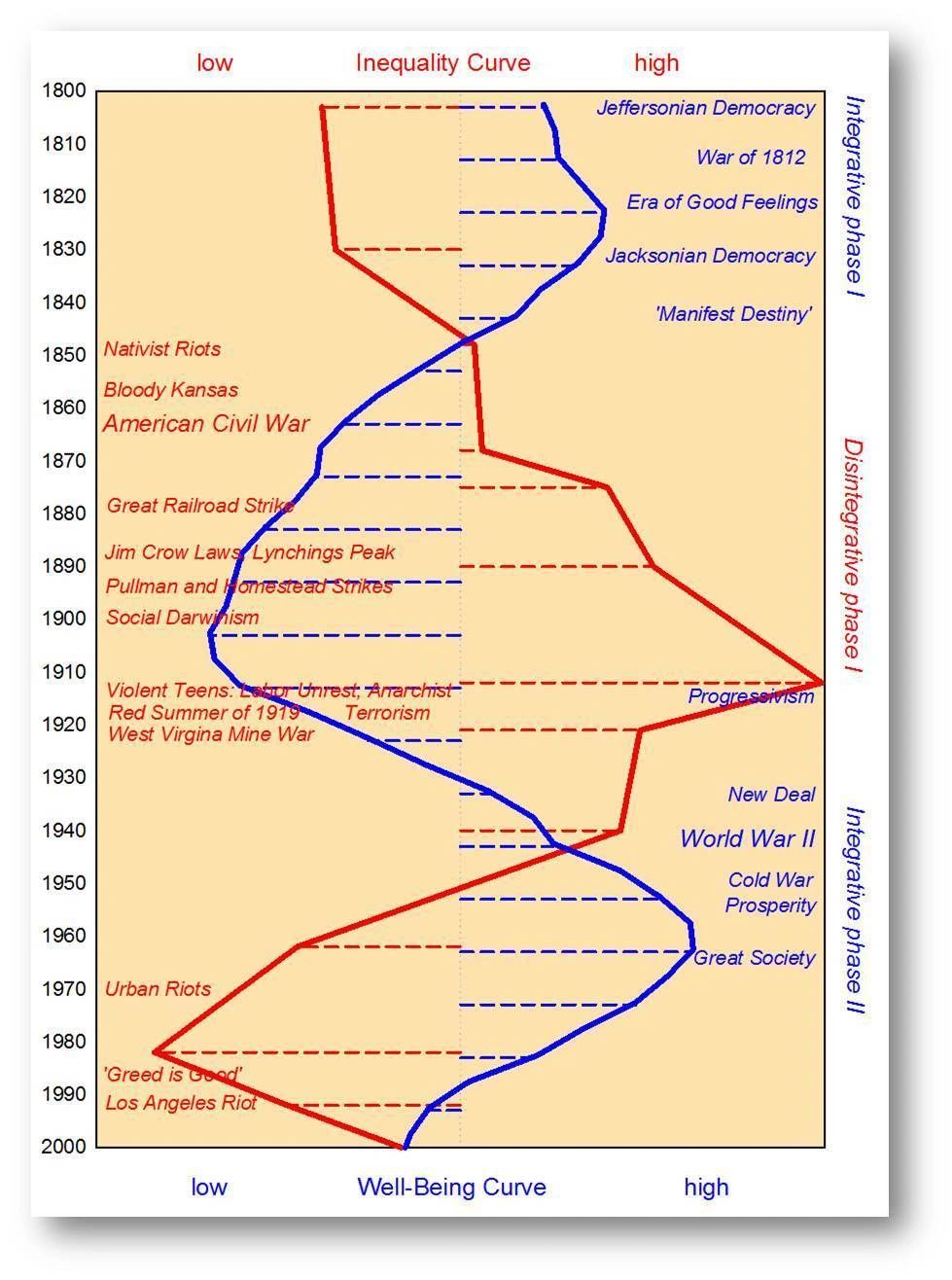
Peter Turchin’s work on the double helix—that is, a startlingly perfect inverse relationship—of inequality with human well-being outcomes is really interesting and worth checking out.
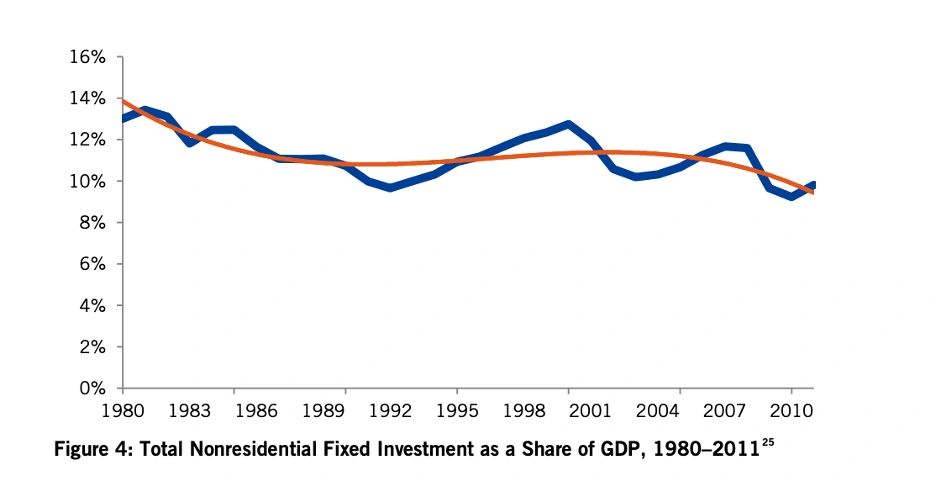
Meanwhile, real investment in the US is far from as strong as one would hope. Companies, Apple being a notorious example, are sitting on billions of dollars rather than putting them to work via real investment. The trend of lagging real business investment has worsened since 2000. We have thrown tons of money into the financial machine while the real economy stagnates.
As Zwan argues:
“profits from interest, dividends, and capital gains for non-financial corporations have outpaced those from productive investment” (Zwan 103)… “victory of the rentiers has come at the expense of wage-earners and households, who have faced stagnating real wages and increased indebtedness” (Zwan 105).
In turn, as the real economy is hollowed out and the financial economy metastasizes, US monetary policy has come to increasingly revolve around ensuring asset prices remain stable. The first paper highlighted below puts it like this:
“Monetary policy based on asset prices rather than employment conditions for average Americans “increased financial fragility in combination with declining wages” and “created a growth regime that relies on debt-driven consumption and housing bubbles” that “undermin[es] its own liquidity and solvency’ (Lapavitsas, 2009, p. 138)” (Zwan 105). In an economy built on consumption and debt rather than production, the Federal Reserve must manipulate asset prices to prevent recession. The financial economy trumps the real economy as the credit cycle subverts the business cycle…”
Below I dig into the paper this is quoted from as well two others that highlight the micro-level foundations of financialization discussed above—the nuts and bolts, the how and why. The first is a graduate thesis by Emory Siedell titled The Dollar Reserve System as a Bastion of Empire and a Force of Economic Necrosis. The next two papers are from the same group of National Bureau of Economic Research (NBER) fellows and are titled The Saving Glut of the Rich and Indebted Demand. As one can see from the titles, they speak precisely to the forces I outlined above.
_The Dollar Reserve System as a Force of Economic Necrosis_
The first thing worth mentioning about this paper—and something I love about it—is that it takes the only good thing from Ray Dalio’s new book—his research team’s excellent graphs—while entirely jettisoning his flawed analysis. Dollar Reserve as a Force of Economic Necrosis is, in fact, a direct repudiation of a central tenet of Dalio’s book. Indeed, his book is focused almost entirely upon ‘financial circulation’, the credit cycle, as opposed to ‘industrial circulation’ and the business cycle. This partly excusable given that recent economic and financial thought so generally conflates the two. Dalio is a finance guy, so it may be for that reason that he completely misses the detrimental impact of financialization on the economy. Humans can’t see their own noses, after all.
The most important thing Dalio gets wrong is his belief that the US Dollar as global reserve currency redounds to the benefit of the US economy. Again, though, Dalio could be forgiven on the basis that so many other credulous analysts make the same mistake. The belief that US dollar hegemony is good for the US economy is one of the most widely believed myths in American policy making circles today—and among the elite in general. Hank Paulson, former Treasury Secretary and former finance guy, makes the Standard Argument™ here.
Dollar Reserve Necrosis gives a quick summary of the economic argument in favor of US dollar primacy:
Primarily, “exorbitant privilege” [argument] claims that the dollar transfers wealth through seigniorage, the issuance of currency. The US produces costless dollars for which “countries have to pony up…actual goods and services” (Eichengreen 3).
[The argument goes as follows:] The asymmetry of dollar production allows “American households to live beyond their means” such that “poor households in the developing world [end] up subsidizing rich ones in the United States” (Eichengreen 5).
This arrangement theoretically gives the US an advantage in monetary and fiscal policy: the Federal reserve can grow money supply with minimal impacts to exchange rate, and the US can run sustained high current account deficits because of demand for dollars.
Think about this for a second, though. American households and the US government taking on more debt is a privilege? Is this what any self-interested person would actually choose? To live beyond their means and continuously take on debt? Wouldn’t it make more sense that a typical self-interested person would rather by the producer and creditor? Yet, the Standard Argument™ tell us that living beyond our means, taking on boat loads of debt, and running massive current account (i.e. trade) deficits are benefits and privileges afforded us by the hegemonic role of the US Dollar. These are some strange benefits. Thanks USD hegemony?
In reality, the obverse is closer to reality: these are NOT PRIVILEGES that USD hegemony affords American consumers and the American economy. These things are BURDENS that USD hegemony FORCES the American economy to bear. Dollar Reserve Necrosis adeptly explains, drawing on Michael Pettis’ excellent work, how this works:
“a strong currency disadvantages US exports and advantages foreign imports (Richardson). Dollar strength in the face of accommodative monetary policy drives de-industrialization and financialization.
Mechanically, the external account is “determined partly by domestic policies and conditions, but also by foreign policies and conditions, which in the latter case directly affects the relationship between domestic American consumption and savings” (Pettis). Net exporters suppress their currencies by buy dollars to support a positive current account balance, “export[ing] their savings to the rest of the world” (Pettis). Foreign nations purchase “excess amounts of dollars” as a “policy…aimed at generating trade surpluses and higher domestic employment” (Pettis). Savings exportation supports the US dollar exchange rate despite substantial US trade deficits. However, these savings are immensely deflationary for the US. An “overvalued dollar” makes exports less competitive, forcing manufacturers to “reduce production 26 and fire American workers” (Pettis). Meanwhile, corporations assume increasingly large debt loads that limit their ability to invest in capital equipment that drives long term growth.
The reserve currency nation must “choose between rising unemployment and debt” (Pettis). Because dollar strength hurts domestic industries, the Federal Reserve must respond per its inflation and employment mandate to “increase domestic demand—and with it domestic employment—by running up public or private debt” (Pettis). Debt abundance creates more dollar-denominated assets, driving dollar strength and perpetuating debt deflation. The result is the situation the US finds itself in today: “gaping trade deficit, low level of savings, and high levels of private and public debt” (Pettis). This cycle is an endogenous feedback loop, coined in financial contexts as “reflexivity” (Soros).”
The pervasive and widely shared misbelief among those like Ray Dalio and Hank Paulson breaks down on serious reflection and is revealed as either a credulous axiomatic belief or, worse, a self-serving belief that benefits them and the finance interests who get to serve as intermediaries taking fees to facilitate capital flows into the US and US assets. US dollar primacy, far from being an exorbitant privilege, is in fact an exorbitant burden. Dalio’s book argues that USD as reserve currency is a core metric by which we should judge whether the US remains the world’s #1 superpower, or whether China is replacing it. The ironic reality is that America would be far stronger if it gave up USD hegemony.
As America absorbs the world’s excess savings—via its deep capital markets, the securitization of the US housing market, and the US Government’s ability to issue USD debt—the value of the US dollar becomes incredibly high. Much higher than it would be if America wasn’t the capital absorber of the world. This is what financial Dutch disease entails: one over developed sector—in America’s case finance and capital markets—drives its currency higher and makes it extremely hard for other sectors to operate profitably. America’s financial dutch disease means American exports are uncompetitive, aggregate domestic demand is directed overseas because a highly valued dollar makes imports cheap, domestic firms face extremely weak incentives to engage in real productive invest domestically, US companies and households take on debt to stay afloat as unemployment rises, and US monetary policy effectively becomes a regime oriented around ensuring that the General Asset Bubble™—the economy’s backbone under the financialization regime—stays afloat.
As the paper puts it:
“the resource curse [another name for Dutch disease] is analogous to the situation in which the US finds itself today. The dollar is an immense resource: the US has unlimited production capacity, and the real demand for dollars is greater than that for any commodity on Earth. Since the end of Bretton Woods, the US has enjoyed a resource boom of dollars, which it could produce without the constraint of gold convertibility and with the support of international dollar demand as necessary to support continued economic growth. The reserve dollar’s benefits accrued to established institutions of politicians, corporations, and the finance industry at the expense of real economic growth, industry, and average Americans. This growth is unsustainable: it is driven by debt (liabilities) in the form of public debt, private debt, and the liabilities represented by dollars themselves.
Dollar Reserve as Force of Economic Necrosis synthesizes a plethora of excellent resources to expose the fallacious argument undergirding US dollar hegemony. It demonstrates that far from being a benefit to US economic power, it is very much the opposite. US dollar supremacy is and has been a major drag on US growth and resilience. In this way, US dollar supremacy and the depth of the US financial markets that undergird it creates an American version of Dutch disease: _America’s financial dutch disease._
Why is the myth so pervasive? First, it seems true on the surface. Indeed, if you need to go deep into debt, being able to borrow in perpetuity and cheaply would seem good. But the argument fails to recognize that it is USD hegemony that, in the first place, forces us into this debtor position. Second, the most important segments of elite society and policy makers benefit from USD hegemony: the national security establishment gains geo-political power while the financial industry benefits enormously as intermediaries of the flows. Thus, a combination of interests and plausibility have allowed this corrosive myth to go unchallenged and become a staple belief of elite Americans. We would be better off dethroning both this hegemonic belief and the hegemonic status of the US dollar as global reserve currency.
The Saving Glut of the Rich & Indebted Demand
It is not only US dollar hegemony and capital inflows from countries with excess savings that contributes to America’s financial Dutch disease. These next two papers highlight the fact that resources are increasingly transferred from the poor to the rich via excessive indebtedness. And, in turn, the money is pumped back into the financial circulation—i.e. buying up assets and buoying their price—further contributing to inequality and the malaise of real productive investment. The Savings Glut of the Rich highlights that the magnitude of this phenomena is on par with US dollar & capital market hegemony:
“[while] the rise in the demand for U.S. dollar-denominated safe assets has been attributed primarily to demand coming from other countries… This study shows that the top 1% within the United States have also increased their holdings of the debt claims that back these safe assets. Quantitatively, the demand for U.S. dollar-denominated safe assets comes almost as much from the rich within the United States as it does from the rest of the world… The rise in savings by the top 1% of the distribution has been on the same order of magnitude as savings entering the United States from abroad…. Half of this increase was financed by the rest of the world, and half was financed by the top 1%.”
In Saving Glut of the Rich, the authors are furthering the deep research that Piketty and his co-authors (Saez et al) have done on historic distributions of wealth and income.
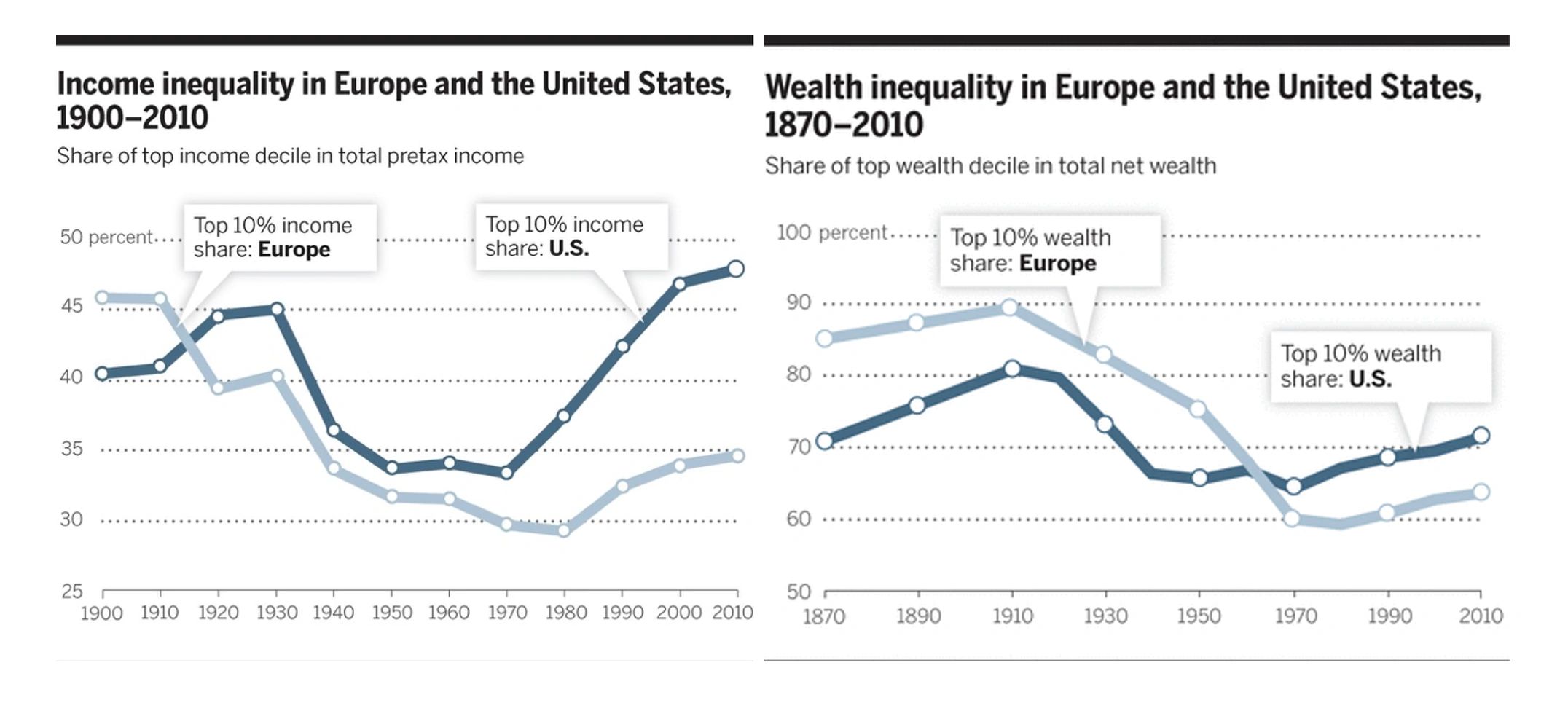
And, if increasing inequality weren’t bad enough on its own—as we saw earlier—real investment is not increasing in accordance with the rise in savings of the rich:
“The findings also call into question the idea in many macroeconomic models that a rise in savings automatically translates into additional capital formation. In the United States over the past 40 years, the substantial rise in savings by the top 1% has been associated with dissaving by the government and the bottom 90%, as investment actually fell. The rise in savings by the top 1% has not been accompanied by a rise in net domestic investment. Instead the additional savings have been absorbed in a less conventional manner through dissavings by the government and the rest of the U.S. household sector.”
For many, indebtedness is a structural outcome of the shifting political economic regime. Financialization leads into financial dutch disease which undermines real jobs and income growth, as the last section emphasized. It also undermines incentives to invest domestically, brought home by the fact that “savings by the top 1% of the distribution have been larger than average annual net domestic investment since 2000.”
The increased savings of the rich have coincided with dissaving—indebtedness—among the household and government sectors. While this insight is not shocking, it’s a truth whose consequences are often not appreciated. Indeed, the consequences are further drawn out in their second paper: Indebted Demand. The idea of indebted demand is straightforward: as households and governments take on more debt that is owed to the rich, aggregate demand—i.e consumption and investment—actually falls as those with higher marginal propensities to consume transfer resources to the rich, who have a lower propensity to consume, via debt service payments. Top down savings crowd out bottom up consumption and investment. As the authors put it:
“large debt levels weigh negatively on aggregate demand: as borrowers reduce their spending to make debt payments to savers, the latter, having greater saving rates, only imperfectly offset the shortfall in borrowers’ spending. We refer to a situation in which demand is depressed due to elevated debt levels as indebted demand.”
A key insight of both papers is that the savings glut of the rich and concomitant indebted demand have led directly to the low interest rate environment in the US as consumers, investors, and borrowers need low interest rates to operate and survive. (A perverse 2nd order consequence is that many highly indebted and inefficient firms can survive and crowd out more productive firms.) Rising interest rates would decimate our indebted demand economy—and it would also substantially deflate the Generalized Asset Bubble™—which the rich, who recycle their increased savings into the financial circulation, would not like. Leading Central Bankers recognize what’s going on:
“Mark Carney, Governor of the Bank of England observed that “the sustainability of debt burdens depends on interest rates remaining low.” Philip Lowe, Governor of the Reserve Bank of Australia has warned that “if interest rates were to rise . . . many consumers might have to severely curtail their spending to keep up their repayments.”
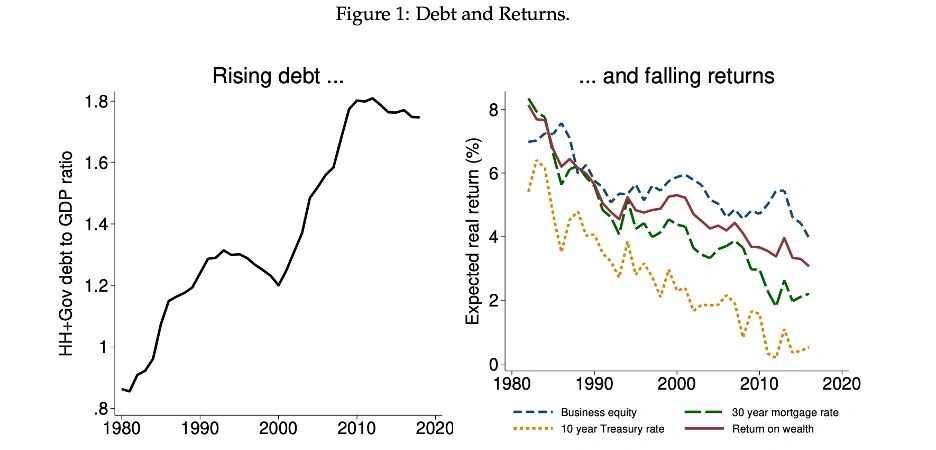
As I explained at the beginning, rising debt is a key symptom of financialization. And its pervasiveness is its unique quality: household, government, and corporate sectors are all increasingly indebted. And the debt, as these papers explain, is basically owed to a combination of the richest people in America and overseas investors (countries with excess savings, such as Japan, Germany, and China who have gamed our globalized system). In my view, indebted demand is but another way of describing financialization. The contribution these papers make is showing the role the uber wealthy play—if inadvertently—in undermine the very structure of the political economic system that enabled them to get rich and that did in fact produce broadly shared prosperity prior to that DAMN YEAR 1971.
Let’s conclude this section by tying in the larger process of The Savings Glut of the Rich and Indebted Demand with financialized dutch disease, via a quote from US Dollar Reserve As Force of Economic Necrosis:
Unlike “pre-1980 policy” that “tacitly focused on putting a floor under labor markets to preserve employment and wages,” modern monetary policy “policy tacitly puts a floor under asset prices”. The “macro economy” is “vulnerable to asset price declines” and the Federal Reserve “is obliged to step in to prevent such declines from inflicting broad macroeconomic damage”. With each cycle, this arrangement “has the twin consequence of bailing out investors and also potentially creating investor moral hazard”. The Federal Reserve’s support of asset prices exacerbates wealth inequality because asset ownership is highly skewed to high net worth individuals. Moreover, the growth of debt supporting the credit cycle “transfers income from high marginal propensity to spend debtors to lower marginal propensity to spend creditors, and this process of transfer can generate business cycles.” This process is distinct from the “pre-financialized” US, in which “wage growth, rather than borrowing, fueled consumption and demand growth…that then encouraged investment spending, which in turn drove productivity and output growth.””
The Federal Reserve’s evolution reflects the underlying reality of the economy: we live in a perversely financialized political economic system. The cause is financialized dutch disease: US dollar hegemony, massive inflows of foreign capital and excess savings, and the savings glut of the rich.
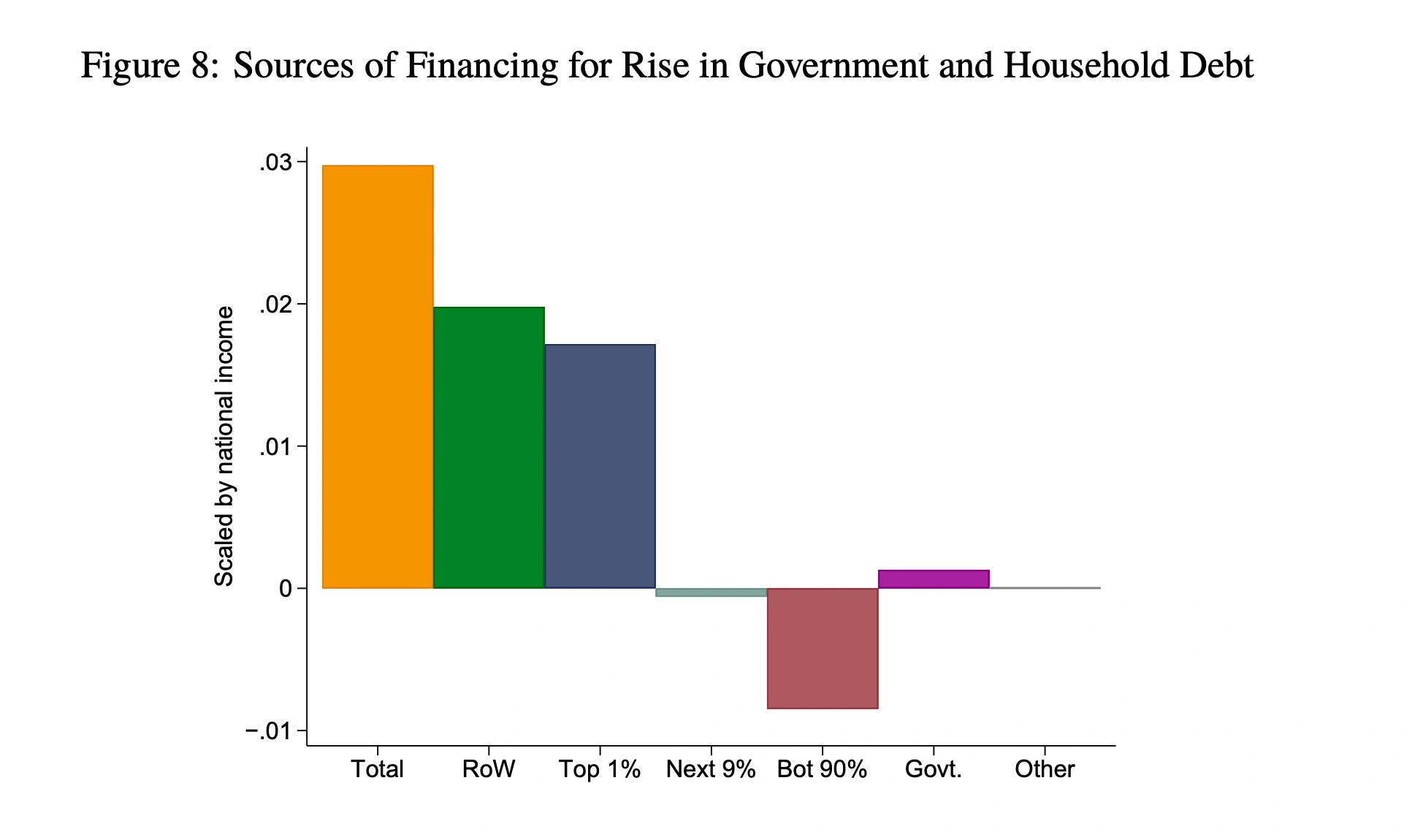
Image above: This figure shows the average annual rise in government and household debt from 1982 to 2016, where the annual rise is scaled by national income each year. The annual average annual rise from 1963 to 1982 is subtracted to isolate the difference between the two time period. It then shows how much of this rise in the latter period relative to the former period has been financed by different groups. The five bars on the right add up to the bar on the left, RoW = Rest of World.
Almost all of the dissaving of the bottom 90% has been matched by the savings of the rich and the overseas investors. The argument of this essay is that this relationship is not just incidental, but causal. Excess savings eat away at their own demand base. In turn, financialization rises, as the real economy whither, the poor borrow against assets, and the perverse debt-debtor relationship characterized in the image above manifests.
Although the Generalized Asset Bubble™ inflates, the underlying economy suffers: jobs and incomes are lost or stagnate (in some cases replaced with sub-par gig economy jobs), companies find less incentive to invest and build-out operations domestically, and corporate and household debt levels rise—collateralized against assets inflated via the Generalized Asset Bubble™—as people try to stay afloat through this perverse political economic regime. The Federal Reserve now haplessly targets asset prices, the backbone of our financialized economy, rather than employment.
The problem, of course, is that inflating the financial economy and its Generalized Asset Bubble™ does not help the real economy. This political economic regime and its monetary policies disproportionately benefit the upper strata, whose share of income and total savings have skyrocketed. The rich become the leading lenders to the bottom 90%. Individuals and corporations end up transferring resources upward: from those with the highest marginal propensity to contribute to aggregate demand (consumption & productive real investment) to those with the lowest.
Financialization via the FIRE! economy and its indebted demand model is unsustainable bedrock for a political economy to rest upon.
Conclusion
We do not want to live in a world characterized by an ever expanding FIRE!™ economy. It 1) generates inequality by its very nature, as contributions to the financial circulation inflate the Generalized Asset Bubble™ without stimulating real investment, which in turn 2) stymies innovation by directing investment away from real and productive enhancements of products and services that actually make human lives better, and 3) it is for both reasons intrinsically unsustainable and thus poised to lead to economic collapse, malaise, and / or popular revolt.
Rather, we should live in a political economy characterized by innovation-oriented thinking and innovation-oriented dynamics. It is innovation, after all, that led to the Great Divergence—the industrial revolution—to modern prosperity and is still today the thing which fuels growth.
The most important steps will be the concrete ones. At a high level, I believe this means policies that increase aggregate demand domestically while limiting the perverse role that excess savings—both foreign and domestic—have in contributing to our financial dutch disease.
United States policy makers need to seriously reconsider the received wisdom of having the US dollar as the world’s reserve currency. If China is truly eager to share the exorbitant burden, we should facilitate their endeavors to internationalize the RMB—even at the expense of geopolitical control. The USD is such a drain on our economic competitiveness that this would almost certainly redound to our benefit—one could argue China understands this, though, which explains why their revealed preference is actually to keep their capital account relatively closed and thus forestall RMB internationalization.
As Michael Pettis has argued, one step toward mitigating USD-induced financial dutch disease is to heavily tax capital inflows–specifically, portfolio inflows (FDI should not be taxed). Placing a heavy cost on those who would seek to acquire USD denominated assets in the US will help undo the foreign contribution to our financialized dutch disease. At the same time, as both Adam Tooze and Pettis have argued, doing so will also improve our overall trade balance. Global capital is the tail that wags the trade dog: if we balance the former then we balance the latter. In other words, if you stop letting countries export their excess savings into our deep & secure financial markets, we also undo our ludicrously imbalanced trade situation.
Domestically, to unwind financialization, we should immediately cease policies that induce it. Most importantly, that means ending tax deductibility of debt. It is inimical to real economic productivity to encourage companies to take on more debt, particularly when those payments contribute to the savings glut of the rich. Similarly, we also need to stop taxing returns on capital at a lesser rate than income. It makes absolutely no sense that the long-term capital gains are taxed at 15%. Capital income should, at the least, be equalized with income from labor.
More generally, we should focus on transferring resources away from the FIRE!™ sector—away from the savings glutters—and toward two areas: poor individuals and innovative enterprises. The proper method for doing this could take up an entire book project, but the basic premise is that poor people have a very high propensity to consume so will spend money that stimulates aggregate demand and thus the circular flow in the real or ‘industrial’ economy. This, in turn, creates bedrock for innovation real entrepreneurs to build upon. But, to take it even further, we should implement an ‘industrial policy-light’ or an ‘industrial strategy’ (such as that suggested by Rob Atikinson at ATIF) that focuses on getting resources into the hands of innovators.
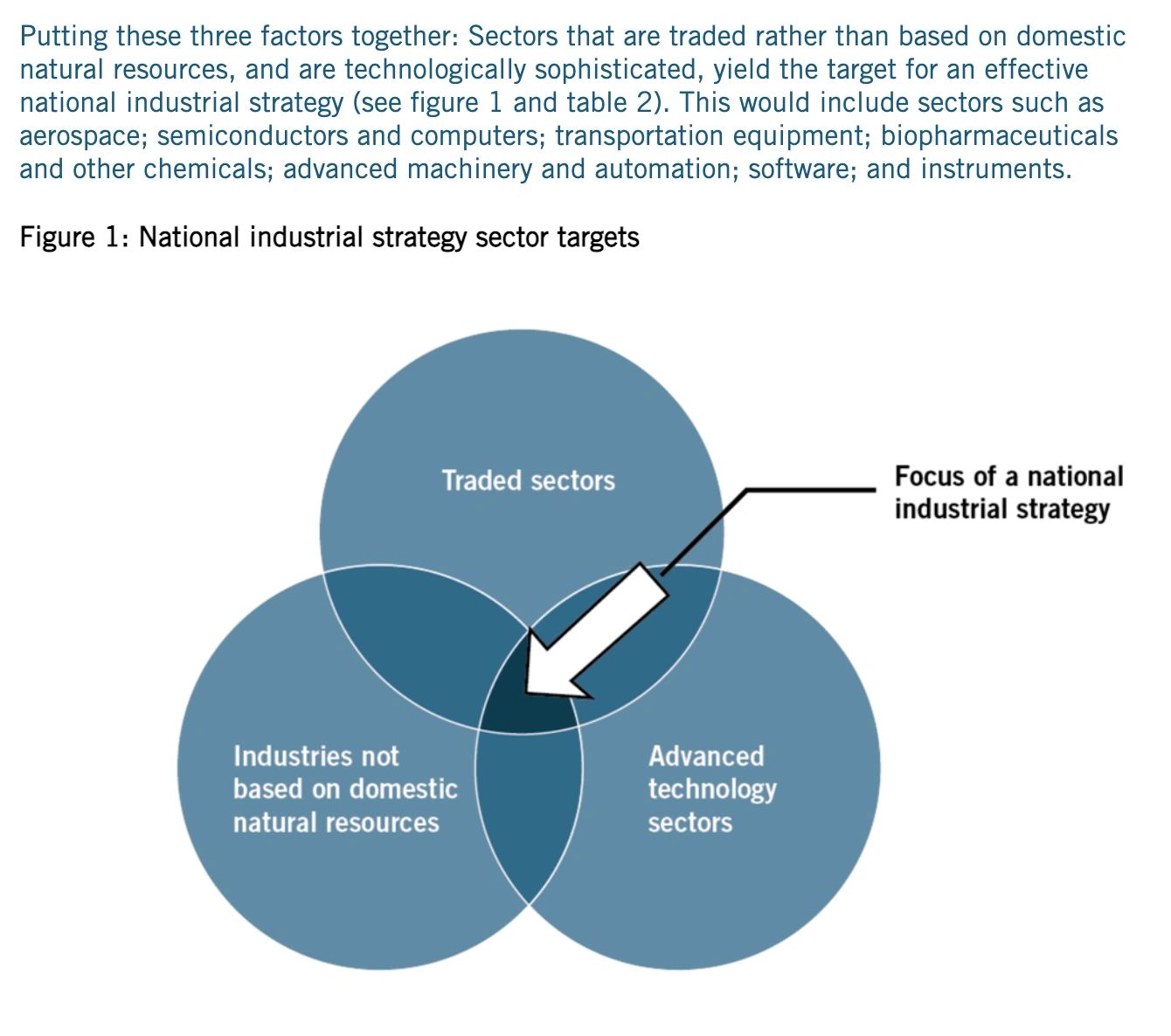
Innovation is what makes the economy grow, so it is only natural we should have an innovation-oriented economic policy. Doing so, however, mandates that we focus on re-directing saving and investment away from the ‘financial circulation’ and back into the ‘industrial circulation.’
The FIRE! economy is undermining our prosperity and our global competitiveness. China is rising. If we want to continue to be #1 economically, then we know what to do: we must tamp down the FIRE! economy.